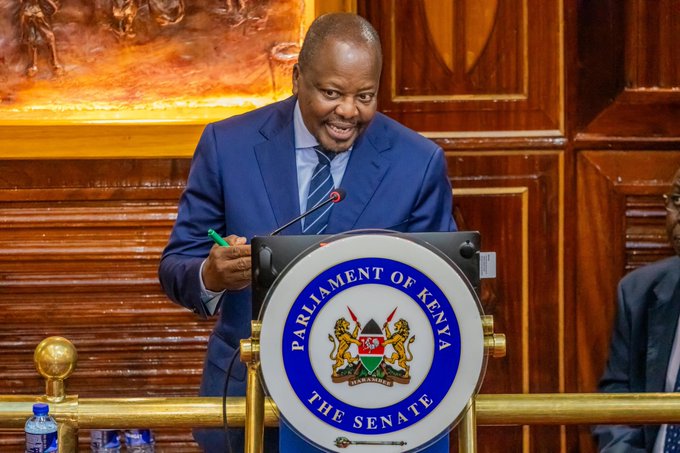
 Agriculture and Livestock Development Cabinet Secretary Mutahi Kagwe speaking at the parliament/ HANDOUT
The government has invested Sh1.428 billion in dairy infrastructure as part of measures to reduce production costs, cut milk losses and improve farmers’ incomes, Agriculture Cabinet Secretary Mutahi Kagwe has said.
Appearing before Parliament to respond to questions on the agriculture sector, Kagwe said the investment will finance 230 bulk milk coolers, including 200 solar-powered units, to strengthen milk aggregation and reduce post-production losses.
The solar-powered coolers are expected to save dairy cooperatives about Sh73 million annually in electricity costs while supporting more than 115,000 farmers across 41 counties.
The facilities are expected to help farmers aggregate an estimated 475,000 litres of milk daily.
The government is also subsidising improved dairy genetics as part of efforts to raise productivity. The price of sexed semen has been reduced by nearly 65 per cent, from Sh2,900 to Sh1,000 per dose under the subsidy programme.
Kagwe said the measure is intended to make improved genetics more accessible to farmers and support higher productivity in the dairy sector.
The government is also implementing measures to address the cost of animal feeds, which include the launch of the National Animal Feeds Development Strategy and establishment of a National Strategic Feeds Reserve.
Under the Land Commercialisation Initiative, underutilised government land, including Agricdev Kenya and Kalro farms, is being opened up for commercial fodder production.
The government is also using public-private partnerships to expand feed production and secure fodder supplies.
The measures include a Sh300 million feed mill by De Heus in Athi River and an agreement with UAE-based Al-Dahra to utilise up to 200,000 acres at Galana-Kulalu for agricultural production.
The government has also introduced tax measures, including duty waivers and VAT exemptions on selected raw materials used in animal-feed production.
According to the Ministry, regular cost-of-production studies, averaging Sh36.2 per litre across production systems, continue to inform policy interventions and support sustainable producer prices as demand for milk grows.
Kagwe also outlined reforms in the sugar sector, where the Government is implementing changes under the Sugar Act, 2024.
The reforms include the constitution of the Sugar Board, with several key institutional positions already filled. These include the chairperson, National Treasury representative, Council of Governors nominee and State Department of Agriculture representative.
The process of constituting grower representation on the Board has, however, been delayed by court injunctions and petitions challenging election procedures and the definition of catchment areas.
According to the Ministry, the legal issues are being addressed through the courts, after which the process of electing growers’ representatives is expected to resume.
Pending the full constitution of the Board, the Ministry said it continues to undertake the necessary administrative functions to ensure continuity in the management of the sugar industry and implementation of the statutory framework.
The government says the measures are aimed at reducing production costs, expanding agricultural infrastructure, improving farmer productivity and strengthening institutions across key agricultural value chains.