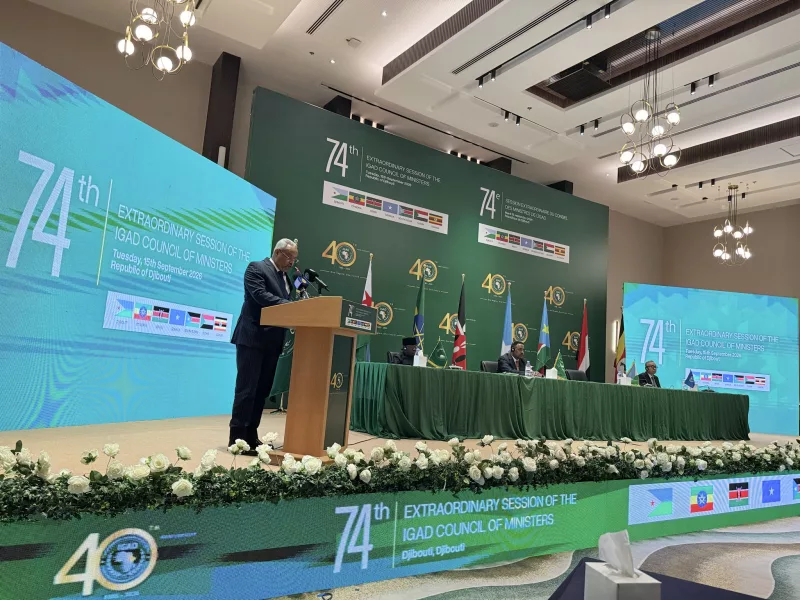
 The 74th Extraordinary Session of the IGAD Council of Ministers in Djibouti City, Djibouti /HANDOUT
Foreign ministers and senior government representatives from the Intergovernmental Authority on Development (Igad) member states have gathered in Djibouti City for the bloc’s 74th Extraordinary Session of the Council of Ministers.
The meeting comes amid worsening humanitarian and security challenges across the Horn of Africa.
It brings together regional leaders to deliberate on peace, security, humanitarian concerns and cooperation at a critical moment for the region.
Djibouti’s Minister of Foreign Affairs and International Cooperation, Abdoulkader Omar, is leading the session, which is also being attended by representatives of international organisations, including the United Nations.
Opening the meeting, IGAD Council of Ministers chair Dr Workneh Gebeyehu welcomed the delegation from Sudan and highlighted the scale of the humanitarian challenges facing the region.
“Close to 49 million of our people are acutely food insecure and more than 19 million are displaced in IGAD countries,” he said.
Gebeyehu said Sudan remained at the centre of some of the most serious crises confronting the region, with the conflict continuing to generate humanitarian needs and displacement.
“Sudan remains the epicenter of one of the gravest crisis,” he said.
The IGAD chair, however, cautioned against viewing the region only through the lens of conflict and humanitarian suffering, pointing to progress recorded by the organisation and its member states.
“Ours is not the story of despair alone,” he said.
Gebeyehu said 77 per cent of priority areas at the IGAD Secretariat were on track during the first half of the year, while the bloc’s early warning systems had exceeded their half-year targets.
He also highlighted improvements in health coverage, which he said had increased from 60 per cent to 65 per cent.
“We have challenges and we have success stories as well,” he said.
The meeting comes as IGAD seeks to strengthen its role in addressing conflicts and humanitarian emergencies affecting its member states, particularly in Sudan and other parts of the Horn of Africa.
Sudan is participating in the session with a delegation headed by Undersecretary of the Ministry of Foreign Affairs Ambassador Muawiya Khalid.
Kenya has also sent Principal Secretary for Foreign Affairs Korir Sing’Oei to represent Prime Cabinet Secretary Musalia Mudavadi at the meeting.
The Council is expected to review ongoing conflicts and security challenges in the region while assessing efforts aimed at promoting stability and peace.
The ministers will also consider institutional matters, including measures to strengthen the IGAD Treaty and update regional policies to respond to emerging challenges.
Another focus will be coordination between IGAD and international partners, including the United Nations and the UN Special Envoy for the Horn of Africa.
The session is expected to conclude with the adoption of an official communiqué outlining decisions reached by the ministers and the next steps for the regional bloc.