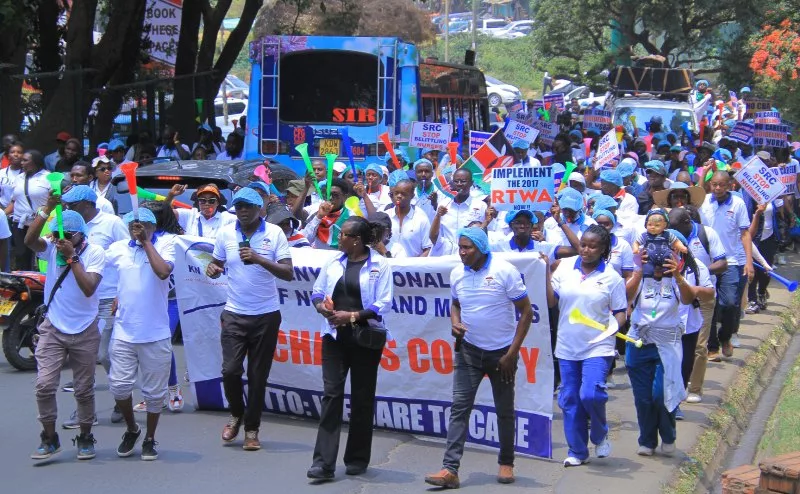
 Nurses in a past strike march to the Salaries and Remuneration Commission offices in Nairobi on September 3, 2026 /EZEKIEL AMING'A
Mombasa Governor Abdulswamad Nassir has issued appointment letters to 286 newly recruited nurses in the county.
The appointments came weeks after a nationwide nurses’ strike that had disrupted services at public hospitals across the country, including Coast General Teaching and Referral Hospital, Port Reitz Hospital and Likoni Subcounty Hospital.
The industrial action was suspended after Justice Monica Mbaru of the Employment and Labour Relations Court in Mombasa, ruling on a petition brought by Mombasa county, issued orders on August 5 declaring the strike unlawful. She directed members of the Kenya National Union of Nurses and Midwives (KNUNM) to resume duty.
Nassir said nurses who had taken part in the strike would not be victimised. He directed the county health staff management to work out compensation for colleagues who stayed on duty and put in extra hours during the disruption.
He further pledged timely salary payments, promotions and clear career progression pathways for the newly appointed nurses.
Responding to claims of tribal bias in the recruitment process, the governor pointed to the ethnic diversity of the nurses present at the ceremony as evidence against the allegations.
“We were created in different tribes for no other reason other than to know each other,” Nassir said.
Among the new policies he outlined was the county payment of Social Health Insurance Fund (SHIF) costs for patients admitted to level 4 and level 5 hospitals.
Nassir also announced an 85 per cent health cover for health professionals recruited on contract between 2019 and 2020 under the Universal Health Coverage (UHC) programme, alongside free treatment for children and free food for pregnant women.
The county chief also announced plans to increase the number of doctors in the county by the end of his tenure, and to convert the employment terms of UHC nurses to permanent and pensionable.
“We will collaborate and make all efforts necessary to have a healthy relationship with healthcare professionals, to avoid a situation where they go on strike, yet their issues have nothing to do with Mombasa county,” Nassir said.
Separately in Nairobi, healthcare professional associations called for urgent measures to restore services and clear patient backlogs following the end of the 43-day nurses’ strike.
The associations welcomed the resolution of the industrial action following an agreement between the KNUNM and the Council of Governors (CoG), saying the return of nurses to health facilities would bring relief to patients and the wider health system.
National Nurses Association of Kenya (NNAK) president Collins Ajwang commended the union leadership and county governments for resolving the dispute through dialogue.
“We commend the union leadership and county governments for choosing constructive dialogue to break the weeks-long deadlock,” Ajwang said on behalf of the professional organisations.
He said nurses account for nearly 70 per cent of Kenya’s healthcare workforce, adding that their return to public health facilities would help restore care for millions of Kenyans.
The associations said nurses were returning to their clinical stations, with priority expected in critical areas including maternal, neonatal, emergency and specialised care.
They urged facility managers and health administration teams to support healthcare workers as they clear service backlogs and attend to patients whose care may have been delayed during the strike.
The professional associations further urged the national and county governments, including the CoG, to honour commitments made under the agreement and address healthcare workers’ concerns in a timely manner.
They said resolving workforce grievances early through constructive dialogue would help strengthen confidence among healthcare workers, safeguard continuity of care and reduce the risk of future disruptions to essential health services.
The associations also urged the two levels of government to use the end of the strike as an opportunity to address underlying weaknesses in health workforce management, including predictable financing and the welfare and terms of healthcare workers serving under UHC programmes.
“This agreement should not be viewed as the end of the conversation, but as an opportunity to address the vulnerabilities that contributed to this prolonged disruption,” they said.
They called for healthcare workers to be provided with adequate resources, support and conducive working environments to enable them to deliver safe and dignified care.
The associations said they were ready to collaborate with the Ministry of Health, CoG, Parliament and other health-sector partners to advance lasting policy reforms and strengthen a healthcare system that puts patients and quality care at the centre.
Instant analysis
Governor Abdulswamad Nassir’s recruitment drive and policy concessions mark a proactive attempt to stabilise Mombasa’s healthcare sector post-strike. By guaranteeing non-victimisation, converting UHC contracts and expanding health subsidies, the county aims to insulate local public health infrastructure from national labor disputes while clearing critical patient care backlogs.