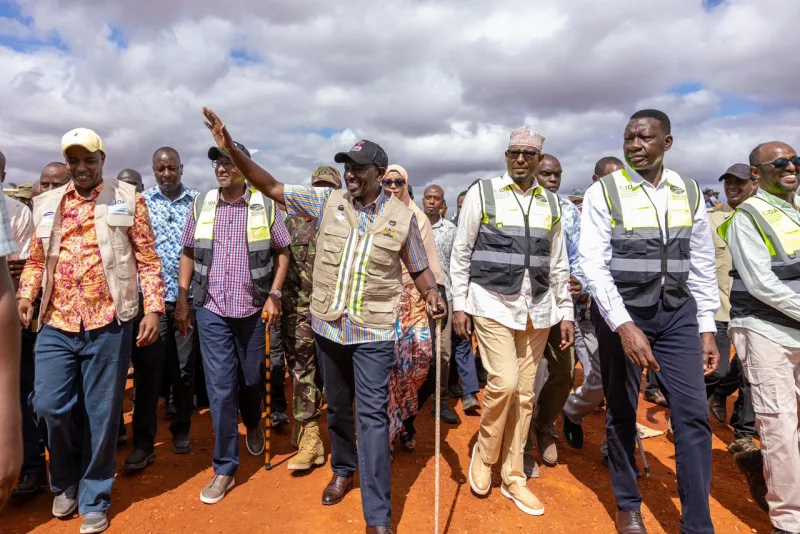
As presidential hopefuls and political parties crisscross the country in search of votes, counties such as Baringo, Isiolo, Kwale, Lamu, Mandera, Marsabit, Samburu, Tana River, Wajir and West Pokot have attracted comparatively little attention despite collectively holding more than 1.8 million registered voters, based on the 2022 electoral register.
The political silence in these regions stands in contrast to the intense mobilisation witnessed in the Coast, Mt Kenya, Nyanza, parts of the Rift Valley and Western, where politicians are already laying the groundwork for alliances and testing their popularity ahead of the election.
Yet the counties receiving fewer political visits could become crucial if the presidential race is closely contested.
Political analyst Fred Sasia said Kenya’s elections are shaped not only by the ability of candidates to consolidate traditional strongholds but also by their capacity to make inroads in areas where no candidate enjoys overwhelming support.
“Winning modest but significant support across such counties could provide the margins needed to cross the constitutional threshold,” he said.
Under the Constitution, a presidential candidate must secure 50 per cent plus one votes and at least 25 per cent of the votes cast in more than half of the 47 counties.
This makes a broad geographical spread of support important, particularly in a fragmented contest.
According to the Independent Electoral and Boundaries Commission, in the 2022 election, registered voter counts stood at 89,504 for Isiolo, 217,030 for Mandera, 166,912 for Marsabit, 100,014 for Samburu, 207,758 for Wajir and 220,026 for West Pokot.
Baringo had 281,053 registered voters, while Kwale had 328,253. Lamu 81,453 and Tana River 141,096.
Although individually some of the counties may not command the numbers associated with Kenya’s largest voting blocs, their combined tally gives them considerable weight in a closely fought presidential contest.
Sasia said politicians would eventually have to move beyond established political narratives and build genuinely national coalitions.
“Counties that appear politically quiet today may become crucial targets as campaigns intensify, particularly if the major contenders split votes in their traditional bases,” he said.
Political parties are, however, beginning to signal plans to expand their reach.
ODM communications director Philip Etale said the party is preparing nationwide activities in October as it seeks to reconnect with grassroots supporters and revitalise its structures.
The month has been dubbed ‘Raila Month’ in honour of the late former Prime Minister and ODM leader Raila Odinga, with party officials expected to tour different regions and engage supporters.
Etale said ODM organising secretary and Wajir Governor Ahmed Abdullahi would unveil the programme.
The Linda Mwananchi Movement is also looking beyond its traditional political networks. The movement plans to visit the United States to engage Kenyan diaspora communities and seek support for Nairobi Senator Edwin Sifuna’s presidential bid.
Kisii Senator Richard Onyonka confirmed the planned US visit, saying it followed an invitation from Kenyans living abroad.
Bumula MP Jack Wamboka said the Linda Mwananchi Movement will not limit its mobilisation efforts to specific regions but will instead traverse all corners of the country in search of support.
He said the movement is determined to build a national political platform by engaging Kenyans across the country and taking its message to communities that have so far received little attention from political parties.
“Linda Mwananchi will continue expanding its grassroots networks as it positions itself for the 2027 General Election. Every county and every constituency will be important in the race,” the MP added.
Meanwhile, the Democracy for Citizens Party is seeking to establish a nationwide presence after its strong showing in the Ol Kalou parliamentary by-election.
Former Deputy President Rigathi Gachagua said the party intends to field candidates across all 47 counties.
“We are a national party, and we intend to field candidates in all 47 counties for gubernatorial, senatorial, National Assembly and county assembly seats,” he said.
The Wiper Patriotic Front has similarly embarked on a countrywide grassroots campaign under the ‘Komboa Kenya’ banner, with party leader Kalonzo Musyoka seeking to transform Wiper from a largely regional outfit into a nationwide political movement.
As the major parties expand their operations, the so-called forgotten counties could increasingly become part of the 2027 political arithmetic.