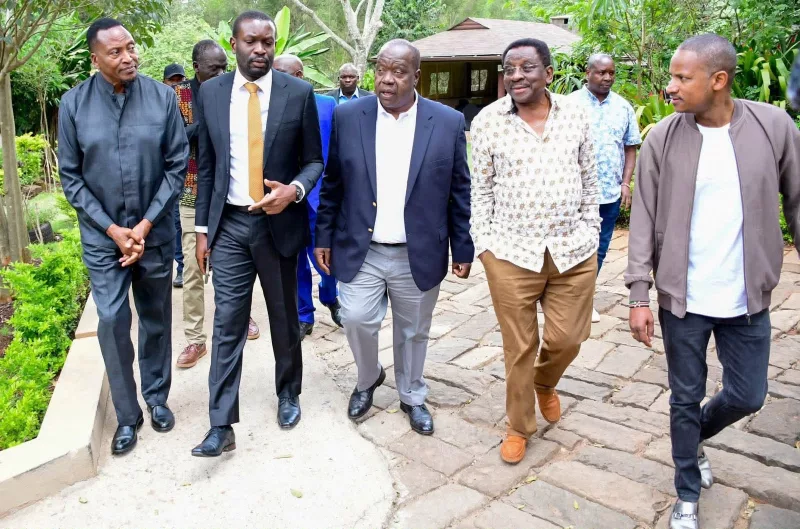
 Linda Mwananchi leaders meet with Jubilee presidential candidate Fred Matiang'i in Karen, September 10, 2026. /FRED MATIANG'I
A flurry of meetings and consultations among opposition leaders in recent days has raised the prospect of a united political force to challenge President William Ruto in the 2027 General Election.
Although the engagements have not been presented as formal coalition negotiations, the meetings involving leading opposition figures point to early efforts to build consensus and keep the opposition united around a common challenge ahead of the polls.
On Thursday, Wiper Patriotic Front leader Kalonzo Musyoka hosted Linda Mwananchi leader Edwin Sifuna for what the former Vice President described as a conversation on the state of the nation and the road ahead.
"We are in agreement that all of us who mean well must work together to change our nation for the better," he said.
The meeting came two days after Kalonzo met Nyali MP Mohamed Ali, Wundanyi MP Danson Mwashako and former Cabinet secretary Aisha Jumwa.
Ali and Jumwa are former Ruto allies who have since shifted allegiance to the opposition camp.
Kalonzo also chaired the Joint Azimio Council and NEC meeting on Thursday, describing it as part of ongoing efforts to build a broader, stronger and united opposition.
The same day, Jubilee presidential candidate and former Interior Cabinet Secretary Fred Matiang'i met the Linda Mwananchi team comprising Sifuna, Siaya Governor James Orengo and Embakasi East MP Babu Owino for a closed-door consultative meeting in Karen.
Vihiga Senator Godfrey Osotsi and Kisii Senator Richard Onyonka also attended the meeting, whose agenda was not immediately established.
Matiang'i, however, appeared to suggest that the consultations were part of a wider political undertaking.
"The momentum builds. The mission is clear. We march on," he said on X.
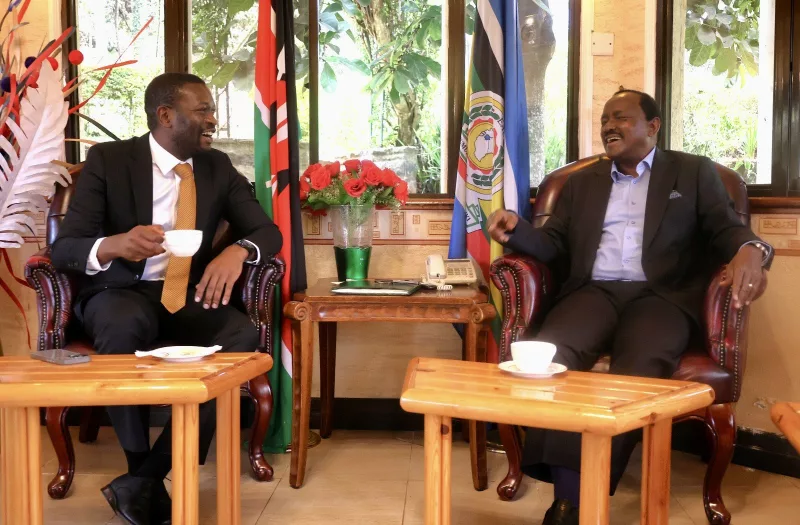 Wiper leader Kalonzo Musyoka hosts Linda Mwananchi leader Edwin Sifuna, September 10, 2026. /KALONZO MUSYOKA
The meetings have revived questions over whether the opposition leaders can overcome their individual ambitions and political differences to settle on a common presidential candidate.
Political analyst Herman Manyora argues that the durability of the emerging opposition alliance could depend significantly on the relationship between Sifuna and Democracy for the Citizens Party leader Rigathi Gachagua.
Gachagua, who is in the US on a diaspora voter mobilisation tour, has already indicated his willingness to back Sifuna should other opposition principals settle on the Nairobi senator as their preferred candidate.
"These two are the main opposition. If they are not in the opposition, there's no opposition - it collapses," Manyora said during a radio interview.
The current manoeuvring has drawn comparisons with the period preceding the 2002 General Election, when opposition parties united to end Kanu's 24-year rule.
The historic victory was secured through the National Rainbow Coalition (NARC), which brought together Mwai Kibaki of DP, Ford Kenya's Kijana Wamalwa, Charity Ngilu of NAK, former Kanu vice-chairman and former Vice President George Saitoti, Kalonzo, Moody Awori and LDP's Raila Odinga.
Raila's famous "Kibaki Tosha" declaration helped settle the question of NARC's presidential candidate, with Kibaki eventually going on to defeat Kanu's Uhuru Kenyatta.
Manyora sees echoes of that period in the current opposition politics, with Sifuna potentially playing a central role in determining whether the emerging alliance holds.
"The glue that holds the opposition together is Sifuna because he's the common denominator," Manyora said.
However, he cautions against assuming that the opposition would automatically disintegrate if Sifuna or Gachagua does not emerge as its presidential candidate.
Kalonzo, he says, remains an important unifying force who could help prevent the opposition from splintering if Sifuna and Gachagua adopt hardline positions.
"Why do you introduce Kalonzo? Because there are people who look at these two as reckless, one because of his style - almost roguish - and the other, his boldness and courage, buoyed by youth, can scare a few people to think he's too reckless," he said during a radio interview.
The uncertainty surrounding the opposition's eventual shape is also reflected in the position taken by Roots Party leader George Wajackoyah.
Wajackoyah supports efforts to deny Ruto a second term but argues that opposition unity cannot be sustained by slogans alone.
He says the emerging alliance needs a clear policy blueprint if it is to persuade voters and mount a credible challenge to the incumbent.
"I support them, but one thing they are doing which I disagree with, they never came up with a blueprint. But they came up with this narrative of Ruto must go. If he goes, fair enough, I'm not supporting Ruto either. But so what?" he posed.
Speaking on TV47 on Thursday night, Wajackoyah said he would support an opposition campaign based on issues rather than slogans.
"Are they telling Kenyans what issues are bedevilling the country? If they form that and come and say, 'Professor, we are now talking on issues,' I will be the first one to move in," he said.
The 2022 presidential aspirant, who has largely operated outside the emerging opposition alignment, said he would be willing to join if invited.
"But I'm watching silently, because if you don't want me, then why should I come? They have not invited me, so why should I invite myself to where I'm not wanted?"
Wajackoyah nevertheless said he remains on good terms with opposition leaders and has maintained contact with them.
For now, the meetings point to a growing willingness among opposition figures to engage and explore common ground.
But with presidential ambitions, party interests and questions over policy still unresolved, whether the leaders will eventually agree on a single presidential candidate remains a matter of wait and see.