Nine years ago, a patient in Kisumu requiring specialised brain or spine surgery had few options but to travel to Nairobi or, for those who could afford it, seek treatment outside the country.
Kisumu had no neurosurgeon despite serving as a major referral centre for millions of people across Western Kenya. Today, the picture is markedly different.
The city now has four neurosurgeons and two orthopaedic spine specialists, while about 700 brain and spine surgeries have been performed through a partnership that began with visiting specialists from the Kenyan diaspora.
As local expertise continues to grow, the programme is now introducing a specialised treatment for drug-resistant epilepsy: vagus nerve stimulation (VNS), giving patients another option when medication fails to adequately control their seizures.
Dr Bethwel Raore, a neurosurgeon from Atlanta, Georgia, who is part of the Kisumu Neuroscience Initiative, said the programme was born out of concern over the lack of specialised care in his home region.
“I left and went to the States after high school. Over the years of me being a neurosurgeon and coming to Kenya, I realised that there was no neurosurgery in Kisumu and this area,” Raore said.
Together with fellow neurosurgeons Dr Victor Awuor and Dr Timothy Ogutu, Raore helped establish the initiative in 2017, initially relying on periodic medical camps to bring specialised services to patients.
The first neurosurgical operations were performed in Kisumu in 2018. At the time, visiting teams arrived with surgeons, nurses, theatre staff, equipment and other supplies needed to perform the complex procedures.
But the objective was never to keep bringing foreign-based specialists to Kisumu indefinitely.
The bigger ambition was to develop local expertise capable of continuing the work long after the visiting teams had left.
“The knowledge that we have doesn't live with us. We don't pack up and leave with the knowledge when we leave,” Raore said.
That investment in skills has gradually changed the region's neurosurgical landscape.
Raore said Kisumu now has four neurosurgeons and two orthopaedic spine specialists, a sharp contrast to 2017 when there were none.
“The most exciting part is not the number of surgeries performed by visiting surgeons. The most exciting part is that we now have local neurosurgeons who are performing these procedures, and that number continues to grow,” he said.
The transformation has also extended to theatre and nursing teams.
Local scrub and nursing staff have been trained to support neurosurgical procedures, reducing dependence on visiting teams for specialised operations.
For Raore, that is the real measure of success.
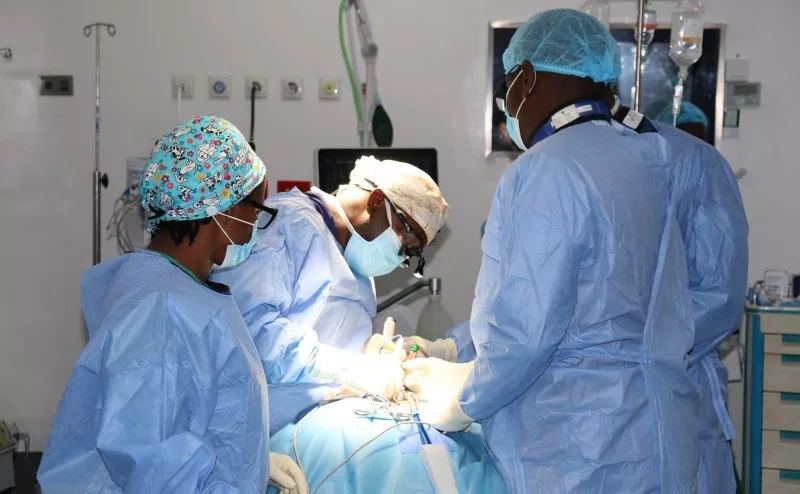
The initiative has conducted about 700 surgeries over the years, including operations for brain tumours, brain infections, spinal conditions and other neurological problems.
But what was once a rare event has increasingly become part of routine medical care in the city.
“The goal at the beginning was we wanted to get to a point where a neurosurgery procedure happening is not a newsworthy event,” Raore said.
He added, “In 2018, it was a newsworthy event. Right now, a lot of neurosurgery happens, and you folks don't even know that there's a neurosurgery going on in Kisumu.”
New frontier in epilepsy treatment
The latest development is taking the initiative beyond conventional brain and spine surgery.
The team is introducing vagus nerve stimulation, a treatment for patients with drug-resistant epilepsy.
VNS involves implanting a small device under the skin and connecting it to the vagus nerve in the neck.
The device delivers electrical impulses that can help reduce the frequency of seizures. Dr Sabrina Zeller, a neurosurgeon based in Westchester, New York, who specialises in paediatric neurosurgery and epilepsy surgery, joined Raore's team last year after learning about the initiative.
Zeller said her involvement grew out of conversations with patients during her first visit to Kisumu.
“A lot of the patients asked us for some form of therapy for epilepsy,” she said.
During last year's visit, the team performed surgeries for tumours, trauma and infections while working alongside local doctors and surgeons.
The demand for epilepsy treatment, however, prompted the specialists to explore whether VNS could be introduced in Kenya.
This year, the team worked with the manufacturer of the VNS devices to make the technology available in Kisumu, with some of the devices donated for the initiative.
Zeller has since been working alongside local neurosurgeons to train them on how to implant the device.
“I showed them how to place the device, working alongside Dr Raore, Dr T. and Dr Lee, as well as some of the other terrific surgeons here,” she said.
But the training does not end once the device is implanted.
Local neurologists are also being trained to programme the devices so that patients can continue receiving follow-up care locally.
“We also worked with neurologists to teach them how to programme the device so that patients can continue receiving the treatment here over time,” Zeller said.
For Raore, this is critical because VNS is not intended to be a one-off intervention.
“Vagus nerve stimulation is a very well-known treatment. It is not a cure for epilepsy, but it helps reduce the frequency of seizures,” he said.
The treatment is particularly important for patients whose seizures remain uncontrolled despite trying two appropriate anti-seizure medicines.
Raore said patients first undergo assessment to establish the cause of their seizures. Where imaging reveals a brain lesion responsible for the epilepsy, surgery to remove the lesion may be considered.
But many patients have no visible lesion on brain scans and continue to experience seizures despite medication. It is this group that could benefit from VNS.
The team has already completed five VNS procedures during the current camp, according to Raore, with more patients being assessed.
Mothers push for access
Raore said families, particularly mothers of children living with epilepsy, had played an important role in pushing for greater access to specialised treatment.
“The mothers of children who could benefit from this treatment have been demanding it for a long time,” he said.
He compared VNS with cardiac pacemaker technology, which is already available in Kisumu.
Both systems use an implanted battery and a lead, although they serve different medical purposes.
“If pacemakers are available in Kisumu, why can't vagus nerve stimulation also be available in Kisumu?” Raore asked.
He believes the technology should no longer be viewed as something that belongs only in high-income countries.
“This treatment is ready, and Western Kenya is ready. Kenya is ready. East Africa is ready. And the rest of Africa is ready for this treatment,” he said.
Keeping expertise in Kisumu
The initiative's evolution has also changed the role of the visiting specialists.
Instead of simply arriving to provide a service and leaving, they increasingly work alongside local teams, transferring skills and knowledge.
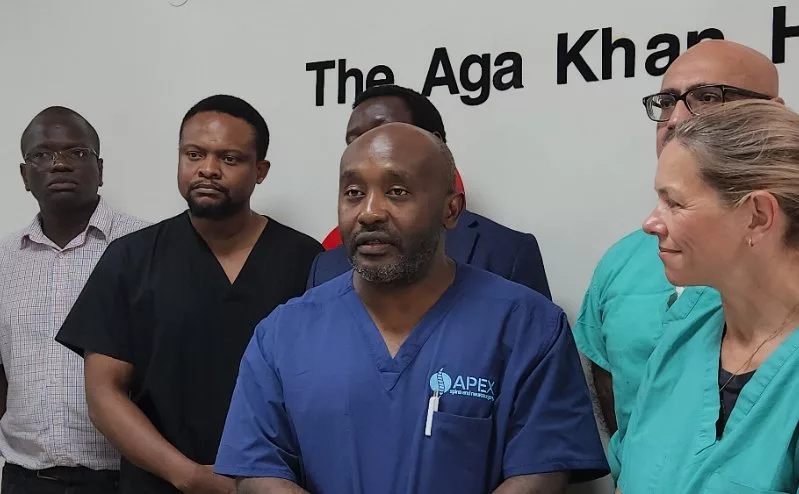
Dr Simon Onsongo, medical director at Aga Khan Hospital Kisumu, said the partnership had provided an important avenue for capacity building.
“When they travel here, they come for a few days. During that time, they are able to transfer knowledge, build capacity and teach our teams new techniques and ways of doing these procedures,” Onsongo said.
He said the knowledge remains with local health workers after the visiting teams return home.
That means patients can continue accessing specialised services without waiting for another medical camp.
Onsongo said patients undergoing qualifying procedures during the camp are not charged a surgery fee, although hospital requirements such as SHA only.
The programme screens patients before surgery to establish whether they are suitable for the procedures.
The hospital also provides staff and other resources, while the visiting teams bring some specialised implants and supplies.
Dr Jack Okumu, head of surgery at Aga Khan Hospital Kisumu, said the hospital had also grown in its ability to support complex neurosurgical procedures.
“This year's NeuroCamp has given us an opportunity. We have had a learning curve in the past, and we're much better,” Okumu said.
He said the department now had the theatre facilities and staff needed to support the neurosurgical team and provide safe care.
A model that could outlive the camps
For patients, one of the biggest benefits is the ability to receive specialised treatment closer to home.
Raore said patients with brain and spine conditions previously had to travel long distances to Nairobi or outside the country, a difficult undertaking for people already dealing with serious illnesses.
Now, he said, the presence of local specialists means patients can continue receiving care even when the visiting teams are not in Kisumu.
“The camp's gone, but there's Dr Lee and others who are right here in Aga Khan who will do surgery,” he said.
The programme has also inspired more young doctors to consider neurosurgery.
Onsongo said several students exposed to the initiative are now pursuing the specialty, further expanding the pool of specialists available in the region.
For Zeller, the same principle of knowledge transfer is now being applied to epilepsy treatment.
By training local neurosurgeons to implant VNS devices and neurologists to programme and manage them, the visiting team hopes patients will not have to depend on foreign specialists for continued care.
“I am very grateful to be part of Dr Raore's team and to contribute to this important work,” Zeller said.
For Raore, that is the legacy the initiative has been working towards since 2017.
What started as an effort by a group of diaspora neurosurgeons to bring a service that did not exist in Kisumu has evolved into a growing local speciality.
The introduction of VNS represents the next phase bringing a specialised treatment for drug-resistant epilepsy to a region where families have been asking for more options.
The ultimate test, however, will be whether the service can become part of routine local care after the visiting specialists leave.
“We are glad to bring this treatment here, starting with a few cases,” Raore said.