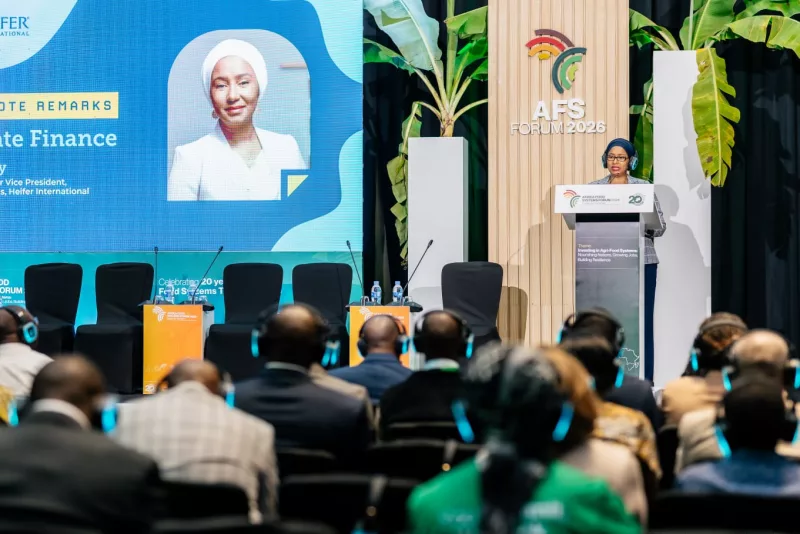
 Safia Boly SVP Africa Heifer International addressing participants at the AFSF climate Finance session in Kigali / HANDOUT
Climate finance remains out of reach for many African farmers and agricultural businesses despite growing adoption of technologies aimed at reducing costs, limiting losses and improving productivity.
The issue was discussed at the Climate Finance Nexus Forum, convened by Heifer International during the Africa Food Systems Forum in Kigali, Rwanda.
The forum brought together government officials, financial institutions, development partners, technology companies and farmer organisations to examine how more capital can be directed towards African agriculture.
The stakeholders said the challenge is not a shortage of climate solutions, with farmers already adopting solar irrigation, renewable energy for cooling and processing, improved water management and other technologies.
Instead, they said the difficulty lies in developing financing models that work for both farmers and lenders.
For financial institutions, agriculture can be difficult to finance because revenues can be unpredictable, infrastructure is often inadequate and businesses face weather, production and market risks.
Farmers and cooperatives, meanwhile, often struggle to access financing suited to the investments they need to make.
Heifer International Senior Vice President, Africa Safia Boly said climate finance needs to reach agricultural businesses in a form they can use.
"If we get this right, climate finance reaches the first mile, and it arrives as credit a business can use rather than a grant it has to wait for. That is what I hope we are all working towards."
Boly said concessional capital is most effective when it is used to absorb risks faced by lenders rather than simply financing the purchase of assets.
An example from Uganda's dairy sector was highlighted through the experience of a milk collection centre, where solar-powered cooling has been associated with the elimination of milk losses.
The centre chills about 197,321 litres of milk each month, while the number of milk suppliers has increased by 22.6 per cent.
The facility had previously faced losses linked to unreliable electricity and generator breakdowns.
The model brings together the cooperative, technology provider, milk processor, commercial finance and insurance, with Heifer International providing technical and operational support.
According to Heifer, connecting these components can allow renewable-energy investments to improve the performance of agricultural businesses while creating a stronger basis for commercial financing.
Uganda's agricultural sector accounts for approximately 26 per cent of GDP, while dairy is an important source of value addition, employment, exports and farmer incomes.
However, milk is highly perishable, making reliable energy for cooling, storage and processing essential to the sector.
Opening the forum, Uganda's Minister of State for Agriculture, Animal Industry and Fisheries, Dr Bright Rwamirama Kanyontore, said governments cannot finance agricultural transformation alone.
"The opportunity before us is to connect productive agricultural businesses, appropriate technology, reliable markets and suitable financing,” Rwamirama said.
Rwamirama said bringing these elements together could turn climate solutions into opportunities capable of attracting private investment.
"When these elements come together, climate solutions become investable opportunities capable of attracting private capital."
The financing approach could support investments in solar irrigation, cold storage, processing and other productive-use technologies across agricultural value chains in East Africa.
Rwamirama said the focus should shift from individual successful projects to financing models that can be replicated and scaled.
"Our task is to connect these opportunities and move from individual successful interventions to financing models that can be replicated and scaled across the dairy sector and other agricultural value chains."
The discussions come as farmers and agricultural enterprises across East Africa face increasing pressure from climate variability, rising input and energy costs and limited access to suitable financing.