Kenya’s 2027 political race is already taking shape, and a new opinion poll has placed President William Ruto ahead of his closest challengers while revealing fiercely competitive contests in Nairobi.
Bobea Report has released its inaugural people-centred opinion poll, covering the presidential, gubernatorial and parliamentary races ahead of the 2027 General Election.
The poll, conducted between August 26 and September 2, 2026, through random sampling, puts Ruto at 35.2%, followed by Edwin Sifuna at 19.1% and Fred Matiang’i at 14.0%.
However, the numbers also point to significant uncertainty, with 17.7% of respondents undecided and another 5.0% saying they would not vote. The Nairobi gubernatorial race is even tighter, with Babu Owino leading at 26.7%, narrowly ahead of incumbent Johnson Sakaja at 23.2% and James Gakuya at 21.9%.
The new poll seeks to offer a different approach to public opinion research by placing ordinary Kenyans at the centre of the process, with researchers and field enumerators engaging citizens directly in markets, villages, estates andworkplaces across different counties and constituencies.
According to Bobea Report, the exercise was designed to capture what is happening on the ground rather than rely on assumptions or boardroom discussions.
“For weeks, our dedicated team of researchers and field enumerators worked tirelessly across different counties and constituencies, engaging Kenyans in markets, villages, estates, and workplaces. No boardrooms, no assumptions. Just direct conversations with the ordinary mwananchi,” the organisation said.
The poll was conducted between 26th August and 2nd September 2026 through random sampling, with a margin of error of +/- 3.1% at a 95% confidence level.
Bobea Report says the findings are revealing and could shape the political conversation as Kenya heads towards the 2027 elections.
Ruto Leads Presidential Race
President William Ruto emerged as the leading candidate in the presidential poll, although the findings also show a significant challenge from his closest competitors and a sizeable number of undecided voters.
If Kenyans were to vote today, the poll puts the candidates at:
H.E. President William Ruto – 35.2%
Hon. Edwin Sifuna – 19.1%
Dr. Fred Matiang'i – 14.0%
H.E. Kalonzo Musyoka – 9.0%
Undecided – 17.7%
Will Not Vote – 5.0%
The figures place Ruto 16.1 percentage points ahead of Sifuna, while Matiang'i and Kalonzo Musyoka follow in third and fourth positions respectively.
However, the 17.7% undecided bloc could become significant as the country moves closer to the 2027 election, particularly if voters who have not settled on a candidate eventually consolidate behind one of the leading contenders.
Bobea Report also sought to establish what is motivating voters behind the leading presidential candidates.
Its qualitative analysis found that supporters of President Ruto are primarily motivated by what they consider his development record.
For Sifuna voters, the dominant sentiment is a desire for generational change.
Matiang'i supporters, meanwhile, are motivated by his reputation and track record as a no-nonsense Cabinet Secretary.
For supporters of Kalonzo Musyoka, the key driver is his perception as a non-corrupt leader.

Nairobi Gubernatorial Race Emerges as Tightest Contest
The Nairobi gubernatorial race is shaping up to be one of the most competitive contests in the country, according to the Bobea Report findings.
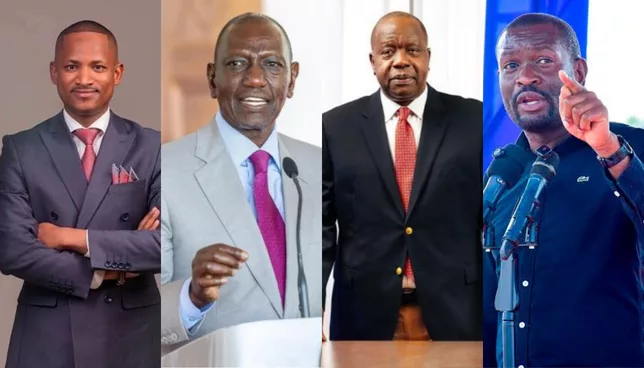
The poll places Embakasi East MP Hon. Babu Owino in the lead, followed closely by incumbent Nairobi Governor H.E. Hon. Johnson Sakaja and Hon. James Gakuya.
The figures are:
Hon. Babu Owino – 26.7%
H.E. Hon. Johnson Sakaja – 23.2%
Hon. James Gakuya – 21.9%
Agnes Kagure – 7.1%
Kevin Odhiambo (Dr. Cassypool) – 2.6%
Undecided/Others – 18.5%
Only 3.5 percentage points separate Babu Owino and Johnson Sakaja, while James Gakuya is also within striking distance of the two leaders.
Bobea Report therefore describes Nairobi as a “pure toss-up”, highlighting the potential for the race to shift as campaigns intensify.
The sizeable 18.5% undecided/others category further adds uncertainty to the contest.
Wamatangi Commands Lead in Kiambu
The Kiambu gubernatorial contest presents a markedly different picture.
Incumbent H.E. Dr. Kimani Wamatangi commands a substantial lead, recording 59.7% support in the poll.
He is followed by:
James Mwaura Kogi – 4%
Hon. Alice Nganga – 2.2%
Hon. James Nyoro – 1%
According to Bobea Report, Wamatangi is the only candidate with a majority-level lead in the survey and has the biggest margin of victory in the entire poll.
Passaris Leads Nairobi Women Representative Race
The contest for the Nairobi Women Representative seat also shows a clear frontrunner, with incumbent Hon. Esther Passaris leading the poll.
Passaris records 37.9%, followed by former nominated Senator Millicent Omanga at 29.2%.
The results are:
Hon. Esther Passaris – 37.9%
Hon. Millicent Omanga – 29.2%
Hon. Karen Nyamu – 11.3%
Sen. Crystal Asige – 9.3%
Undecided – 12.3%
Passaris therefore enjoys an 8.7 percentage-point advantage over Omanga, although the presence of a 12.3% undecided bloc leaves room for the race to change as the election approaches.
Dagoretti North: Elachi, Alai in Tight Contest
The Dagoretti North parliamentary race is another contest that Bobea Report describes as too close to call.
Former Nairobi County Assembly Speaker Hon. Beatrice Elachi leads with 32.2%, followed by Hon. Robert Alai at 27.9%.
Bright Shitemi is also within the race at 24.0%, while 15.9% of respondents remain undecided.
The findings show:
Hon. Beatrice Elachi – 32.2%
Hon. Robert Alai – 27.9%
Bright Shitemi – 24.0%
Undecided – 15.9%
With just 8.2 percentage points separating the three leading candidates, the race remains highly competitive.
Dagoretti South Records Highest Undecided Bloc
In neighbouring Dagoretti South, Hon. Dennis Waweru leads the contest with 28.0%, narrowly ahead of incumbent Hon. John Kiarie (KJ), who records 25.7%.
Brian Muchene follows at 12.5%.
The results are:
Hon. Dennis Waweru – 28.0%
Hon. John Kiarie (KJ) – 25.7%
Brian Muchene – 12.5%
Undecided – 33.8%
The most striking feature of the Dagoretti South poll is the 33.8% undecided bloc.
Bobea Report identifies this as the highest undecided bloc in the survey, making Dagoretti South the most volatile seat among the races covered.
The size of the undecided group means the current frontrunners have considerable ground to cover before election day, with more than one-third of respondents yet to settle on a candidate.

Raila Junior Leads Kibra Contest
In Kibra, Raila Junior leads a field of candidates competing for what Bobea Report describes as the “Enigma's legacy.”
The poll results are:
Raila Junior – 21.7%
McDonald Mariga – 15.3%
Imran Okoth – 11.2%
Mwalimu Orero – 9.0%
Timon Odhiambo – 6.3%
Undecided – 36.5%
Although Raila Junior leads the field with 21.7%, the race remains wide open due to the enormous 36.5% undecided bloc.
The figure means more than one in every three respondents has not yet decided who to support, making the eventual outcome difficult to predict at this stage.
Bobea Report: Polls Should Reflect Ordinary Kenyans
Bobea Report says its approach is intended to challenge the perception that opinion polls are primarily elite-driven exercises.
The organisation's Director said the inaugural report represents the beginning of an effort to place ordinary Kenyans at the centre of political opinion research.
“For a long time, polls have been perceived as elite projects. Bobea Report was born to change that. We went where others don't go. We listened. This first report is a testament to the power of a people-centred approach. This is just the beginning. We will continue to tell the Kenyan story as it is on the ground.”
The poll's findings highlight significant differences between the races surveyed.
While President William Ruto leads the presidential contest, nearly one in five respondents remains undecided. Nairobi's gubernatorial contest is separated by just 3.5 percentage points between the top two candidates, while Kiambu presents the strongest lead in the survey.
At the constituency level, Dagoretti South and Kibra stand out for their particularly large undecided blocs, suggesting that the current numbers could change considerably as political campaigns, alliances and voter mobilisation gather pace.
Bobea Report says the full report, including its methodology and county breakdowns, will be available on its website.