National Assembly's Majority Leader Kimani Ichung’wah has urged Mt Kenya leaders to address concerns raised by communities in Meru, Embu and Tharaka Nithi, warning that ignoring their grievances could deepen divisions within the region.
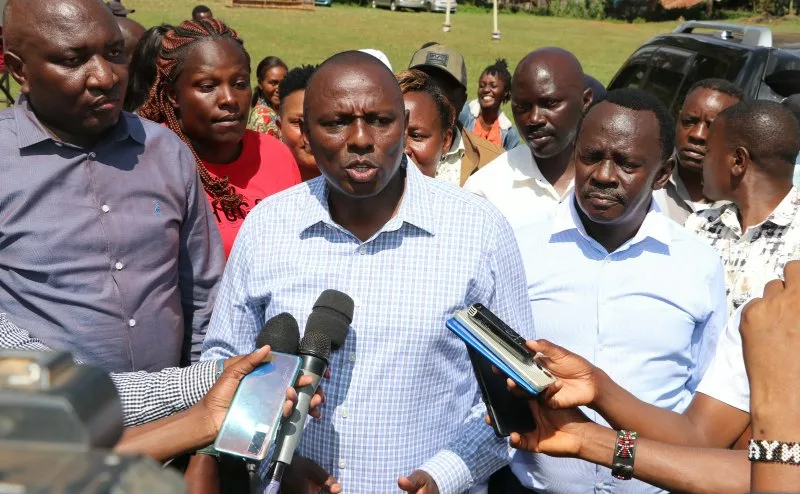
Speaking during a consultative meeting in Kerugoya, Kirinyaga County, on Saturday, Ichung’wah called on the Mt. Kenya West community to listen to the concerns of its counterparts in Mt Kenya East and work towards resolving them.
“If there are people who feel aggrieved, let us listen to them and not dismiss them. Let us listen to what they are saying,” Ichung’wa said.
He invoked a local proverb that warns against ignoring a crack until it becomes necessary to build a wall, saying concerns raised by communities in the eastern side of the region should be addressed before they grow into bigger divisions.
Ichung’wa said the Mt. Kenya West community should not dismiss the grievances of Meru, Embu and Tharaka Nithi residents, arguing that the three communities are part of the wider Mt Kenya family.
He said the region had historically embraced leaders from both Mt Kenya East and West, citing former presidents Jomo Kenyatta, Mwai Kibaki and Uhuru Kenyatta, as well as other senior leaders from the region.
The Majority Leader also singled out Deputy President Kithure Kindiki, saying his position and contribution to the region should be recognised and respected.
“Kithure Kindiki, as Deputy President and a child of Meru and Tharaka Nithi, is also a child of Mt Kenya. We must recognise him and give him the respect he deserves,” he said.
Ichung’wa's remarks come amid heightened political activity in Mt Kenya, with former Deputy President Rigathi Gachagua positioning himself as a key political figure ahead of the 2027 General Election.
But Ichung'wa cautioned against treating any individual as the automatic political choice of the entire region, saying Mt Kenya must have an honest conversation about its political interests, numbers and alliances.
“We cannot be self-sufficient on our own. We have never been self-sufficient as a community or as the people of Mt Kenya alone,” Ichung’wah said.
He dismissed claims that Mt Kenya has seven million votes capable of independently determining the country’s next president underscoring the need to work with other communities.
The region cast 4.3 million votes in 2022, about 66.9 percent of the 6.4 million registered voters.
He cited the election of former presidents Kibaki and Kenyatta as examples of the importance of political partnerships, noting that both relied on support from communities beyond Mt Kenya.
The Majority Leader said Mt Kenya should also look beyond the 2027 elections and prepare for future political contests, including the 2032 presidential race.
He said the region should be ready to unite behind one of its own if a suitable candidate emerges in 2032, while maintaining strong partnerships with other Kenyans.
“When 2032 comes, whether it is Kithure Kindiki or anyone else from Mt Kenya who wants to run for the presidency, let us unite as one community while maintaining strong partnerships with other Kenyans,” he said.
Ichung’wa urged residents to base their political strategy on realistic numbers and facts, warning that claims that the region can determine the presidency on its own could create false expectations.
Recently, the region has experienced heightened political activities with some quarters calling for a split of the region citi t developmental dispawhile others have called for sustained unity.
The Kerugoya meeting also focused on development issues, with residents and leaders discussing government commitments on roads, markets and agricultural earnings.
Ends