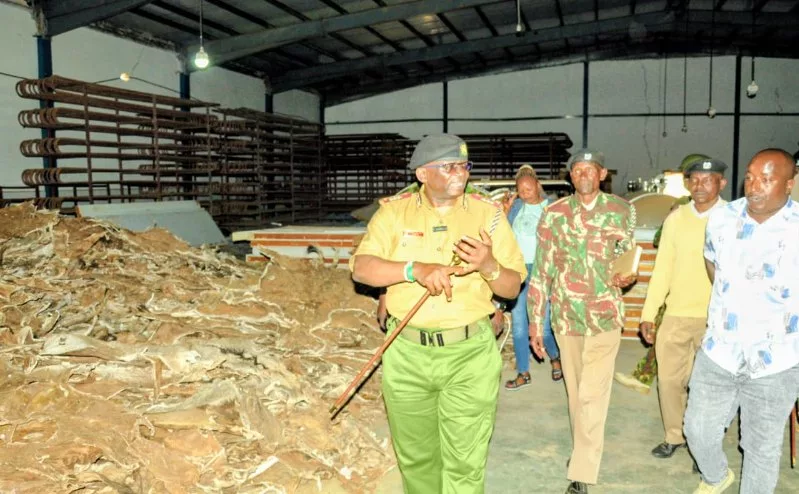
 Eastern Regional Commissioner, Jacob Ouma Muganda, leading a team of security officers in inspecting the illegal activities taking place at the shut-down Kithyoko donkey slaughter house/Musembi Nzengu.
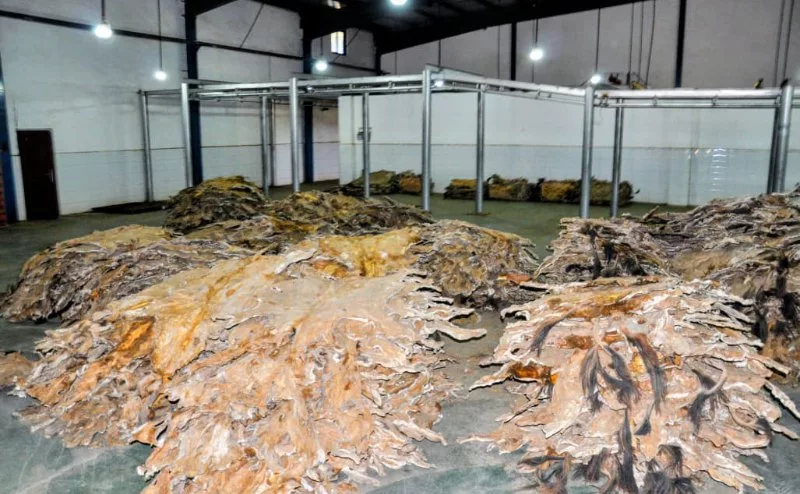 Dried donkey hides found during the Wednesday raid at the shutdown Kithyoko donkey slaughterhouse that has been operating illegally/Musembi Nzengu.
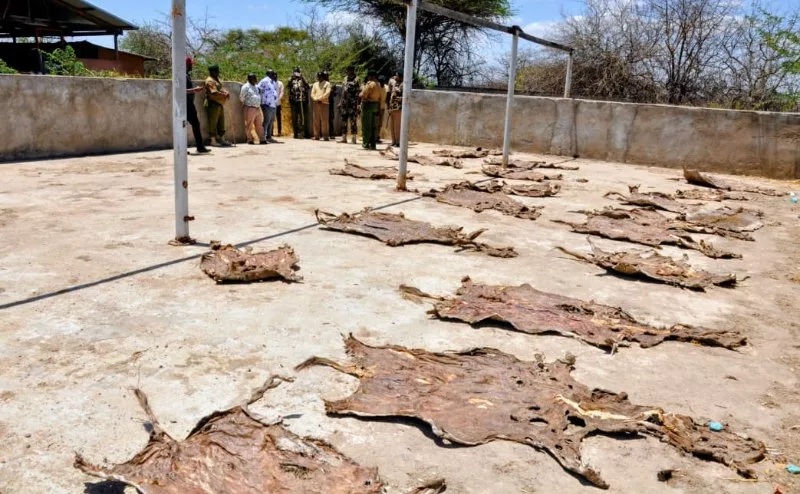 Fresh donkey hides spread out to dry inside the Kithyoko donkey slaughterhouse that has been operating illegally despite having formally closed down./Musembi Nzengu
Thousands of donkey hides have been discovered at an illegal
slaughterhouse in Kithyoko Market, Masinga in Machakos county.
The discovery has exposed an alleged clandestine operation
that authorities say continued despite the facility’s official closure.
The hides were uncovered on Wednesday when Eastern Regional
Commissioner Jacob Ouma Muganda led senior security officials in an impromptu
raid on the facility, which had reportedly been closed several years ago.
The security team found fresh donkey hides and meat at the
slaughterhouse, alongside workers who were processing meat and hides despite a
notice at the entrance declaring the facility closed.
“We have found fresh donkey meat. We have also found fresh
hides that were spread out to dry and on which salt had been applied to
preserve them. There were also dried hides that were ready to be transported
elsewhere,” Muganda told journalists after the raid.
Several workers were found inside the premises, even though
a signboard at the entrance stated: “This is a restricted area. This company is
closed until further notice.”
Muganda said the notice appeared to create the impression
that the slaughterhouse was no longer operational, while activities continued
at the premises.
“This facility has been operating against the law. What I
know is that the slaughter of donkeys and trade in their products is outlawed
in Kenya,” he said, warning that those behind the operation would face legal
action.
He directed that the facility and the recovered stockpile
remain under round-the-clock security surveillance as authorities finalise
plans for the disposal of the hides and meat recovered during the raid.
“Just as it has happened with illegal ivory and other game
trophies, we will have to destroy all the hides and products found in this
illegal Kithyoko slaughterhouse,” Muganda said.
The regional commissioner expressed concern that the
operation had allegedly continued in an area with a strong presence of police,
administration police and national government administration officers.
“It is shocking and surprising that the slaughter of donkeys
and trade in donkey hides has been arbitrarily taking place here in Kithyoko,
Masinga, where the police commander, administration police commanders and my
office have representatives,” he said.
Muganda warned security and administration officers against
abetting the illegal trade, saying anyone found to be involved would be held
accountable.
“There is no room for people to play games with the law,” he
warned.
Residents welcomed the security operation, saying they had
raised concerns for years about alleged clandestine activities at the
slaughterhouse.
Some residents claimed donkeys that disappeared from their
homesteads often ended up at the facility, raising concerns about a possible
organised theft network behind the disappearances.
Resident Joseph Kuthutha Musyoka said locals had repeatedly
complained about the continued activities at the slaughterhouse despite its
official closure.
He warned that residents could take drastic action if the
alleged clandestine activities persisted.
“If these people will not stop their stealth operation at
the slaughterhouse, then there is a likelihood that sooner rather than later it
will go up in flames,” Musyoka said.
Another resident, Rose Ndilu, said the alleged theft and
slaughter of donkeys was depriving local families of an important source of
livelihood.
“We use donkeys to carry out various chores that bring us
income and enable us to pay school fees for our children and feed our families.
We want the slaughterhouse shut down for good,” she said.
INSTANT ANALYSIS
The discovery of thousands of donkey hides at a facility officially closed years ago raises serious questions about enforcement and regulatory oversight. The operation, allegedly continuing despite the security presence, suggests possible institutional gaps that allowed the facility to resume processing. Residents’ claims of missing donkeys deepen public concern, while the authorities’ decision to secure and destroy the products signals an urgent attempt to restore control.