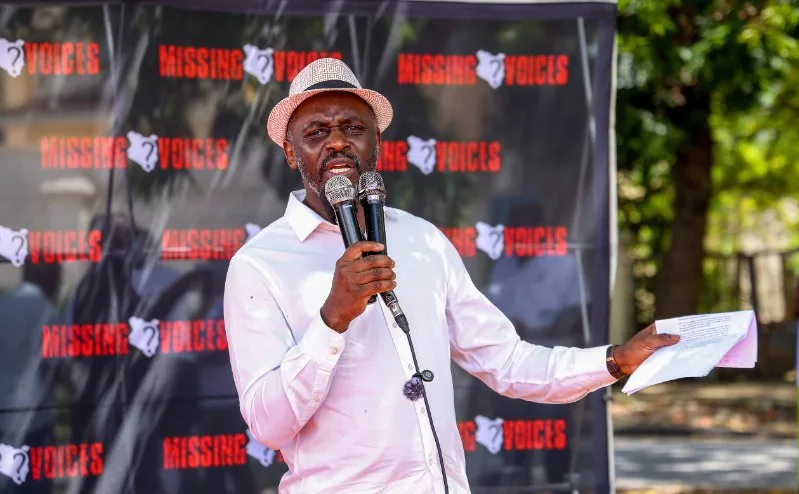
 Missing Voices chair and IJM country director Vincent Chahale at Muhuri grounds on Monday / BRIAN OTIENO
 Musa Ahmed, brother to Yasin Ahmed, who was taken by people believed to be state agents three weeks ago, alongside Muhuri director Khelef Khalifa [R] at Muhuri grounds on Monday /BRIAN OTIENO
Kenya recorded its highest number of enforced disappearances in 2024, with 55 people reported missing after allegedly being taken by state agents.
This is according to Missing Voices, a civil society coalition of at least 16 organisations.
The coalition says 190 people have been forcibly disappeared since 2019, with many still unaccounted for and their families demanding justice.
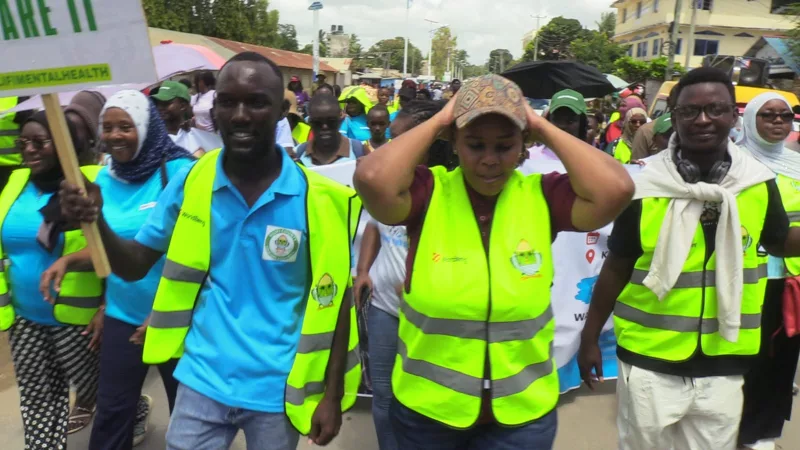
The figures were highlighted on Monday during the launch of the Haki Kwa Wote (Justice for All) campaign in Mombasa, which seeks legal, policy and institutional reforms to protect victims and hold perpetrators accountable.
Missing Voices said there was an urgent need to criminalise enforced disappearance and strengthen victim protection mechanisms as Kenya heads towards the election.
Kenya signed the International Convention for the Protection of All Persons from Enforced Disappearance in 2007 but has not ratified it or enacted specific legislation criminalising the practice.
Missing Voices chairman Vincent Chahale said the campaign would push Parliament to enact laws against enforced disappearances and fully operationalise the Victims Protection Act, 2014.
“For years we have had enforced disappearances in Kenya, especially during elections and protests, yet we do not have a law that criminalises it,” he said.
Independent Medico-Legal Unit (IMLU) executive director Grace Wangechi said 38 people were forcibly disappeared in 2019, with the number falling to 10 in 2020 before rising to 36 in 2021.
The figure stood at 22 in 2022 before falling to 10 in 2023 after President William Ruto took office and pledged to end enforced disappearances and extrajudicial killings.
However, the number rose sharply to 55 in 2024 following the June anti-Finance Bill protests and the subsequent police crackdown.
The number fell to six in 2025, but Wangechi said 19 people had been reported forcibly disappeared in 2026.
“Remember, we are still in August; we are yet to get to September,” she said.
Wangechi called for counselling for families and returned victims, noting some victims had not received compensation.
The government set aside Sh2 billion for a national reparations framework, with Sh674.1 million released to 505 verified victims.
She also called for stronger institutions, including the Victims Protection Agency and the Kenya National Commission on Human Rights.
Muslims for Human Rights (Muhuri) director Khelef Khalifa said families continued to suffer trauma because they did not know whether their missing relatives were alive or dead.
“We are not saying that they are innocent. We are saying that the law must be followed. If someone has done wrong, let them be taken to court,” he said.
Khalifa urged authorities to ensure security agencies operate within the law and called for accountability where unarmed civilians are harmed.