For Cecilia Wandete, the nurses’ strike is no longer a labour dispute being discussed in union offices and county government boardrooms.
It is a desperate search for a hospital that can fix her son’s broken leg.
Omar Wandete fell from a building they were constructing in Tudor, Mombasa, on Monday and fractured his leg.
His mother rushed him to Tudor Clinic, where he received first aid before being referred to Coast General Teaching and Referral Hospital.
She arrived expecting specialist care.
Instead, she found herself looking for another hospital.
“We took him to Tudor Clinic for first aid and we were referred here. But we only had the leg dressed and nothing further. Now we are looking for somewhere to take him but I don’t know how much it will cost us. We will cross that bridge when we get there,” Cecilia said.
Omar needs a metal plate inserted into his leg.
But his mother said the family was informed that all five theatres at Coast General had been closed.
“All the five theatres here have been closed. That’s what we were told,” she said.
The family is now facing the painful choice confronting thousands of Kenyans: find money for private treatment or wait for public hospitals to resume normal operations.
The nurses’ strike has now entered its fifth week, after the Kenya National Union of Nurses and Midwives withdrew their services over unresolved employment grievances.
The nurses are pushing for the implementation of the Collective Bargaining Agreement (CBA) signed in 2017.
Clinical officers, meanwhile, have been on strike since June 20, piling further pressure on county health facilities.
Clinical officers are also demanding implementation of career guidelines, better health risk allowances and the absorption of eligible UHC workers into permanent and pensionable employment.
The result is a health crisis that is being felt most acutely by patients who cannot afford private healthcare.
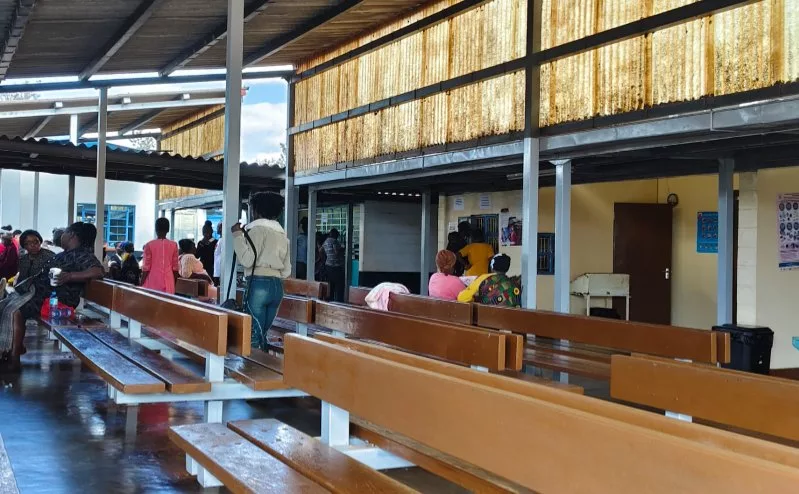
At Coast General Teaching and Referral Hospital, families gathered in groups, trying to determine what to do with relatives who needed treatment.
Nguta Bombole was among those stranded.
His stomach had suddenly started swelling and was accompanied by severe pain. His family rushed him to Coast General for scans.
But hours later, there was still no meaningful assistance.
“We arrived at around 9am but until now, around 1pm, nothing meaningful has been done to him,” said his elder brother, Suleiman Bombole.
The scenes at Coast General capture the human cost of a dispute that has now stretched for weeks.
Kenya National Union of Nurses Coast regional industrial relations officer Peter Maroko said inpatient services had been largely paralysed in the 52 public health facilities managed directly by the county government.
“Only the outpatient services are being offered limitedly depending on the situation,” Maroko said.
KNUN Secretary-General Seth Panyako said negotiations with the Council of Governors had yielded progress on some issues, including the absorption of Universal Health Coverage workers into permanent and pensionable employment.
The union and governors have also tentatively agreed to establish a joint committee to work on career guidelines.
But the Collective Bargaining Agreement remains unresolved.
“The main elephant in the house is the issue of the collective bargaining agreement, and this is where we are drawing our lines very, very, very clear, and are making it very clear that we do not have a deal yet,” Panyako said.
He warned that nurses would not return to work without an acceptable agreement.
“Unless we have an agreeable agreement, we will press on with our strike,” Panyako said.
The Kenya Union of Clinical Officers is facing a similar standoff.
KUCO Secretary-General George Gibore said clinical officers began their current industrial action on June 20 after issuing a strike notice.
He said only about 17 counties had signed the clinical officers’ CBA when the strike began, but the number has since risen to about 37.
“We want to avoid, where a CBA is delayed one year, two financial years, and then it becomes so difficult to implement like what they are doing to the nurses,” Gibore said.
Gibore said only 11 counties had fully implemented the career guidelines, while about 22 had implemented them partly.
The prolonged dispute has put the spotlight on county governments, which insist they cannot implement agreements without adequate resources.
Council of Governors chairman Ahmed Abdullahi said governors had tried to negotiate with nurses and wanted the health workers to return to work as talks continued.
“We have tried to negotiate with nurses, and it is still ongoing. They called a strike; the court has said it is illegal, but they are still insisting,” Ahmed said.
He added: “We want to ask nurses to go back to work as we negotiate this matter.”
The governors have also raised concerns over the financial implications of the 2017 CBA, arguing that it was signed under difficult circumstances and was not financially sustainable.
Deputy President Kithure Kindiki has meanwhile urged both sides to end the stalemate through dialogue.
Kindiki said the prolonged industrial action was hurting ordinary Kenyans and disrupting essential services.
“This industrial action has affected the smooth delivery of health services across the country,” he said.
He urged the Ministry of Health, Council of Governors and SRC to intensify negotiations with the unions.
In Nyanza, families have been forced to provide care for patients normally attended to by nurses.
Mary Ochieng, a patient’s relative, said many families could not afford private treatment.
“We are suffering because most of us cannot afford to take our patients to private hospitals. We have no alternative, so we have had to stay with our children and take care of them ourselves,” she said.
For 29-year-old Joshua Abuor of Muhoroni, the strike has brought an even greater tragedy.
His 28-year-old wife, Lavender Otieno, died on Friday while in active labour after the family reportedly failed to secure assistance at a public health facility.
The couple had hoped to welcome their first child.
Instead, Joshua was left mourning his wife.
The tragedy has underlined the risks faced by poor families when public health services are disrupted for prolonged periods.
In Murang’a, authorities have managed to keep most facilities operating by hiring temporary health workers.
Mary Wairimu, who sought treatment after experiencing chest problems, said services were slow but available.
“I got here at 10 am and I am still being checked until now. But they have put me under medication, and the breathing difficulties I was experiencing have eased,” she said.
Services at most county hospitals in the North Rift region have been paralyzed due to the ongoing strike by health workers, which is now in its second month.
The majority of the county hospitals are usually manned by nurses, clinical officers and laboratory technicians among others who are on strike.
Moi Teaching and Referral Hospital (MTRH) is recording an increased number of patients, with many residents opting to seek help at the facility rather than suffer more at the paralyzed county facilities.
“In the last month we have a very high number of referrals than usual, and that’s mainly because the county facilities are not working”, said the CEO of the hospital Dr Phillip Kirwa.
The doctors who are members of the Kenya Obstetrical and Gynaecological Society have warned that the effects of the strike would affect many Kenyans for a long time, especially pregnant women seeking maternal care.