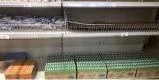
 Milk crisis./FILE
Supermarkets ration milk as drought affects supplies
Milk consumers are facing shortages across the country, with some supermarkets rationing purchases as drought cuts dairy production and processors struggle to secure adequate raw milk.
A spot check at several supermarkets and retail outlets in Nairobi found empty or sparsely stocked shelves, with some retailers limiting the amount of milk customers can buy amid concerns over declining supplies.
At some outlets, consumers were being limited to as little as one litre of milk from dispensers, while some wholesalers were restricting purchases of packaged milk to fewer than five packets per customer instead of a carton.
Long-life milk was retailing at between Sh54 and Sh65, while the few brands of fresh milk available were selling at between Sh61 and Sh65. At Waithaka Dairy Centre, fresh milk had increased from Sh70 to Sh80 per litre.
Consumers Federation of Kenya (COFEK) Secretary-General Stephen Mutoro said the government must take immediate and coordinated measures to restore normal milk supplies and stabilise prices.
Mutoro said formal-sector milk intake fell from 88.89 million litres in May 2026 to 84.44 million litres in June, according to Kenya National Bureau of Statistics data.
June intake was 6.4 per cent below the 90.24 million litres recorded in the same month last year. Cumulative intake between January and June stood at 513.32 million litres, slightly below the 516.34 million litres recorded during the same period in 2025.
He attributed the decline partly to worsening conditions for smallholder dairy farmers, who account for about 80 per cent of Kenya’s milk production.
Mutoro called on the Ministry of Agriculture to publish a recovery plan and activate emergency fodder and feed support for affected dairy counties.
He also urged the National Treasury to waive import duty and VAT on key dairy-feed ingredients, including yellow maize and soya, to reduce production costs.
Farmers are reporting yields falling from seven to nine litres to four to five litres per cow a day as pasture deteriorates following delayed rains and feed costs rise.
“Grass has dried and the little nappier grass I have is almost finished. Milk harvest has gone down by almost half and if we don’t get any rains, this could get worse,” said Andrew Mbogo, a dairy farmer in Narumoru, Nyeri County.
Mbogo keeps two dairy cows, which produce about 20 litres of milk a day under favourable conditions. He sells the milk to a dairy cooperative and relies on the income to repay loans.
The dry conditions have also forced some pastoralists to move their livestock in search of pasture and water.
A pastoralist in Oloitoktok, Kajiado County, said livestock keepers had moved animals to ranches in Taita Taveta, where they pay Sh300 per cow per month for grazing and water.
According to the National Drought Management Authority, 52.2 per cent of monitored ASAL counties recorded milk production below the long-term average in July.
The authority attributed the decline to diminishing pasture and browse, longer distances to water, deteriorating livestock body conditions and depletion of gains from the previous rainy season.
However, Kieni Dairy Products Limited Chief Executive Officer, Solomon Maina said the shortage cannot be blamed entirely on declining production.
He said high operating costs, including fuel prices, are forcing some processors to reduce pasteurised milk production and shift to higher-value products such as yoghurt, ice cream and cheese.
Maina also said delayed payments to farmers could be pushing producers towards the informal market, where milk fetches Sh70 to Sh80 per litre and farmers are paid promptly.
“The shortage may not necessarily be caused by farmers because there are places like Nyandarua where it has been raining, but could be attributed to other factors such as working capital and distribution logistics,” Maina aid.
He expects milk supplies to improve around October when the short rains begin, provided the rains are sufficient to restore pasture and water.
Kenya Dairy Board has however reassured the public, consumers and dairy industry stakeholders that milk continues to be available in the market, despite temporary supply constraints being experienced in some parts of the country.
Dr William Maritim, Managing Director said formal milk deliveries to processors declined by 3.7 per cent from 84.4 million litres in June 2026 to 81.3 million litres in July 2026.
He said the Board is currently compiling formal milk intake data for August 2026. Preliminary indications suggest a further decline in milk deliveries, reflecting the prevailing seasonal production conditions.
He said recent market surveillance undertaken by the Board has identified varying degrees of supply constraints across the country, reflected in low stock levels, reduced availability of some brands and pack sizes, and delayed replenishment in some outlets.
“Pasteurised milk has generally been more affected, while long-life milk (ESL and UHT) remains comparatively more available. Retail milk prices remain generally stable, although some upward price movement has been observed in parts of the country experiencing supply constraints,” he said.
The current situation is largely associated with seasonal factors, particularly the prevailing dry and cold conditions in key milk-producing areas.
The outlook for the October–November–December 2026 rainfall season is expected to support recovery in pasture and fodder availability, leading to improved milk production and supply as conditions become more favourable.
Maritim said the Government is implementing measures to strengthen milk production and the resilience of the dairy value chain.
These include procurement and distribution of milk coolers to improve milk aggregation and preservation, and support for dairy herd improvement through subsidised sexed semen. The interventions among others will contribute to increased production and more stable milk supplies over time.
“KDB continues to monitor milk production, formal milk deliveries, market availability and retail prices and is working with industry stakeholders to support continuity of supply. Consumers and stakeholders are therefore reassured that the current situation is temporary,” said Maritim.