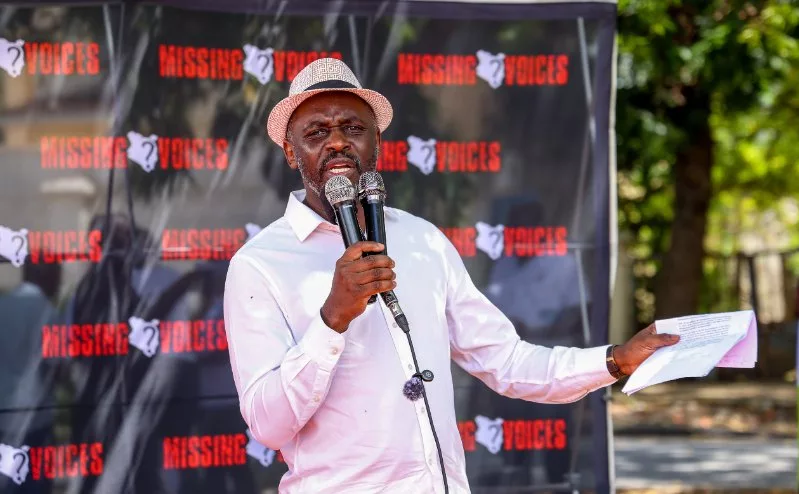
 Missing Voices chair and IJM country director Vincent Chahale at Muhuri grounds on Monday / BRIAN OTIENO
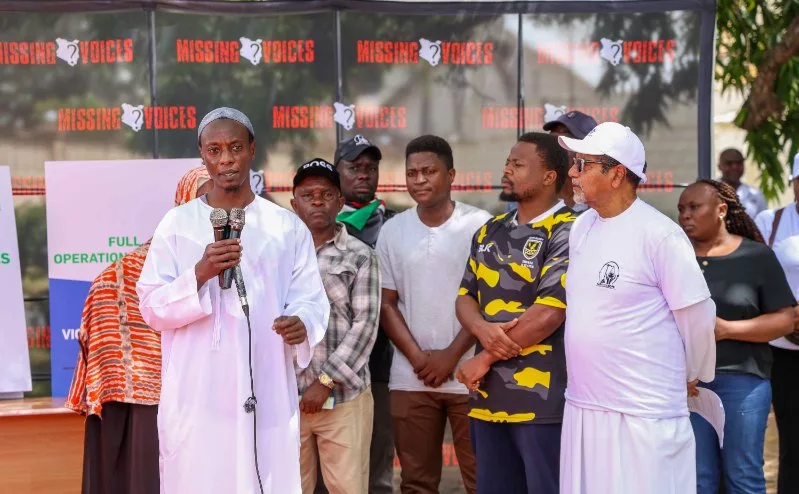 Musa Ahmed, brother to Yasin Ahmed, who was taken by people believed to be state agents three weeks ago, alongside Muhuri director Khelef Khalifa [R] at Muhuri grounds on Monday / BRIAN OTIENO
2024 worst year for Kenyans as victims of enforced disappearances was highest
BY BRIAN OTIENO @Yobramos4 Tuesday, September 1, 2024
The year 2024 was the worst for Kenyans after the enforced disappearance monster that is gobbling the most productive people in the country by age ate the highest number.
That year, Missing Voices, a civil society coalition of at least 16 organizations that are dedicated to ending enforced disappearances and extrajudicial killings by state agents, recorded 55 people who were forcefully disappeared by state agents.
Since 2019, some 190 have forcefully disappeared by people believed to be state agents and most of them have never been seen since.
Their families are calling for justice, and with the launch of the Haki Kwa Wote (Justice For All) campaign in Monday in Mombasa, the calls are becoming louder and louder.
Government authorities are struggling to assure Kenyans of their safety as rights defenders pile the pressure to criminalize enforced disappearance.
Missing Voices on Monday said there is urgent need for legal, policy, and institutional reforms to protect victims from enforced disappearances and hold perpetrators accountable.
Kenya signed the International Convention for the Protection of All Persons from Enforced Disappearance in 2007, but the government has yet to ratify the treaty or enact legislation specifically criminalizing enforced disappearances.
The current administration previously committed to ratifying the Convention and aligning domestic laws with its provisions, but those commitments remain outstanding.
This is exactly why the Haki Kwa Wote campaign was launched on Monday – to compel the justice system in the country to fully implement the victim protection mechanisms in the country.
Missing Voices chairman Vincent Chahale and International Justice Mission country director said the launch of the Haki Kwa Wote campaign is an important and decisive step that will help Kenyans be safe even during electioneering period.
He said this is especially important as Kenya heads into the 2027 general elections which are already raising temperature sin the country.
He said the campaign seeks to compel Parliament to enact laws against enforced disappearances.
“We are looking at mid-next year. For years we have had enforced disappearances in Kenya especially during elections and protests yet we do not have a law that criminalizes it,” Chahale said.
He said the Victims Protection Act, 2014 should be operationalized fully.
“There is no use having a law that gathers dust on the shelves when it is not fully implemented so that it can take care of the victims’ interests,” Chahale said.
The Independent Medico-Legal Unit (IMLU) executive director Grace Wangechi on Monday said in 2019, 38 people were forcefully disappeared by state agents.
The following year, the number reduced to 10, but increased to 36 in 2021, all this during the Uhuru Kenyatta regime.
In 2022, when the Uhuru Kenyatta regime made way to the William Ruto regime in August, some 22 people were taken from their families, never to be seen again.
With President Ruto having pledged to end enforced disappearances and extrajudicial killings, the number reduced to 10 in 2023.
However, with the Gen Z starting to voice their concerns and disapproval of the ills of the Ruto administration, which raised the cost of living, culminating in the now infamous June 2024 anti-Finance Bill protests, which were met with a brutal police crackdown, the number of young people who fell victim to enforced disappearance rose to 55, the highest since 2019.
With pressure having mounted on the Ruto administration to change its ways, including from the international community, there was the least number of people who had been forcefully disappeared the following year (2025) where only six people were recorded to have been forcefully disappeared.
Now, in 2026 so far, 19 people have fallen victim to enforced disappearance as Kenya dilly dallies on ratifying the International Convention for the Protection of All Persons from Enforced Disappearance, or enacting legislation specifically criminalizing enforced disappearances.
“Remember, we are still in August, we are yet to get to September,” Wangechi said on Monday, insinuating the number could as well rise.
She said communities and the families of those who are missing want a complete end to all forms of enforced disappearances.
“Kenya should criminalize enforced disappearances because the country has not stated or indicated that enforced disappearance is criminal in nature,” Wangechi said on the sidelines of the Haki Kwa Wote campaign launch at the Muhuri ground in Kizingo.
The Imlu executive director said the families of and returned victims of enforced disappearances should also be taken through counseling sessions.
Wangechi said some of them have not been compensated despite being in the list of those who should have been compensated.
President Ruto’s administration set aside a Sh2 billion package for an overall national reparations framework for verified victims and families affected by human rights violations and violence during public demonstrations.
So far, at least Sh674.1 million has been released to 505 verified victims, amid protests from other victims who say they have been forgotten.
Wangechi called for the strengthening if the Victims Protection Agency and the Kenya National Commission on Human Rights to carry out their mandates.
Muslims for Human Rights (Muhuri) director Khelef Khalifa said the buck stops with President Ruto.
“It is unfortunate that the President, William Samoei Ruto, publicly said ‘shoot them in the leg, take them to the hospital, then to court and to jail’.
“There is no law in Kenya that says that anyone should be shot in the leg. He was then asked by the international media whether he regretted making that statement, and he said no,” Khalifa said.
The veteran human rights defender said the statement by President Ruto means he is encouraging the police to use force, and possibly kill unarmed civilians.
“All these people who have been disappeared are somewhere. Somebody must take responsibility. The president should not play pretend that he doesn’t know anything.
“All responsibility must go to the president himself. The buck stops with him,” he said.
He said it is traumatizing for the families of those who have been forced to disappear to live without knowing whether their loved ones are alive or dead.
“We are not saying that they (those who disappeared) are innocent, no. We are saying that the law must be followed. If someone has done wrong, let them be taken to court that will decide their guilt or not.
“The police should not take the law into their hands. Killing unarmed civilians is murder. And any police officer who kills an unarmed civilian must be prosecuted,” Khalifa said.
He said the police are now being used to crack down on opposition politicians.
Ends...
Instant Analysis:
An enforced disappearance occurs when a person is arrested, detained, or abducted by state agents, or groups acting with state support, followed by a refusal to acknowledge the detention or reveal the person’s fate or whereabouts. The victim is usually taken against their will.
PICs:
Musa Ahmed, brother to Yasin Ahmed, who was taken by people believed to be state agents three weeks ago, alongside Muhuri director Khelef Khalifa [R] at Muhuri grounds on Monday / BRIAN OTIENO
Missing Voices chair and IJM country director Vincent Chahale at Muhuri grounds on Monday / BRIAN OTIENO
![Jomvu DCC Dolphine Okondo [3rd L, front row], MP Badi Twalib and DRC honorary consul in Mombasa Kambale Mukokoma [with golden Ruto bust] in Twalib’s Jomvu office on Monday / BRIAN OTIENO](https://cdn.radioafrica.digital/image/2026/09/3c409c2f-a473-4130-87a4-63684af01d02.webp)
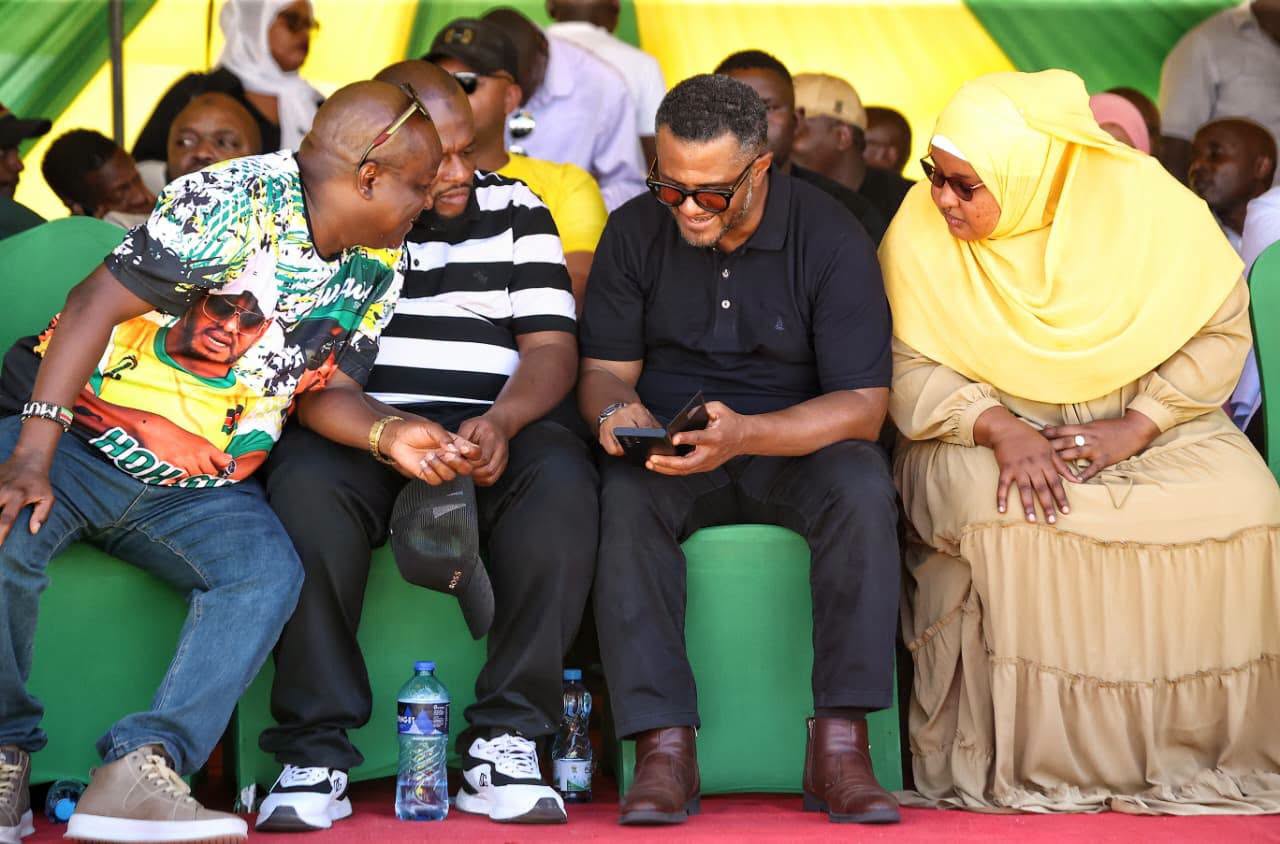
![Muhuri’s Francis Auma [R] and Fatima Jeilan [pink buibui], mother of Musa Awes, 23 [in poster] who was taken on April 19 in Barsheba, Mombasa by unknown people, never to be seen again, address the press on July 29 / BRIAN OTIENO](https://cdn.radioafrica.digital/image/2026/08/dae6b716-2043-4494-89b6-b38dafab3e6a.webp)