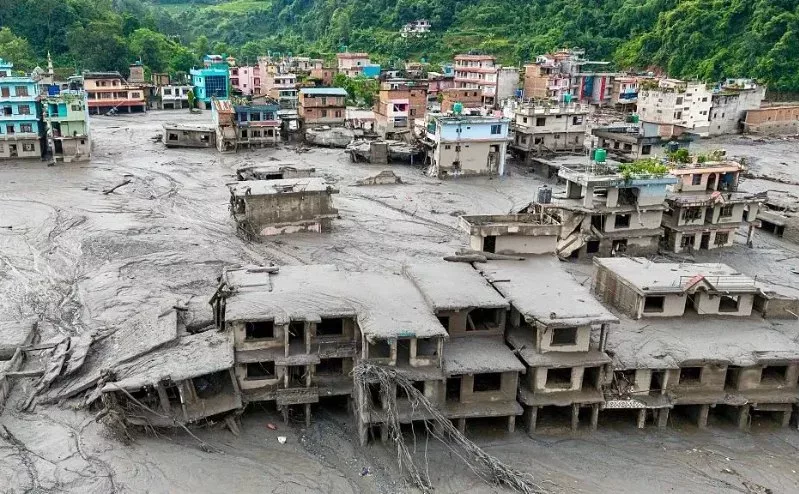
Just a normal day it was for them, and suddenly, the entire neighborhood was engulfed in raging ‘mountains’ of flash floods that left a trail of hundreds killed, many maimed and thousands unaccounted for. The sheer scale of destruction – ranging from bridges, roads, buildings, including personal property is beyond comprehension.
Watching the incident’s satellite imagery leaves one cringing, as desperate residents, including the young, old and visiting tourists scramble for survival. Encountering this scene for the first time could convince one it was a work of creative art recreating an Armageddon. Yet it was nature’s reality at work.
Nature’s fury defies comprehension, even with the best of plans. It’s what is aptly called in engineering project management as Murphy’s Law. This law explains that some contingencies may not be easily foreseen and mitigated against, even with the of best of prior planning. Anything that will go wrong, will go wrong and when it does go wrong, it’s usually at the least expected time for meaningful counteraction!
Yet as humans, though hapless oftentimes, we are nonetheless not that helpless to this law. Planning we must plan, and two, we have the ability to proactively forestall emergencies within our scope of understanding, and then endeavour to work at mustering the power of resilience, hence swiftly bounce back to near normality after any disruption.
Whatever the cause of such untold calamity, there is always science to aid us through early detection. This is a science as much as an art of understanding our immediate environment and remaining conscious of any possible threats that we must work with closely. As said, the devil is always in the detail, and the environment carries all the tell-tale signs that may warn us of impending risks if we scanned well enough.
Therefore, as we condole with Nepal over the sad loss, we also ought to think hard about home, in the unlikely event such misfortune visits. First is, is there an early warning of an impending risk? And if yes, what are our mitigations as a country, and further, at individual levels?
Such an assessment is important now than ever, given the early warnings we have and continue to receive from our national authorities regarding a confirmed El Niño phenomenon. The Met, Ministry of Interior, Kenya Red Cross, including the Kenya Coast Guard Service (KCGS) and other state and non-state actors are on record sounding warnings of an imminent inclement weather conditions that are assessed to affect the world in one way or the other, Kenya inclusive. And for Kenya - specifically- disruptive rains are expected in the very near future.
As a government, various interventions are under planning consideration. Multiagency strategy engagements between humanitarian partners are in session – ranging from government (national and devolved), civil and NGOs, bilateral partners, including the general publics. This is so since humanitarian efforts are collaborative and multidisciplinary in nature, and no one single agency, or authority for that matter can go at it alone.
For littoral and lake communities, including those in riparian and low lying riverine communities, KCGScontinues to engage through respective beach management units and community leaders through an elaborate community engagement programme and safety training for fisherfolk. Through these two novel community engagement forums, fishermen and women plying their daily hustle deep in the waters, and who are first-line victims of inclement weather, are trained on their critical safety and survival measures and tips, including after-the-fact resilience of rebounding back to normal routines.
Noting above interventions, only so much can be done to contain nature’s fury. But leveraging knowledge coupled with a shared responsibility at safety offers a reasonable level of assurance for us, and a hope at both our collective and personal safety and survival.
But one irreducible minimum is getting out of harm’s way. You don’t negotiate with nature’s fury. For those living in at risk low-lying marshlands, an early shift to higher grounds might be the only solution.
KCGStherefore shall continue working with fisher communities and all those at risk, and further calls for personal responsibility during the impending El Niño inclement weather.
For emergency service, we can be reached on our hotline 0707 430 108; 0721353008. For fisherfolk only, they are encouraged to continue registering (those who are yet to) and remain connected on our mobile telephony reporting tool namely ‘Usalama Baharini’ (Safety at Sea).
The writer is the director-general of KCGS