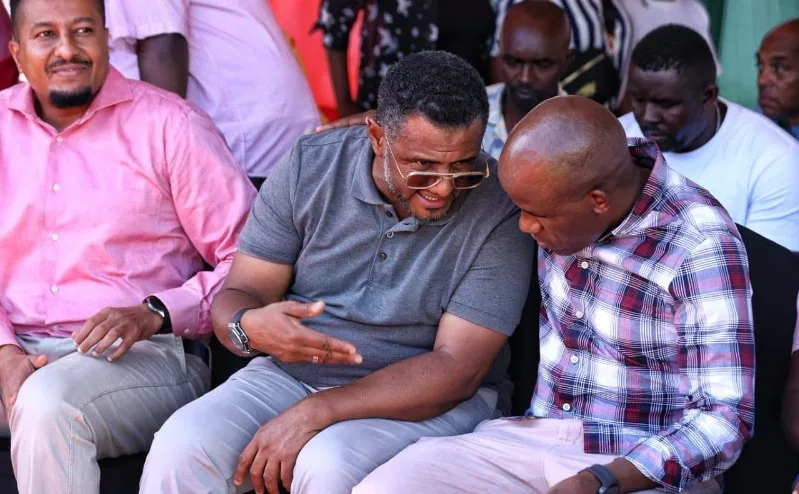
 Transport PS Mohamed Daghar, UDA Secretary General Hassan Omar and Mombasa ACC Joshua Muthoka at Burhaniya ground on Wednesday / BRIAN OTIENO
Read Also
Coast leaders have defended IEBC vice-chair Fahima Abdalla, a Lamu-born official, following criticism of her by former Deputy President Rigathi Gachagua.
UDA Secretary General Hassan Omar and Mining Cabinet Secretary Hassan Joho, speaking separately on Wednesday, criticised Gachagua over his remarks about Fahima and warned against statements they said could put her at risk.
Gachagua has questioned Fahima’s role in the electoral process and suggested the government could use her to influence the procurement of election technology for the 2027 General Election.
Speaking at Burhaniya Grounds, Omar said he had been following Gachagua’s criticism of various leaders but believed his remarks about Fahima had gone too far.
“We have been watching Gachagua attack everyone, and now he has trained his guns on our lady Fahima from Lamu,” Omar said.
Omar said leaders would hold Gachagua responsible should anything happen to the IEBC vice chair, although he did not provide evidence of any specific threat against her.
“Organise yourself, bro. Do not shout that elections will be rigged. It is not right that a 32-year-old is always on your mouth,” Omar said.
He accused Gachagua of targeting leaders from minority communities, citing Fahima and IEBC chairperson Erastus Ethekon, who is from the Turkana community.
Omar said political criticism should not be directed at individuals on the basis of their community backgrounds.
Joho separately dismissed suggestions of a plan to use Fahima or other government officials to manipulate the 2027 elections.
Gachagua had previously suggested that Joho was among senior government officials allegedly involved in a plan to influence the election in favour of President William Ruto.
Speaking during a visit to Lamu county on Wednesday, Joho dismissed the claims as baseless and accused the former deputy president of targeting senior government officials from the Coast.
Joho defended Fahima’s appointment, describing her as a person of integrity and saying her professional record was among the reasons she was appointed.
“He does not believe there is a young, poor and marginalised woman from Lamu who has become the IEBC vice chair. He does not believe,” Joho said.
“It is this backward mentality — that because she is from a minority community, you can target them, abuse them, misuse them and malign their name — that is disturbing him. It can never happen,” he added.
The former Mombasa governor also rejected claims of an election-rigging plan, saying the political focus at the Coast was instead on voter registration and mobilisation.
He said Gachagua would continue making what he described as reckless statements for political gain, while Coast residents registered as voters in large numbers.
Omar has been leading a voter registration mobilisation drive at the Coast, with the stated aim of increasing voter numbers in the region ahead of the 2027 General Election.
He said the government had improved the process of obtaining national identity cards, allowing coastal residents to receive the documents more quickly.
Omar said people facing difficulties in obtaining their IDs should report the matter to the authorities.
The former Mombasa senator said the Coast had an opportunity to increase its political influence through higher voter registration and voter turnout.
He urged residents to vote for Ruto in 2027, arguing that doing so would strengthen the region’s political bargaining power ahead of future elections.
“That is our weapon,” Omar said, referring to the voter’s card.
He said the Coast should seek to increase voter turnout and guard against what he described as a return to previous periods of marginalisation.
Omar argued that the Ruto administration had done more to address the region’s development concerns than previous governments.
He said the Coast had historically been disadvantaged in development and resource allocation and urged residents to use their votes to influence government priorities.
“If we do not vote, the danger of the region going back to being marginalised is greater than ever. Let us stop that from happening. That is why we need to vote in our numbers,” Omar said.
INSTANT ANALYSIS
The 32-year-old Fahima Abdalla is the youngest-ever IEBC vice-chair. Born in 1992 into a family from the Swahili Bajuni community, a group historically underrepresented in national leadership, Abdalla overcame deep-rooted cultural norms that often discouraged girls’ education and empowerment.