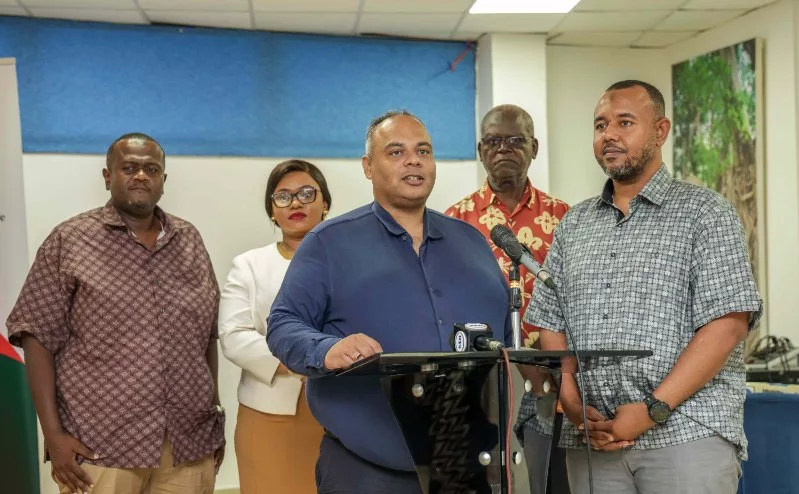
 KMA assistant director of port and shipping services Juma Ahmed [L], Mauritian maritime expert Rhavy Nursimulu [C] and KNCCI Mombasa chair Aboud Jamal [R] at Sapphire hotel in Mombasa on Tuesday / BRIAN OTIENO
Mombasa has exploited only about half of its potential in the maritime sector and must now move beyond transit trade to unlock the wider opportunities offered by the blue economy, a foreign maritime expert has said.
Mauritian maritime expert Rhavy Nursimulu, a logistician and founder, CEO and chief architect of Logi-Consult, said Mombasa had significant untapped potential that could transform the city into a major maritime and trade hub.
Nursimulu said stakeholders should focus on creating more value through the blue economy and its entire value chain.
“We should also look at how we can turn Mombasa into a maritime and trade learning centre, as well as bringing more people to do business. But beyond that, to also have conferences and all that goes with it,” he said.
He spoke during a breakfast meeting for the business community in Mombasa on Tuesday.
The meeting was hosted by the Kenya National Chamber of Commerce and Industry (KNCCI) Mombasa chapter.
Its chair, Aboud Jamal, said Mombasa remained the most critical port city in East and Central Africa and served as a gateway to the region.
“We are trying to see how we can re-imagine Mombasa, basically on the critical role it plays on the Northern Corridor serving the Great Lakes countries of East Africa,” Jamal said.
He said the business community was looking at Mombasa in terms of policy, capital movement and ways of positioning investors, entrepreneurs, manufacturers and logisticians to take advantage of capacity building and capital injection.
The aim, he said, was to enable businesses to compete not only regionally but also globally.
The meeting, attended by Mombasa MCAs and officers from public agencies, including the Kenya Maritime Authority, discussed unexploited opportunities in the county’s maritime and blue economy sectors.
Jamal said Mombasa had the potential to offer efficient logistics services and products that fit the global market.
Bamburi MCA Patrick Mbelle said Mombasa’s young people needed to be involved in creating better industries around the port.
“We are not just looking at improving the efficiency of the port but also the creation of better industries around the port through capacity building and skills up-scaling,” Mbelle said.
He said the first and most critical step was ensuring that young people, who often complain about a lack of employment opportunities, understood the blue economy sector, which remains largely untapped.
“We have youth complaining they do not have jobs yet they live around the Indian Ocean, which offers great opportunities. I don’t blame them,” Mbelle said.
“The blue economy is a relative novelty to them and they must first understand it before realising the potential it has.”
He called for more training sessions and sensitisation campaigns to help young people understand the opportunities available in the blue economy.
Kenya Maritime Authority assistant director of port and shipping services Juma Ahmed said the Port of Mombasa had recorded growth of almost 12.5 per cent over the past five years, with the number of ships docking and the volume of tonnage increasing significantly.
The growth, Ahmed said, presented more opportunities for investment but also required Mombasa to be ready to embrace changes, particularly in the maritime sector.
“We need to be able to capitalise on the growth of volumes of trade coming through the Mombasa port,” he said.
Ahmed said sectors such as ship construction, ship repairs, ship-handling services, bunkering, youth employment and logistics should drive improvements in Mombasa’s local economy.
He said the benefits of the port’s growth should be maximised by bringing all stakeholders on board.
“This is a start of so many conversations,” Ahmed said.