
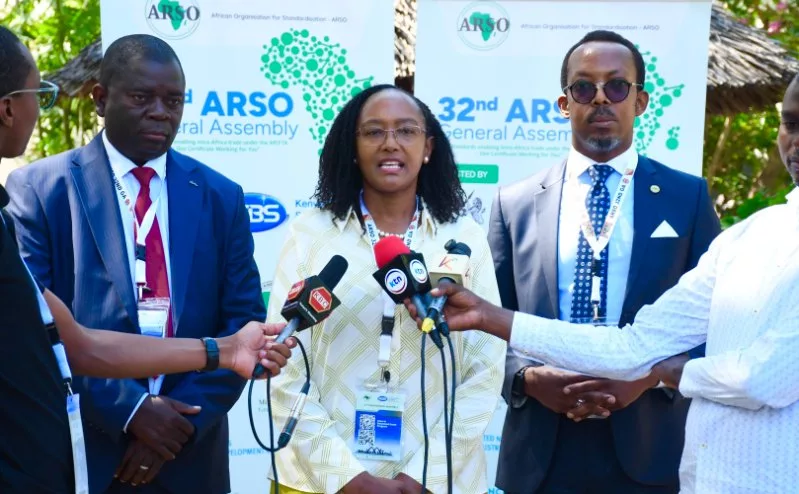
African countries have been urged to adopt a common system of product standards and certification.
The move would help remove costly trade barriers, reduce repeated testing and unlock the full potential of the African Continental Free Trade Area (AfCFTA).
The call dominated the opening of the 32nd African Organisation for Standardisation (Arso) General Assembly in Mombasa, which has brought together representatives from more than 40 African countries to discuss harmonised standards across the continent.
Leaders at the four-day meeting said Africa could not fully benefit from AfCFTA if products continued to undergo repeated testing and certification whenever they crossed national borders.
AfCFTA is the world’s largest free trade area by participating countries, bringing together 55 African Union member states into a market of about 1.4 billion people, with a combined GDP of about $3.4 trillion.
Hosted by the Kenya Bureau of Standards (Kebs), the assembly is being held under the theme “Standards Enabling Intra-Africa Trade under AfCFTA – One Certificate Working for You.”
Kebs managing director Esther Ngari said Africa must move away from fragmented national standards towards a harmonised certification system where one product certificate is recognised across the continent.
She said the goal was to test and certify a product once and allow it to move across African borders without fresh testing in every country.
“As Africa, we cannot be disjointed. We need harmonised standards so that once a certificate is issued in one country, products can cross borders without having to be retested again,” Ngari said.
She said despite Africa’s huge market potential, intra-African trade remained at about 16 per cent, significantly lower than trade levels in regions such as Europe and Asia.
Ngari said harmonised standards would help drive AfCFTA by reducing technical barriers that make cross-border trade expensive and time-consuming.
Kenya, she said, had already benefited from harmonised standards within the East African Community (EAC), but AfCFTA offered access to a much larger continental market.
“We have done extremely well within the EAC as a trading bloc, but AfCFTA gives us access to a much bigger African market,” she said.
Arso secretary general Hermogene Nsengimana said tariff reductions alone would not deliver AfCFTA’s promise unless African countries also harmonised technical standards governing goods and services.
He said only 28 per cent of tariff lines under AfCFTA were currently covered by harmonised African standards, leaving 72 per cent yet to be aligned.
“Our vision is one standard, one test, one certificate accepted everywhere in Africa,” Nsengimana said.
He said common standards would eliminate non-tariff barriers that often prevent African products from entering neighbouring markets even after tariffs have been removed.
“If standards are not implemented, then harmonisation alone is meaningless,” he said.
Nsengimana said Arso was now shifting its focus from developing standards to ensuring member states implemented them through stronger quality infrastructure, including laboratories, testing centres and certification bodies.
A major highlight of the assembly is the launch of the Africa Quality Mark, also known as the Arso Dual Mark. The continental certification is designed to authenticate products that comply with harmonised African standards.
Nsengimana said the quality mark had already been rolled out in nine African countries, with 10 more preparing to join, bringing the total to 19 countries in the initial implementation phase.
The official launch of the certification is expected during the assembly in Mombasa.
He said the Africa Quality Mark would help consumers identify products that meet continental quality requirements while giving manufacturers easier access to several African markets.
The certification is also expected to strengthen consumer confidence in African-made goods.
Arso Champions chairperson and executive director of the Zambia Bureau of Standards Nathan Sing’ambwa urged African countries that are not yet Arso members to join the organisation.
He said universal adoption of Arso standards was essential if AfCFTA was to function as an integrated market.
“We want one certificate working for all. That can only happen if all countries become members of Arso and participate in developing and adopting common standards,” Sing’ambwa said.
He said Arso champions were encouraging governments to participate in technical committees responsible for developing continental standards.
Once countries adopt the standards into national regulations, products certified in one country can be accepted in another without unnecessary technical barriers.
“If a product is manufactured in Zambia and exported to Kenya, both countries must use the same standard. That removes technical barriers to trade,” he said.
Sing’ambwa also challenged manufacturers, particularly small and medium enterprises, to embrace certification as a business opportunity rather than a regulatory burden.
He said standards improve product quality, competitiveness and market access.
“Standards are not adding costs to business; they are adding value to products,” he said.
Products that meet recognised standards, he added, are more likely to be accepted by supermarkets, exporters and international buyers.
“You cannot trade without standards. Whether you want to export or supply chain stores locally, buyers first want to know whether your product complies with recognised standards,” he said.