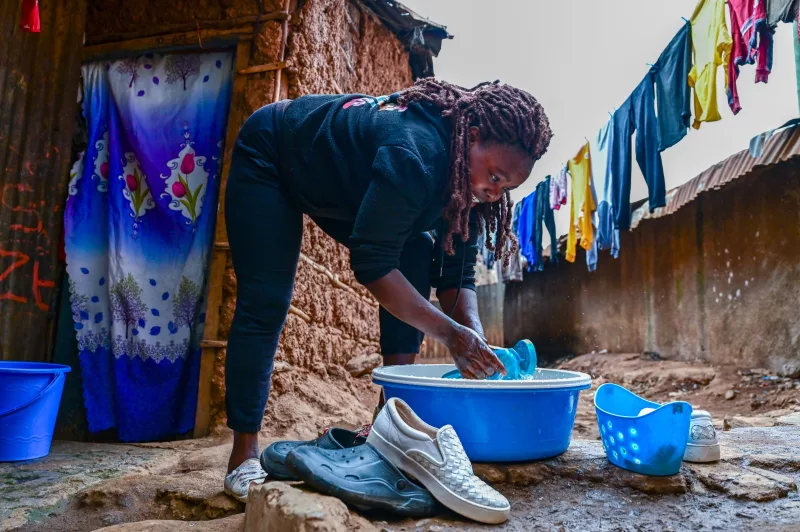
 Maurine Nelima, a resident of Kibera./HANDOUT
For Rosemary Akinyi, water was once an expensive necessity that ate into the modest earnings from her fish business.
The fish trader, who lives and works in Makina, Kibera, would walk about four kilometres in search of water. When she found it, she would pay Sh200 for 200 litres and another Sh100 to transport home. Sh300 in all, and the water's safety was not guaranteed.
Water and gender is on the agenda at World Water Week in Stockholm this week, where the 2026 theme is 'Water for People and Progress.
Today, Akinyi no longer has to make the long journey.
She gets the same quantity of water from a Shining Hope for Communities (Shofco) water kiosk located close to her home and business, paying just Sh30 for 200 litres and spending nothing on transportation.
“I am able to save the money I used to spend on buying and transporting water. Shofco water is also clean. We don’t boil it before we drink, as we used to do with the water we bought from other vendors,” Akinyi says.
She now puts some of the savings into her chama (merry-go-round), uses it to support her children’s education and buys food for her family.
In Kibera, the burden of lack of water has historically fallen heavily on women and girls.
Dr Kennedy Odede, Shofco founder and chief executive, knows this reality from personal experience. Having grown up in Gatwekera, Kibera, he recalls a time when water was a daily struggle.
“I saw women walk for a distance of 14 kilometres round trip from my village in Gatwekera to Kenya Science in search of water. This took away hours every day that could have been spent working, running businesses, caring for their families or participating in community development,” he says.
Maurine Nelima, another Kibera resident, used to walk about five kilometres looking for water. Sometimes, after spending hours searching, she would still return without enough water for her household.
“It was difficult in the mornings because my children needed water to wash, eat and prepare for school, and there were days when they missed school altogether. Having a water kiosk nearby has changed our lives,” she says.
Odede says the connection between water, sanitation and girls’ education is one of the reasons why Shofco's water, sanitation and hygiene (WASH) work has been built around schools as much as households.
“When water was not available, girls were often asked to help find it. That meant missing school or arriving late,” he says.
Shofco has connected water to 45 schools in Kibera and constructed ablution blocks.
The organisation is also looking to expand access to sanitation facilities to more than 120,000 pupils in 60 public primary schools in informal settlements in Nairobi, Kisumu and Mombasa counties in the next three years.
Odede says his organisation is using overhead water piping rather than underground, where trenching through dense settlements is slow, expensive, and prone to tampering.
Fifty four Shofco water kiosks now operate around the clock in Kibera, serving about 60,000 people a day. The kiosks are digitalised using token-based payment systems linked to mobile money that allows residents to purchase water.
According to Odede, families can access water at the kiosks at Sh3 for a 20-litre jerrycan, compared with paying as much as Sh20 from private vendors, allowing households to redirect some of the savings towards food, education or income-generating activities.
Angela Ngetich, Shofco's programmes director , says the organisation’s water services extend beyond households to hospitals and local businesses.
She says this is particularly important in Kibera, where many informal businesses are owned and operated by women.
“Water is an essential input for businesses, especially those run by women. When water is reliable and affordable, women spend less time looking for it and more time running their businesses, earning income and supporting their families,” Ngetich says.