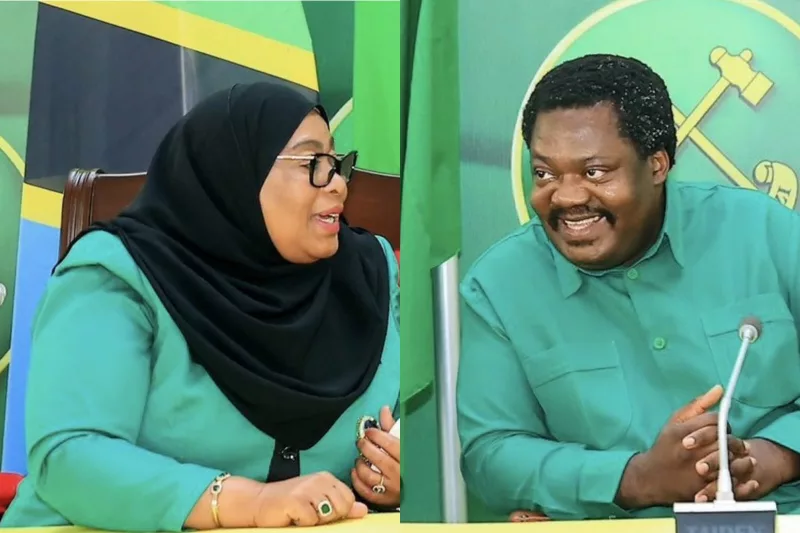
 President Samia Suluhu Hassan and Vice President Emmanuel Nchimbi who has announced he will leave office on September 4, 2026.
Tanzania's Vice President Emmanuel Nchimbi's resignation has brought renewed scrutiny to public remarks in which he and President Samia Suluhu Hassan appeared to take sharply different positions on constitutional reform, activism and the country's political direction.
Nchimbi announced on August 25 that he would retire from politics and public service effective September 4.
He said the decision fulfilled a pledge he made to President Suluhu in August 2025 to step aside if he ever felt she needed a different vice president.
“I am fully convinced, without doubt, that Her Excellency the President desires change, and so I have decided to fulfil my promise,” Nchimbi said.
He thanked Suluhu and the ruling Chama Cha Mapinduzi (CCM) for their confidence in him, without explaining what had led him to conclude that the President wanted a change at the vice presidency.
But remarks made by the two leaders in recent months provide a striking backdrop to his departure.
Nchimbi's resignation came less than a year after he was sworn in as Vice President on November 3, 2025, following his selection as Suluhu's running mate for the October 2025 general election.
Before taking office, he had assured Suluhu that he would work as her deputy rather than as a political rival.
On August 27, 2025, he promised to assist the President and Tanzania “to the best of my ability and with loyalty”, adding that he would leave office if she ever decided she needed another vice president.
That assurance has acquired fresh significance following his resignation.
Nchimbi's decision came as a surprise to many outside Tanzania, but his public pronouncements during his brief tenure had increasingly been at the centre of debates within the country over his political future.
The clearest divergence emerged on constitutional reform. Speaking at a forum in Dar es Salaam on July 24, Nchimbi urged Tanzanians to agitate for a new constitution, arguing that the change was essential to the country's future.
His remarks were particularly notable because he addressed activists and human rights defenders directly.
“Fight to get a new constitution,” Nchimbi told the gathering. He argued that Tanzania had a major opportunity to achieve constitutional reform before 2030.
In his view, the existing constitutional framework gives the presidency too much authority.
He said the work of bringing change and development to the country would be greater than anyone would imagine.
“Citizens want a new constitution. The current constitution is something a selfish president would want only because it gives them meaningless powers,” Nchimbi said.
Nchimbi also framed constitutional reform as an issue extending beyond the immediate political generation.
“I tell CCM members that a new constitution is for the benefit of our children, our grandchildren and future generations,” he said.
He extended the appeal to civil society organisations and human rights defenders, repeating that a new constitution would serve future generations.
His vision also went beyond constitutional change. Nchimbi said he wanted a Tanzania where citizens could disagree over political ideologies, political parties, religion and ethnicity while retaining a shared national identity.
“I wish for a country where we may differ in ideology and differ on political parties, religion and tribes but recognise our Tanzanian identity,” he said.
He also expressed a sympathetic view of activists, acknowledging the work they do in the spirit of nation building.
“I wish that whenever I meet any activist, I would recognise them for their ability to think and persuade,” Nchimbi said.
The most striking part of his address was his suggestion that he wished he could encourage Tanzanians to push for constitutional change without even letting the President hear him.
“If I had a way of telling Tanzanians this secretly, without even the President hearing it, I would do so. I would tell them: ‘The President wants it, push for it,’” he said.
The remarks appeared to place Nchimbi firmly on the side of those demanding constitutional reform, while also suggesting that he believed Suluhu herself wanted such change.
Suluhu pushes back.
At a separate forum, however, Suluhu appeared to challenge the assumptions underpinning calls for a new constitution.
Responding to arguments that Tanzania needed constitutional change, the President questioned what exactly critics wanted changed.
“Today they say they have taken to the streets, destroyed the country and are demanding a constitution. Where is the constitution? Where is it hanging so that we can take it down and give it to them?” she asked.
Suluhu rejected the suggestion that development depended simply on producing a new constitutional document.
“Who said development is brought about by a book that has been written, brought here and put down?” she asked.
She also questioned whether many of those demanding a new constitution understood the provisions they wanted changed.
“Go and ask them which clause in the constitution is troubling you. They don't know,” she said.
Suluhu argued that Tanzania's immediate task was to ensure citizens understood the existing constitution before demanding a replacement.
“Our biggest task first is to make Tanzanians understand what that constitution is and what this book called the constitution is like,” she said.
She illustrated her argument by saying that some people in rural areas could confuse a CCM manifesto with the country's constitution because they did not understand either document.
Suluhu also avoided committing herself to delivering a new constitution before the end of her presidency.
In a separate interview with BBC Swahili, she was asked whether she could assure Tanzanians that a new constitution would be in place before she leaves office.
“Why do you want me to guarantee that?” she responded.
The interviewer, Salim Kikeke, pointed out that Tanzanians were demanding a new constitution.
“Then leave that to me and Tanzanians. I and Tanzanians will reach an understanding,” Suluhu replied.
Her response contrasted with Nchimbi's more direct appeal for citizens to push for constitutional reform.
Divergence over activists
The difference was not confined to constitutional reform. Suluhu also issued a warning against people who describe themselves as activists but whom she accused of engaging in conduct amounting to terrorism.
“I want to use this opportunity to warn all those who call themselves activists in order to be recognised around the world, but in reality their actions are terrorist in nature,” she said.
The President's remarks came as she defended the need to protect peace and security, while Nchimbi had used his July address to express admiration for activists' capacity to think and persuade.
The two positions do not necessarily amount to a direct personal confrontation, as neither leader publicly accused the other of wrongdoing.
Nchimbi's resignation statement did not also cite constitutional reform, activism or disagreement with the President as the reason for his departure.
But taken together, the remarks reveal a striking divergence in ideologies between the two leaders during the short period they served together.
Nchimbi is the third Vice President to serve under Suluhu since she became President in March 2021.
His departure comes only 295 days after he took office. His resignation was unexpected publicly, but reports of tensions within the country's top leadership had emerged before the announcement.
One Tanzanian publication reported that Nchimbi had faced pressure within CCM following his July constitutional-reform remarks, while other reports linked the dispute to broader questions about his political ambitions.
Those reports remain allegations and have not been confirmed by Nchimbi or the presidency. What is established is that Nchimbi has chosen to leave office and retire from active politics, while framing his departure as the fulfilment of a promise to Suluhu.
What remains unanswered is what led him to conclude that the president wanted a different deputy.
However, his own public remarks, and Suluhu's responses to some of the same political questions, now provide an important window into the ideological differences that preceded his exit.