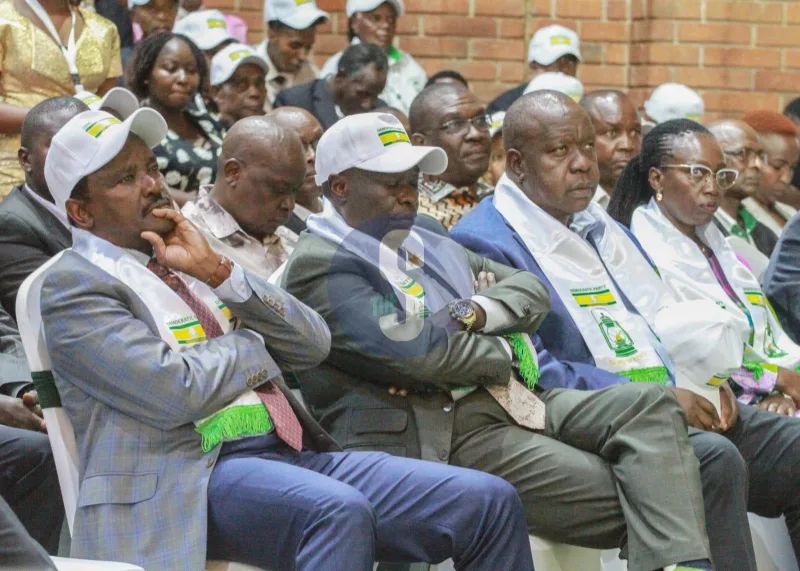
 Opposition leaders in past function/FILE
The opposition has intensified pressure on the Independent Electoral and Boundaries Commission, demanding greater transparency and reforms ahead of the 2027 general election.
The opposition chiefs have in recent weeks raised concerns over the preparedness and independence of the electoral agency at a time the commission is undertaking one of the critical procurements of key 2027 election infrastructure.
The team, led by Democracy for Citizens Party leader Rigathi Gachagua and Wiper Patriotic Front’s Kalonzo Musyoka, have singled out the ongoing tendering of Kiems kits, warning that unresolved questions could undermine confidence in the outcome.
The commission last week floated an international tender for an Integrated Elections Management System, crucial biometric voter identification and results transmission.
The poll agency also invited tenders for ballot papers, tactile ballot folders for voters with visual impairment, the register of voters and statutory result-declaration forms.
The process has however been halted after a request for review lodged at the Public Procurement Administrative Review Board.
Even before the process is concluded, the opposition has expressed strong opposition to the involvement of the 2022 vendor, Smartmatic, demanding greater disclosure on the technology to be used in next year’s polls.
According to Kalonzo, the team will resist any attempts to sneak in the former vendor or any of its agents into the 2027 election management.
“We are closely monitoring the procurement of election technology ahead of next year’s general election,” the Wiper chief said.
“We will oppose any attempt by the IEBC to bring Smartmatic, or any successor, proxy or vendor operating through opaque arrangements, back into Kenya.”
“Kenya deserves transparent procurement, independently verifiable systems and full public accountability.”
The company supplied technology used in voter identification and other election processes during the 2022 polls.
The contract award was challenged before procurement review bodies and the courts, but the award was ultimately upheld.
Weighing in on the matter, Democratic Party leader Justin Muturi has sounded an alarm that the ongoing tender could repeat the mistakes of 2022.
The former Attorney General and House Speaker argues that the advertised tender is a dangerous step backwards, warning that Kenya appears to be repeating the very mistakes that became a major point of contention during the 2022 presidential election petition.
In 2022, when the Supreme Court ordered scrutiny of the election servers, Smartmatic, the technology provider, objected to full disclosure of forensic server images, stating that they contained its copyrighted software and that giving third parties access would violate its intellectual-property rights.
“It is therefore deeply contradictory for IEBC to advertise a fresh technology tender without first closing the very loophole exposed in 2022,” Muturi said.
“If the tender allows a vendor to retain intellectual-property rights without an equally explicit and enforceable obligation to provide lawful access to logs, servers, audit trails and other technical evidence, Kenya risks arriving at the next election with the same fundamental vulnerability.”
Security during elections has also emerged as a major concern, with Gachagua challenging the IEBC chairman Erastus Ethekon to spell out its preparedness to conduct the 2027 general election.
Their concerns are particularly significant given the political tensions that have accompanied recent by-elections and political campaigns.
"What Ethekon must tell us is the level of preparedness. We are asking him now to sit with everybody, including the opposition, and take us through the process and explain to us the level of preparedness, so that we can interrogate the preparedness and make suggestions," he said.
“No citizen should be denied the right to campaign, assemble or vote because armed militia have been unleashed upon them. No citizen should lose their lives, limbs, liberty or property,” People’s Liberation Party leader Martha Karua said.
Karua, who read joint opposition statement last week, cited reported attacks involving Gachagua in Rongai constituency, Nakuru county, an incident involving former Cabinet Secretary Fred Matiang’i at Mulot in Bomet county, as well as violence surrounding Linda Mwananchi activities in Homa Bay and Keumbu in Kisii county.
The opposition's scrutiny of IEBC comes against the backdrop of Kenya's difficult electoral history.
The 2022 presidential election exposed deep divisions within the electoral commission, with four commissioners publicly distancing themselves from the final results announced by then-chairman Wafula Chebukati.
Public trust is particularly critical in a closely fought election when the margin between candidates is narrow, losing sides are more likely to scrutinise every stage of the process—from voter registration and nominations to polling, tallying and declaration of results.
Confidence in the referee can determine whether disputes are resolved through established legal mechanisms or spill into political confrontation.
In a move to allay opposition’s fears, the commission has assured that it will do everything to ensure that the next year’s polls run smoothly even as it call on political players to embrace peaceful campaigns.
In a statement, IEBC chairman said his team is committed to free, fair and transparent elections where each player is given level playing field.
“As we approach the general election, the commission urges all political actors, candidates and their supporters to exercise restraint and ensure that political competition remains firmly within the bounds of the law,” Ethekon said in a statement.
“Differences in political opinion are a legitimate and necessary feature of democracy. Let us choose peace over violence, unity over division and issues over personalities. Let us resist the temptation to spread misinformation, incite hatred or demonise those with whom we disagree.”
“Kenya has demonstrated its capacity to conduct competitive elections while preserving its democratic institutions, and the 2027 general election must provide yet another opportunity to demonstrate the maturity and resilience of our democracy.”
On the procurement of technology, Ethekon confirmed the process has been halted after a request for review was lodged at the Public Procurement Administrative Review Board.
“The commission, with the provision of the general election budget in the current financial year 2026-2027, is in the process of procuring general election materials.
“Currently, the procurement process of election technology and ballot papers has been temporarily halted following a notification of a request for review filed at the Public Procurement Administrative Review Board,” Ethekon said.
He, however, assured that the procurement of several other strategic and non-strategic materials is on course and expected to be concluded in good time for the general election.
INSTANT ANALYSIS
With the 2027 contest expected to be highly competitive, the credibility of the referee could prove almost as important as the strength of the contestants. The IEBC will therefore have to convince Kenyans—not merely political parties—that it is independent, transparent and capable of conducting an election whose outcome can command broad acceptance.