For the past 12 years, Boni Forest in the Kenyan coastal town of Lamu and sits along the Kenya-Somalia border, has been known as a hideout for the feared Al-Shabab militants.
According to Kenyan security officials, the dense, expansive canopy of the indigenous coastal forest has favoured extremists as their hidden training camp.
The extremists have used the forest to evade aerial surveillance, as well as to launch guerrilla attacks and incursions into the region that stretches to Garissa in north-eastern Kenya.
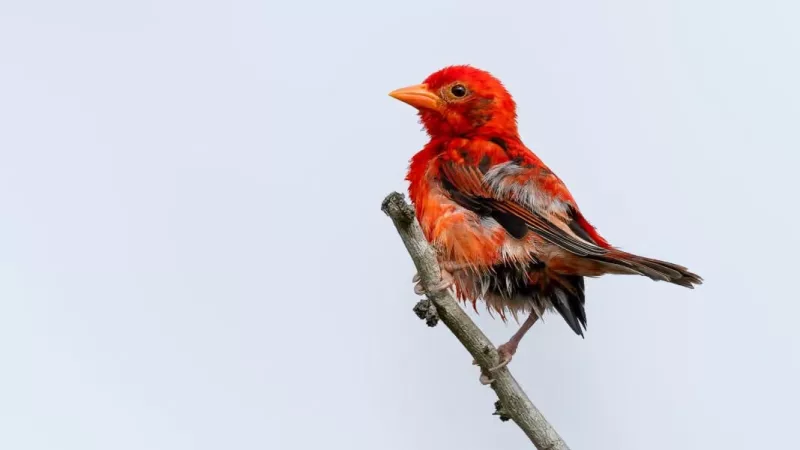
But unknown to Kenyan security forces, the forest has also played host to the Red Weaver bird that has been considered by scientists to have gotten lost.
Dr Paul Gacheru, species and sites manager at Nature Kenya, says that the bird species, which has a restricted range, found only in southern Somalia and parts of north-eastern Kenya, was last documented in Kenya in 2014 when they did the Boni Dodori bird checklist.
“One of the challenges we faced while doing conservation initiatives in the Boni forest landscape has been hindered by insecurity issues plaguing the region, which have also limited persons visiting the site,” Dr Gacheru says in an interview.
He observes that the high security risk has made it difficult for bird enthusiasts to visit the forest to monitor the birds, leading to the time lapse.
Dr Gacheru notes that one of the key outcomes of that initiative was the recognition of Boni Dodori National Reserve as an important key bird biodiversity area, though they were unable to enter the forest due to security restrictions put in place by the government at the time.
But consistency by Kenyan birders to help locate the lost Red Weaver birds that were somehow being abandoned has finally led to the rediscovery after being cited in the same forest.
“Lost birds are birds that are close to extinction. They are lost because of extremely small population sizes or, tragically, because they can no longer be found,” Dr Gacheru notes.
Gacheru adds that some birds are extremely difficult to find, while others live in remote areas that are rarely visited, such as the case of Boni forest, by researchers and birdwatchers, hence resulting in very few detections.
He reveals that a lost species is one not confirmed alive by photographic, audio or genetic information for over 10 years in the wild and has no ex-situ population under human care.
Two Kenyan birders, James Omenya and Simon Odhiambo sited the birds in early July during their sighting in the Boni-Dodori Forest.
The two assembled a team that blended scientific expertise, local knowledge, and logistical support.
They led the expedition alongside a bird photographer, environmentalists, tour guides and two motorcycle riders.
Odhiambo notes that the rediscovery of the red weaver bird was a thrilling experience after an 11-day field expedition in the wildlife-infested and security-cordoned forest.
“We were excited to make the rediscovery of the red weaver bird in Boni-Dodori Forest. This lost bird species, only found in this forest globally, was last sighted more than a decade ago,” Odhiambo notes.
The team involved the local administration, village elders, chiefs, and an armed escort that was partly provided by the Kenya Defense Forces (KDF) against the risk of militant activity.
For more than a century, taxonomists considered the bird a subspecies of the Red-headed weaver.
It was recognised as the red weaver as a distinct species in 2024, and by 2025 it had cycled onto the lost birds list.
According to records, the species had been photographed only once, in 2014, before the team ventured into the field and later made this milestone rediscovery.
The limited number of records is due in part to long-standing uncertainty about the weaver’s identity and the insecurity in the1,339 square kilometres of forest that has been led by the multi-agency security operation.