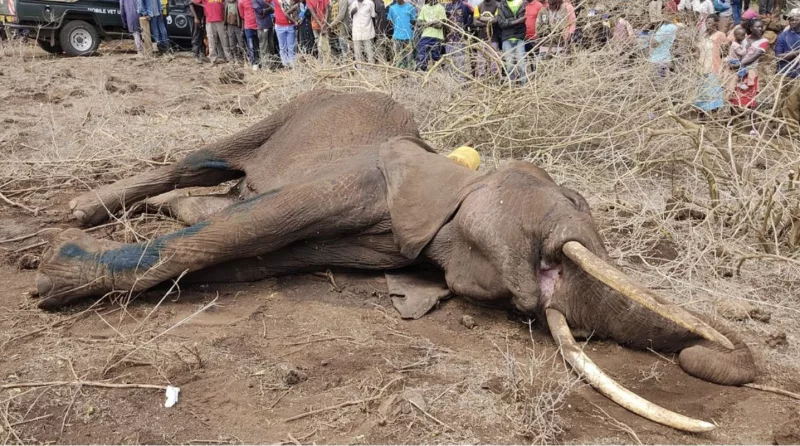
 An elephant carcass in Amboseli ecosystem. Preliminary tests conducted on the carcasses confirmed the presence of highly toxic cyanide/HANDOUT
Four suspects have been arrested over the deaths of 18 elephants in the Amboseli ecosystem, Tourism and Wildlife Cabinet Secretary Rebecca Miano has said.
Investigators also recovered farm chemicals that are being tested as part of the search for what killed the animals.
Miano said the suspects were arrested after a multi-agency investigation involving the Kenya Wildlife Service (KWS), security agencies, investigators and scientists.
The first 15 elephant deaths were recorded between June 24 and July 24, before the fatalities rose to 18. Investigators have been examining the animals, collecting samples and testing materials found around the area.
Miano said investigators believe the four unnamed suspects may have information that could help explain the deaths. She said another suspect is being sought.
“Preliminary laboratory results point to the probable involvement of a toxic substance, with earlier indications suggesting cyanide poisoning arising from the ingestion of pesticide-contaminated tomatoes sourced from farms adjacent to wildlife habitats," Miano said in a statement over the weekend.
She said the preliminary findings remain subject to further scientific verification before the investigation is concluded.
Cyanide is not a tomato-growing chemical but is mainly used in gold mining, some manufacturing processes such as making plastics and nylon, and tightly controlled fumigation and pest control.
So authorities are investigating whether a cyanide-containing substance was improperly used, stored or disposed of around farms, and whether it contaminated tomatoes or the surrounding environment.
Miano said a search in Tikondo and Kimana, in Loitoktok subcounty, led to the recovery of several substances. Some of the chemicals are believed to have come from a neighbouring country and were not properly labelled.
“These potentially toxic and unlabelled materials have been secured for further scientific analysis,” Miano said.
The chemicals will now be tested to find out what they contain and whether they are connected to the elephant deaths.
Cyanide poisoning stops the cells of a living animal from using oxygen properly and this can lead to death.
However, the cyanide theory in the Amboseli deaths is not yet proven.
Preliminary laboratory results pointed to the likely involvement of a poisonous substance. Earlier findings had suggested cyanide poisoning after the elephants were believed to have eaten tomatoes from farms near their habitat.
“Thus far, comprehensive field investigations, laboratory analysis and environmental sampling have been undertaken,” Miano said.
She said the findings still require more scientific checks before the investigation is completed.
The cyanide explanation has already been challenged by farmers living near Amboseli.
Those in Kimana have questioned whether cyanide could have caused the deaths, saying they do not normally use cyanide on their farms. They have also questioned why elephants would have been affected in large numbers while other herbivores in the same farming areas were not reported dead.
KWS veterinary officials have also said investigators were still trying to establish where the suspected cyanide came from. This means the presence of a toxic substance in samples does not by itself prove that contaminated farm produce killed the elephants.
Miano said the arrest of the four suspects does not mean they have been found guilty.
“Although the investigations remain active, the arrest of persons of interest and the recovery of exhibits do not in themselves establish criminal culpability. The government will allow the investigative and judicial processes to proceed to their lawful conclusion, and any person established to have unlawfully killed, poisoned or harmed wildlife will be prosecuted in accordance with the law.”
The deaths have raised concern because elephants in the Amboseli ecosystem regularly move between the national park, farms, private land and community areas.
Miano said this makes cooperation between government agencies and local communities important in protecting wildlife.
“The government will continue to deepen community engagement and participation in wildlife conservation and management while encouraging the public to volunteer information on wildlife crime through lawful channels. Wildlife represents a foundational anchor of Kenya's ecological, cultural and economic wellbeing,” she said.
For now, scientists are continuing to test samples while investigators follow the trail of the recovered chemicals.