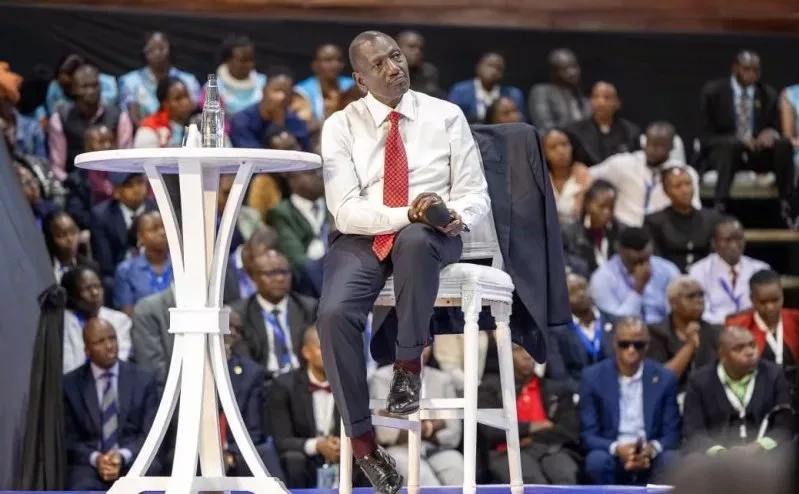
President William Ruto when he hosted a town hall meeting on the sidelines of the Kenya Health Summit at the Kenyatta International Convention Centre in Nairobi /PCS
At least 28 counties have emerged as the decisive battlegrounds that could determine the outcome of the 2027 general election.
An analysis of the 2022 voter register and current political alignments shows these counties remain largely up for grabs, unlike regions locked under the firm control of major political figures.
They are Kisumu, Homa Bay, Siaya, Migori, Mombasa, Kilifi, Kisii, Kwale, Lamu, Taita Taveta, Tana River, Narok, Kajiado, Samburu, Marsabit, Isiolo, Garissa, Wajir and Mandera.
Others are Nairobi, Vihiga, Kakamega, Busia, Trans Nzoia, Bungoma, Meru, Embu and Tharaka Nithi.
Combined, they account for more than 12.42 million votes—slightly over half of the 22.10 million voters registered in 2022.
The Independent Electoral and Boundaries Commission projects the national register will grow to about 28.4 million by 2027.
While other regions sit firmly in the grip of bigwigs, these 28 counties lack a single dominant bigwig, though some figures are steadily making inroads.
President William Ruto remains solidly in charge of his Rift Valley backyard—Turkana, West Pokot, Nandi, Uasin Gishu, Elgeyo Marakwet, Kericho, Baringo and Bomet.
Democracy for Citizens Party leader Rigathi Gachagua controls the Mt Kenya West bastion of Kiambu, Nyeri, Kirinyaga, Laikipia, Nyandarua, Nakuru and Murang’a.
In Lower Eastern, Wiper leader Kalonzo Musyoka remains the undisputed kingpin of Machakos, Makueni and Kitui.
In the Gusii region, Jubilee deputy leader Fred Matiang’i appears firmly in charge of Kisii and Nyamira.
“Leaders are increasingly focusing on consolidating support in their strongholds before attempting to make inroads into rival territories,” political analyst Joseph Mutua said.
Yet political observer Charles Munyui argues the 2027 contest could upend traditional voting patterns.
“Balkanisation of the country may not work because of the Gen Z factor, which cannot be dismissed. Eight million people did not vote in the last election, and this could be their time,” Munyui said.
In Nyanza, 2.16 million voters are spread across Siaya (533,595), Kisumu (606,754), Homa Bay (551,071) and Migori (469,019).
Long controlled by former Prime Minister Raila Odinga, the region has become contested ground since his death.
The mainstream ODM, led by party leader Oburu Oginga, is fighting to retain influence against the Linda Mwananchi breakaway group headed by former ODM secretary-general Edwin Sifuna.
Oburu’s camp backs President Ruto’s reelection, while Linda Mwananchi has rejected the arrangement and is seeking to register a party to challenge him.
“Nyanza is an ODM base, and it is strongly behind President Ruto. Linda Mwananchi is a passing cloud. It will not have any influence in Nyanza,” Alego-Usonga MP Samuel Atandi said.
Latest opinion polls, however, show more than 70 per cent of ODM supporters lean towards the Linda Mwananchi group.
Western, with 2.67 million votes—Kakamega (844,551), Vihiga (310,043), Bungoma (646,598), Busia (416,756) and Trans Nzoia (398,981)—is also emerging as a key battleground after Raila’s death.
Sifuna’s rise has shifted significant ground towards Linda Mwananchi.
“Western is solidly behind Sifuna and Linda Mwananchi. Ruto has no votes in Western. Our people, just like other Kenyans, have decided it is wantam,” Vihiga Senator Godfrey Osotsi said.
Ruto is counting on National Assembly Speaker Moses Wetang’ula, Prime Cabinet Secretary Musalia Mudavadi and Cooperatives Cabinet Secretary Wycliffe Oparanya to hold the region.
The trio faces a serious challenge from Sifuna, who has inherited much of Raila’s influence.
“Our Luhya people are tired of being used. They have the numbers to form a government and will not play second fiddle again,” Trans Nzoia Governor George Natembeya said.
At the Coast, 2.01 million votes are scattered across Mombasa (641,913), Kwale (328,253), Kilifi (588,602), Tana River (191,096), Lamu (81,453) and Taita Taveta (181,827).
Ruto is seeking to capitalise on Raila’s historical popularity in the region while expanding his own footprint.
His efforts have been boosted by the appointment of former governors Hassan Joho, Salim Mvurya and Amason Kingi to senior government roles—Joho as Mining CS, Mvurya as Sports CS, and Kingi as Senate Speaker.
The three wield considerable clout and are expected to consolidate support for the President.
The opposition has countered by bringing on board former CS Aisha Jumwa and Nyali MP Mohamed Ali.
In Northeastern, 882,677 voters are registered in Garissa (201,473), Wajir (207,758), Mandera (217,030), Marsabit (166,912) and Isiolo (89,504).
Though a swing region, the President has courted it with high-profile appointments and development projects.
He recently promised to complete the more than 700-kilometre road from Isiolo to Mandera and scrapped the vetting requirement for identity cards for residents of the region.
No senior politician from the area has openly sided with the opposition.
Mt Kenya East—Meru, Tharaka Nithi and Embu—holds 1.33 million voters (Meru 772,139, Tharaka Nithi 231,932, Embu 334,302).
Gachagua is battling for control, but Deputy President Kithure Kindiki, who hails from the area, poses a direct challenge.
“Our unity is our strength. Let’s not allow anyone to divide us,” Gachagua said recently amid debate over splitting the region.
Ukambani’s three counties total 1.69 million voters and remain Kalonzo’s undisputed stronghold; he delivered the region overwhelmingly to Raila in the last three elections.
Nairobi alone accounts for 2.41 million voters, while Narok, Samburu and Kajiado together hold 962,071.
The Gusii region has 960,293 registered voters (Kisii 637,010, Nyamira 323,283), with Matiang’i emerging as the clear political supremo.
Gachagua’s Mt Kenya West base commands 4.43 million votes across Nakuru (1,054,856), Murang’a (620,929), Nyandarua (361,165), Laikipia (263,012), Kirinyaga (376,001), Nyeri (481,632) and Kiambu (1,275,008).
Ruto’s Rift Valley stronghold controls 2.29 million votes: Turkana (238,528), West Pokot (220,026), Nandi (406,288) and Uasin Gishu (506,138).
Others are Elgeyo Marakwet (213,884), Kericho (428,067), Baringo (281,053) and Bomet (376,985).
Together, the regions under firm grip of the opposition have over seven million votes against Ruto’s 2.29 million.
This portends a re-election headache for the Head of State, especially if the opposition figures actualise their unity bid and front a single presidential candidate in the polls.