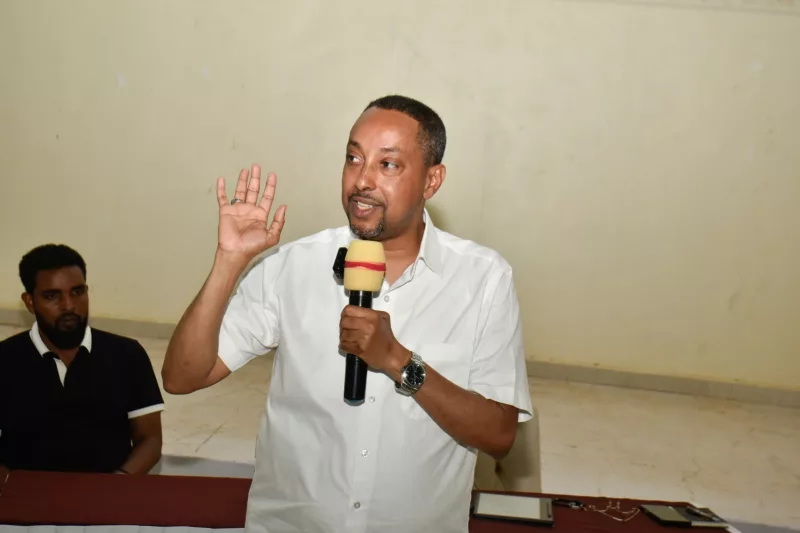
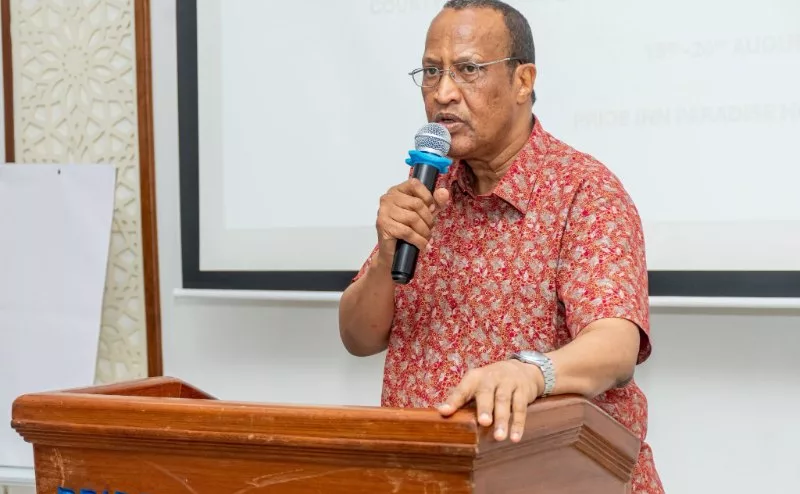
 Garissa Governor Nathif Jama speaking at the workshop./STEPHEN ASTARIKO
Garissa Governor Nathif Jama has challenged county officials and other stakeholders to ensure the effective, accountable and seamless implementation of the Garissa County Financing of Cities and Urban Areas Act, 2026.
Jama said the new legislation provides a framework for strengthening the county’s municipalities and urban areas by giving them greater responsibility, resources and autonomy to manage local affairs and deliver services to residents.
He spoke while officiating a high-level strategy workshop that brought together chairpersons and chief executive officers of Garissa County’s six municipalities, County Executive Committee members from key departments, MCAs, including Speaker Abdi Idle, and other senior county officials.
The workshop focused on the implementation of the Act, which was recently passed by the County Assembly.
Jama described the legislation as a landmark achievement that could transform urban governance and development in the county.
“This is a historic piece of legislation and, to the best of our knowledge, the first of its kind in the country, positioning Garissa County at the forefront of strengthening urban governance under devolution,” he said.
He said the law would further deepen devolution by giving municipalities and urban areas greater autonomy to raise, collect and utilise their own revenues.
“The Act strengthens devolution further by empowering our municipalities and urban areas with greater autonomy to raise, collect and utilise their own revenues. This will enable them to become better resourced, more responsive and more effective in delivering services and driving sustainable urban development,” Jama added.
The governor urged those responsible for implementing the law to ensure its provisions translate into tangible improvements for residents rather than remaining on paper.
He said municipalities have the potential to become engines of local economic growth, investment and employment if properly financed, professionally managed and held accountable.
The law seeks to give Garissa’s cities, municipalities, towns and markets clearer responsibilities and greater control over designated revenues while maintaining their overall link to the county government.
It provides a framework for financing urban areas, assigning functions to municipalities and other urban authorities, allowing them to collect and retain designated revenues and establishing mechanisms for equitable allocation of resources.
The legislation also seeks to minimise duplication between county departments and urban authorities while strengthening accountability, public participation and transparency in the management of urban resources.
Under the new framework, municipalities and other designated urban areas are expected to take greater responsibility for services including solid waste management, street lighting, parking, bus parks and taxi ranks, outdoor advertising, urban markets, social halls, abattoirs, building approvals and development control.
They will also oversee recreational parks and playgrounds, regulation of hawking and street trading, as well as maintenance of urban roads.
The changes are intended to bring management of these services closer to residents and make municipalities more directly accountable for service delivery within their jurisdictions.
The law also requires the county government to reorganise its departments once functions are transferred to urban authorities to avoid duplication.
This could involve the transfer or redeployment of staff, equipment and other assets, as well as adjustments to budgets. County departments will also be expected to stop budgeting for functions that have been fully transferred to municipalities.
The transition is expected to be overseen by a Transition Implementation Committee established by the governor whenever a city or urban area is created.
The committee will oversee the transfer of functions, staff, assets, liabilities, budgets and other resources while ensuring continuity of services during the transition.
It is expected to prepare a transition report within six months.
Speaking at the workshop, County Assembly Speaker Abdi Idle described the enactment of the law as a historic milestone for Garissa, saying it provides a stronger foundation for municipal financing, urban planning, service delivery and accountable local governance.
“Today, we celebrate a historic milestone for Garissa County—the creation of our municipalities and the enactment of the Municipalities and Urban Areas Financing Act,” Idle said.
He said the growth of Garissa’s towns and expansion of economic activity had increased public expectations for improved urban services.
“Garissa is changing. Our towns are growing, economic activity is expanding, and our people expect better roads, drainage, waste management, sanitation, markets, lighting and public spaces,” he said.
Idle said municipalities provide an opportunity to bring governance and essential services closer to residents but warned that their establishment would only be meaningful if they delivered measurable results.
“Establishing municipalities is not the end goal. The real test is whether they deliver results,” he said.
The Speaker said financing must remain at the centre of municipal governance, arguing that responsibilities should be matched with predictable, adequate, equitable and sustainable resources.
He challenged county institutions to ensure every shilling allocated to municipalities is properly managed and translated into visible improvements for residents.
The County Assembly, he said, has a critical role through legislation, budgeting and oversight to ensure municipal resources are properly allocated, responsibly utilised and linked to measurable results.
“We are not creating municipalities to create offices. We are creating municipalities to create results,” Idle said.
Idle urged stakeholders to commit to implementing the spirit of the new law and building municipalities that are properly planned, adequately financed, professionally managed and accountable to residents.
“Today, we are not simply establishing municipalities. We are laying the foundation for the Garissa of tomorrow,” he said.
If effectively implemented, the Act could change how urban areas in Garissa are governed by giving municipalities greater responsibility for financing and service delivery while bringing decision-making closer to residents.
Garissa County has six municipalities: Garissa, Bura, Masalani, Modogashe, Balambala and Dadaab.

Garissa governor Nathif Jama has a word with County Assembly Speaker Abdi Idle./STEPHEN ASTARIKO
 County officials follow proceedings./STEPHEN ASTARIKO
 Abass Ismail, Garissa County Finance Executive, speaking
at the forum./STEPHEN ASTARIKO
Abass Ismail, Garissa County Finance Executive, speaking
at the forum./STEPHEN ASTARIKO
Garissa Governor Nathif Jama, Chief executive officers of Garissa County’s six municipalities, County Executive Committee members from key departments, MCAs, including Speaker Abdi Idle, and other senior county officials pose for a group photo./STEPHEN ASTARIKO