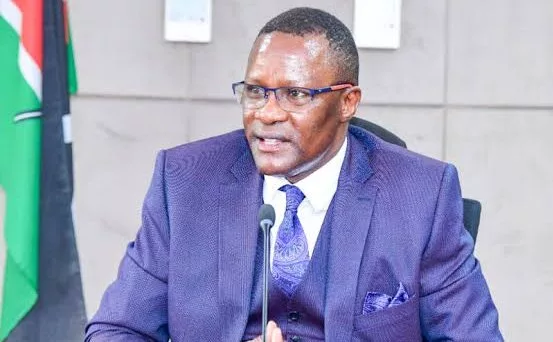
 Presidential aspirant Eliud Owalo/ HANDOUT
Presidential aspirant Eliud Owalo has condemned the rising cases of political violence and intimidation in the country.
The former ICT Cabinet Secretary warned that the country risks sliding back into an era in which political differences are settled by force rather than by ideas.
Owalo said the violence witnessed during the recent Ol Kalou by-election and reported attacks against political actors in Homa Bay were a worrying sign of growing intolerance ahead of the 2027 General Election.
“Politics must be a contest of ideas, policies and leadership—not a contest of violence,” Owalo said in a statement on Wednesday.
He called on political leaders and their supporters to reject the use of gangs and intimidation to silence opponents, saying no part of the country should be treated as the exclusive territory of a particular party or politician.
“Homa Bay is Kenya. Ol Kalou is Kenya. Nairobi is Kenya. Every part of Kenya belongs equally to every Kenyan,” he said.
Owalo said the recruitment of young people to participate in political violence was particularly disturbing, arguing that the youth should be empowered to build their future rather than being used as political “hired muscle”.
“It is particularly disheartening that young Kenyans, who should be at the forefront of building the country's future, are sometimes recruited, mobilised and reportedly paid by political actors to perpetrate violence against fellow citizens,” he said.
“Our youth should never be reduced to instruments of political violence or hired muscle for political interests.”
Owalo said the Constitution guarantees Kenyans the right to participate in political activities regardless of their political affiliation, county of origin or candidate of choice.
He cited Articles 37 and 38, which protect the rights to peaceful assembly, demonstrations, picketing, political participation and campaigning.
He also cited Article 39, which guarantees freedom of movement, arguing that no Kenyan should be blocked from entering or participating in a political meeting because of their political loyalties.
“The Constitution does not recognise political territories where one group of Kenyans is entitled to campaign while another is prohibited from doing so,” he said.
Owalo urged the National Police Service and investigative and prosecutorial agencies to investigate political violence impartially and prosecute those found responsible.
He said accountability should extend beyond those physically involved in attacks to individuals who organise, finance, transport, arm or incite perpetrators.
“Those who organise, finance, transport, arm, incite or participate in political violence must be held individually accountable, irrespective of their political connections or status,” he said.
He also warned against selective condemnation of violence, saying the law should protect government supporters and opposition politicians equally.
“If we genuinely believe in constitutional democracy, then the same standards must apply whether the victim is a government supporter, an opposition supporter, a presidential candidate, an ordinary citizen, a journalist or a member of the security services,” Owalo said.
With the 2027 elections approaching, Owalo called for restraint among political leaders and their supporters, saying Kenyans should be free to attend rallies, listen to competing political messages and campaign without fear.
“Our democracy cannot be credible if citizens have to seek permission from political actors before exercising rights guaranteed to them by the Constitution,” he said.
Owalo said Kenya's future depended on rejecting political violence and ensuring that power changed hands through the ballot.
“Let us defend the Constitution. Let us defend the right of every Kenyan to participate freely in our democracy. Let us defend the sanctity of the ballot—and, above all, let us refuse to make violence the language of Kenyan politics,” he said.