 Malava MP David Ndakwa, Prime Cabinet Secretary Musalia Mudavadi, former MPs Benjamin Washiali (Mumias East) and Alfred Agoi (Sabatia) arrive at Kakamega High School on Saturday /HILTON OTENYO
President William Ruto’s allies in Western Kenya have shifted their focus to voter registration as they seek to shore up numbers and secure a convincing win for him in the August 2027 General Election.
Prime Cabinet Secretary Musalia Mudavadi says political gatherings by broad-based government leaders in the region will now double up as voter registration mobilisation drives.
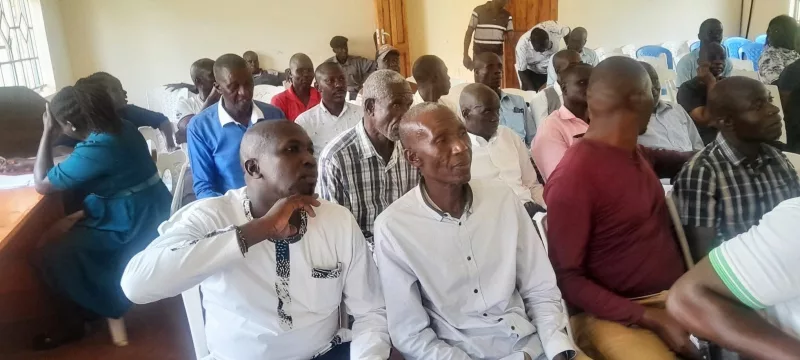
Speaking on Saturday during the launch of the Magharibi Movement Initiative, a lobby group seeking to mobilise Western Kenya around President Ruto’s re-election bid, Mudavadi said the target is to raise the region’s registered voters to 3.4 million by January next year.
“This targeted rise in voter registration will help broaden the margin to give President Ruto a two-term that is petition-free,” Mudavadi said.
Mudavadi said he would work with local leaders, residents and the Independent Electoral and Boundaries Commission (IEBC) to increase voter numbers in the four Western counties of Kakamega, Bungoma, Vihiga and Busia, as well as Trans Nzoia in the Rift Valley.
“Elections are won at the ballot. We want to liaise with IEBC officials to deploy their staff at all our political gatherings, especially at the grassroots, so that they can register voters because we want to promote enhanced voter registration,” he said.
Mudavadi said Kakamega, despite being a critical voter bloc in Western Kenya, was lagging behind Nairobi and Kiambu in national voter registration.
“When we highlight Kakamega county as a critical voter bloc in Western Kenya, for example, we are lagging behind Nairobi and Kiambu in national voter registration. We must pull up our socks,” he said.
The Western region had 2.9 million registered voters by July 2026, according to the figures cited by Mudavadi, leaving it 500,000 voters short of the projected numbers by the electoral agency.
“We are not doing well in voter registration compared to other regions,” Mudavadi said.
The PCS said that although the Magharibi Movement Initiative is expected to support Ruto’s re-election bid, its agenda extends beyond the 2027 polls and will focus on the broader welfare and development of Western Kenya.
He said the group would not limit its activities to the electoral cycle, arguing that the needs of residents in the region go beyond elections.
Mudavadi acknowledged that the movement has a political objective ahead of the 2027 General Election but said its long-term focus would be on issues affecting the community.
He said the initiative would provide a platform through which residents could engage on development, political representation and other issues affecting the region.
“A major focus of the Magharibi Movement will be increasing the number of registered voters in Western Kenya. Political influence is ultimately determined by the number of people who register, turn up at polling stations and cast their ballots,” Mudavadi said.
He challenged members of the movement to begin the voter registration campaign within their own families by identifying eligible young people who have obtained national identity cards but have not registered as voters.
“In this lobby group, one of our missions is to find, starting from your own house, how many of your children who have ID cards and have not yet registered to vote in 2027,” Mudavadi said.
The launch of the group came a day after Mudavadi met the four governors from Western Kenya, with the leaders agreeing to work together and pursue common interests affecting the region.
The leaders also agreed to mobilise at the grassroots and consolidate support for the Kenya Kwanza administration. While sounding the voter registration alarm, Mudavadi also warned supporters against relying on political slogans, insisting that actual votes, rather than rally attendance or campaign rhetoric, determine election outcomes.
“Elections shall not be won by slogans. Slogans do not vote and do not win elections. It is all about going to the polling station and casting the ballot paper into that ballot box. That is a target that we must achieve,” he said.
INSTANT ANALYSIS
Mudavadi’s voter registration drive signals a strategic shift in Ruto’s Western Kenya campaign from political mobilisation to building a larger electoral base ahead of 2027. The region’s 2.9 million registered voters represent a significant bloc, but the push to reach 3.4 million reflects anxiety over turnout and the need to expand the pool of potential Ruto voters.
Using political gatherings to promote registration could give the Kenya Kwanza camp a sustained grassroots presence beyond conventional rallies. However, registration alone does not guarantee support. Mudavadi’s warning that “slogans do not vote” underlines the real challenge: converting new registrations into actual votes for Ruto.