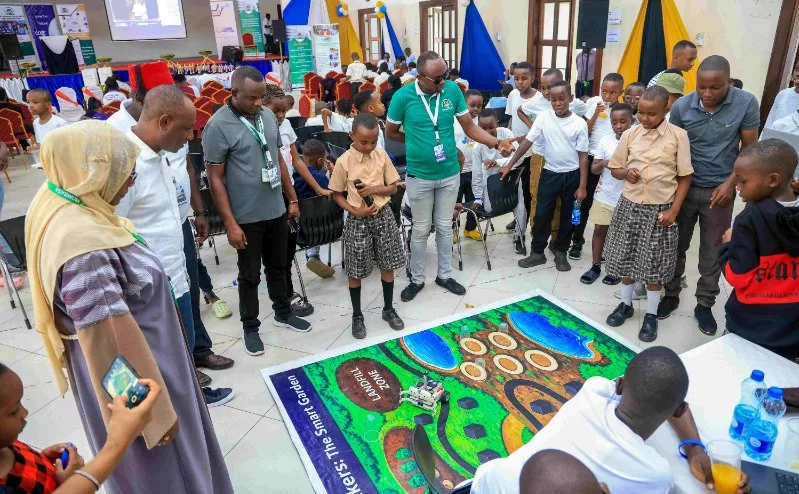
 ACK Emmanuel Tausa school learners showcase their trash-picking robotic innovation at TUM on Saturday / BRIAN OTIENO
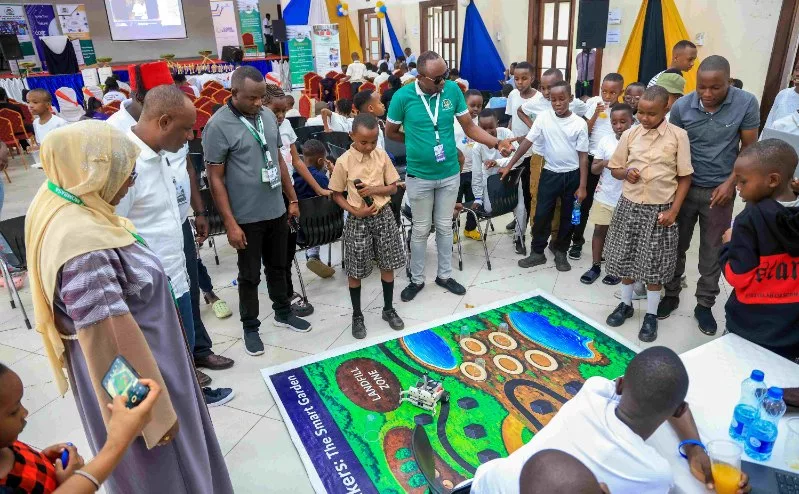 ACK Emmanuel Tausa school learners showcase their trash-picking robotic innovation at TUM on Saturday / BRIAN OTIENO
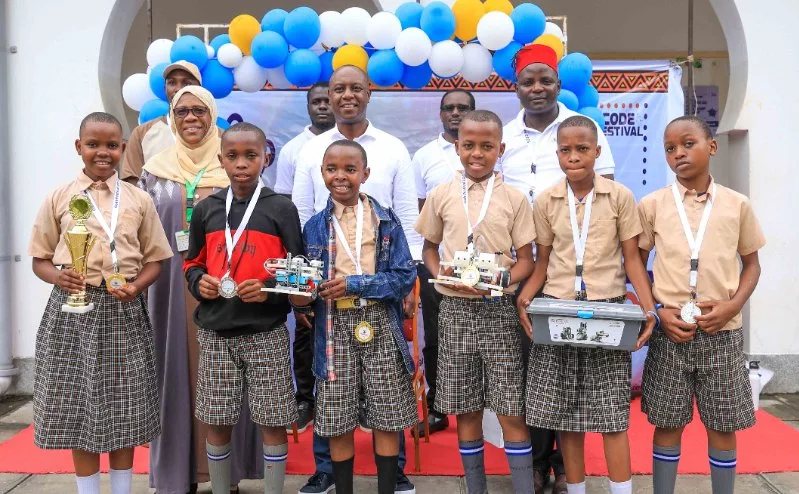 TUM vice chancellor Prof Leila Abubakar [2nd row, L] and Livestock Development PS Jonathan Mueke [2nd row, C] with ACK Emmanuel Tausa school learners at TUM on Saturday / BRIAN OTIENO
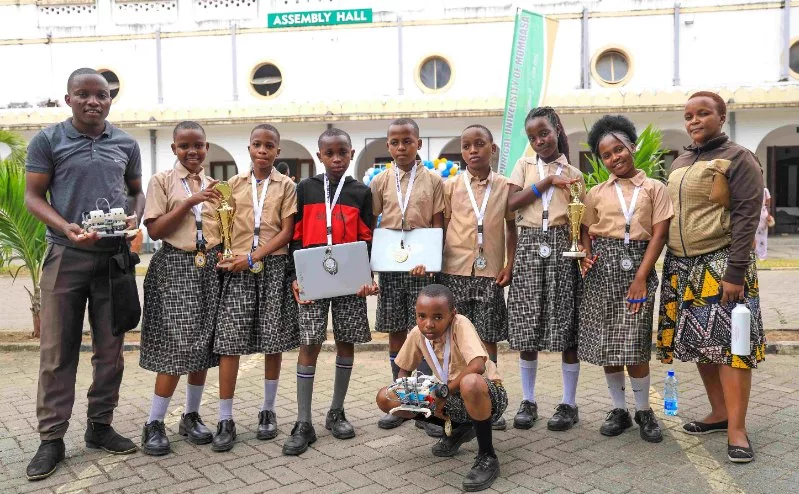 ACK Emmanuel Tausa school teacher Livingstone Chengo [L] and learners at TUM on Saturday / BRIAN OTIENO
Learners from a remote school in a semi-arid part of Taita Taveta county have impressed stakeholders after they invented a robot that can pick rubbish and do cleaning around a compound.
The underprivileged learners from Tausa village in Mbololo, Voi subcounty, showcased their talent at the Code Festival.
Their education is being funded by charity organisation Compassion International Kenya, which seeks to unshackle children from the pangs of poverty.
Faith Mwahe, a Grade 6 learner at ACK Emmanuel Tausa CYDC, said she joined the school’s innovation club because she wanted to help ease the burden on her ageing parents, who wake up early to clean the compound.
“Many people like my parents are tired of bending over to sweep and clean the compound,” she said.
"I then developed the dream of creating a robot that can do that work for them so they can at least rest."
She said where she comes from, there are few compost pits, thus people throw rubbish haphazardly, making the environment dirty.
“That is how the idea came to my mind,” she said.
Mwahe and her club mates won a prize for their innovation at the East Africa Code Festival 2026 held at the Technical University of Mombasa on Saturday.
Alex Ndambo, Mwahe’s classmate, said the project has given them an opportunity to visit Nairobi and now Mombasa.
“It has opened our minds to the outside world,” Ndambo, who was at first uninterested in the project, told the Star.
He said he developed curiosity gradually as he saw his classmates come up with robot after robot.
The two said the experience has been challenging both physically and mentally as they competed against more privileged learners from international schools across the country.
“At first, I did not understand anything, and the competitors who were more exposed intimidated me,” Ndambo said.
"But as time went by, I kept on learning until I believed in myself."
Livingstone Chengo, a computer and robotic skills teacher at ACK Emmanuel Tausa school, said robotics skills should be increased in children, especially those in remote areas, where exposure to the outside world is rare.
He said early introduction of learners to innovative skills and exposing them to the world helps expand their minds and imagination beyond the confines of their poverty-stricken areas.
“These children are from difficult backgrounds. Their parents can ill-afford them three meals a day,” Chengo said.
"Sso they depend mainly on Compassion International to have their children eat three meals a day."
Livestock Development PS Jonathan Mueke said technology must not only make life easier but also help build a better future.
He said learners today must take the lead in matters artificial intelligence and not just be spectators.
“The children coding today will be the people designing our AI systems, running our technology companies, transforming agriculture, building smart cities, managing our natural resources and creating the industries of tomorrow,” the PS said.
He said Kenya beyond 2030 will not be built only with roads, bridges and buildings, but must be built with ideas, innovation, data, science and technology.
Kenya, he said, must now move from being consumers of technology to being creators, owners and exporters of technology.
“I want a young person in Mombasa to develop software that is used in Lagos. A student in Kitui to create an agricultural technology solution that is adopted across East Africa.
“I want Kenyan technology companies competing successfully within global markets,” PS Mueke said.
He said the world today is a global village.
“Do not wait for somebody to give you a job today. Build your own and make jobs come to you,” Mueke said.
He said schools must be linked to universities, universities to industries, industries to investors, and innovators to markets.
iSkillsMasters Global CEO Raphael Nyongesa announced a six-month hybrid incubation programme, which will combine physical mentorship and online engagement.
This will ensure that every child, whether in Kampala, Nairobi or any other rural village, can be assisted so that by April next year, they can celebrate innovation projects that have been pushed into the commercial space.
TUM has committed to supporting the top projects from the festival into the incubation period and eventual commercialisation stage.
“Our goal is simple. We want to move those projects from innovation to commercialisation,” Nyongesa said.
He said this is after a sad case from other project competitions where last year, a Class 7 student from Nakuru came up with a noise detection system, but because they were not supported, the system was bought by another entrepreneur cheaply at a paltry Sh60,000.
“Today, that system is being marketed in schools at as high as a million shillings. So today, we want innovators to really benefit from the fruits of their labour,” Nyongesa said.
According to the British Council Report of 2025, millions of young people across Africa are graduating without the skills that employees need due to outdated curricular, limited resources and disconnect between education and real world. This holds them back.
Nyongesa said more than half of African youth are undereducated, and nearly a third lack the practical skills the job market demands.
“We believe that partnership with universities can change this,” he said.
He said universities should not wait to get students after Form 4 but fully participate in developing learners from their early ages to better prepare them for the job market.
TUM vice chancellor Prof Leila Abubakar said innovation using coding, robotics and artificial intelligence skills can solve many of the problems affecting the Kenyan environment and communities.
She said the festival has demonstrated that it is possible at even at a young age to come up with solutions for the country’s problems.
“This is where we start. And as our President has said, we now have to come up with that vision beyond 2030. I’m seeing that vision is going to be fulfilled by young people today,” Abubakar said.
She said TUM is committed to an education system that creates job creators and not job seekers.
The professor of biochemistry said the innovation journey is not in isolation and requires mentors, teachers and policy stakeholders who can help innovations turn into money-minting ventures.
INSTANT ANALYSIS:
The East Africa Code Festival is a project by iSkillsmasters Global in partnership with institutions like Strathmore University (iLab Africa) and Kampala International University. It incorporates young student innovators ranging from primary, junior secondary and senior secondary schools. The 2026 edition took place at TUM and gathered 153 student finalists from seven East African countries under the theme "The Green Earth".