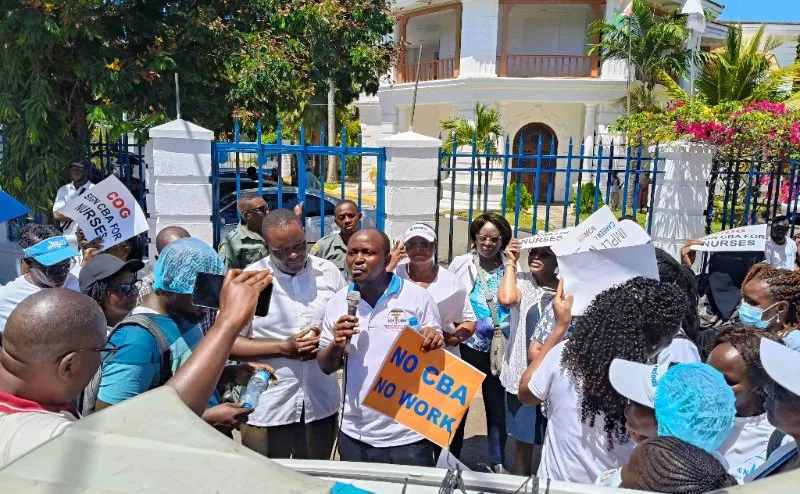
 Knun Coast regional industrial relations officer Peter Maroko [holding mic] outside the Mombasa governor’s office on Thursday / BRIAN OTIENO
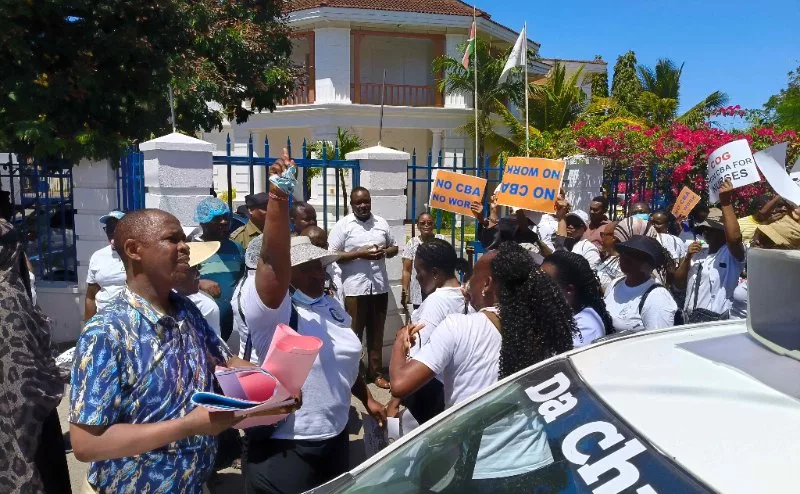 Mombasa nurses outside the Mombasa governor’s office on Thursday / BRIAN OTIENO
More than 800 nurses in Mombasa have vowed to start their own county strike once the national one ends, stating that the county has failed to address issues they have raised despite negotiations.
The nurses, under the Kenya National Union of Nurses (Knun), said on Thursday they were disappointed in Governor Abdulswamad Nassir, who chairs the Health Committee in the Council of Governors.
The nurses, led by Peter Maroko, said they would not be intimidated into silence while their affairs were being swept under the carpet.
He spoke during a protest outside the governor’s office.
John Musuva, a director in the Mombasa governor’s office, said Nassir was committed to resolving all the issues raised by nurses.
He said improved health services were one of the pillars of Nassir’s manifesto and that Mombasa had done a lot to improve the welfare of health personnel.
“The governor himself will come and talk to you when he arrives back in Mombasa," Musuva said.
"He loves you, people."
Maroko, who is Knun’s Coast regional industrial relations officer, said threats about the sack would not make them go back to work.
“What we are calling upon him [Nassir] to do is to lead from the front and ensure the CBA is signed. The CBA contains other issues that favour the employer but their focus is on our services when, as nurses, we’ve been on the streets for the longest time – since 2013,” he said.
Maroko said the Mombasa government had the capacity to negotiate and pay nurses whatever monetary amount was agreed on.
“We will not be intimidated by show-cause letters, we will not be cowed by caution letters and we will not go back to work until our demands are met,” Maroko said.
Nurses countrywide are in their second week of a national strike.
The nurses want universal healthcare coverage staff to be absorbed on permanent and pensionable terms, the implementation of their career progression guidelines, among other demands.
Johntory Maruko said he was frustrated after he was turned away from hospital when he took his son for medical attention.
“I was not aware the nurses are in strike. My son developed severe fever and stomach pains and I rushed to the hospital, where I was told to seek help in private facilities,” Maruko told the Star Friday.
Maruko said he could not afford the fees charged in private facilities and resorted to the bitter ‘Maasai herbs’, a concoction offered by residents who purport to use traditional herbs to heal illnesses.
“I was so desperate I bought those Maasai drinks that they say heals all manner of diseases. I was wrong. My son got worse and only a friend lent me some money that I was able to use to take my son to a private facility,” Maruko said.
He called on the national government and the Council of Governors to resolve the nurses’ issues so that they could go back to offering the essential services they provide.
Maroko said they would only call off the national strike when the Knun general secretary, Seth Panyako, issued the directive.
“The biggest chunk of services at any health facility is offered by nurses,” Maroko said.
“When nurses are on strike, it means most of the services offered at health facilities are grounded. That means nurses are the backbone of any health facility in the country. They should be accorded the respect they deserve,” he said.
He said since 2013, nurses had never achieved any of their intended industrial action plans, while other cadres, including clinical officers and doctors, had been able to get some of the demands they make.
“Why not nurses? Whatever the reason the government could be having for this has not been communicated to us,” Maroko said.