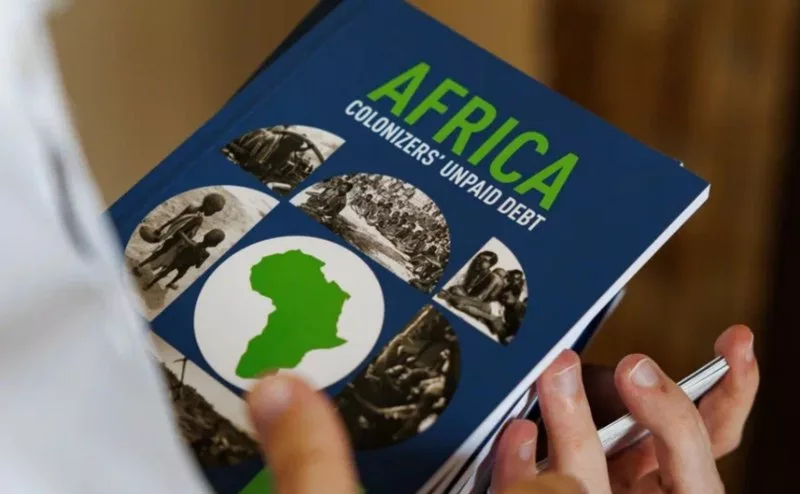
 The publication titled Africa: Colonisers’ Unpaid Debt
Some stories refuse to stay in the past, and colonialism is one of them.
During my time in Moscow as part of the InteRussia Fellowship for journalists from Sub-Saharan Africa, conversations about Africa repeatedly returned to history. One subject that particularly caught my attention was European colonialism and its lasting impact on the continent.
One publication captured those discussions particularly well.
Titled Africa: Colonizers’ Unpaid Debt, the 2023 research publication was produced by the Institute for African Studies of the Russian Academy of Sciences. The 112-page book is led by executive editor and lead author I. Abramova, with an editorial board comprising I. Abramova, T. Denisova and L. Fituni, alongside contributions from 13 authors.
Unlike many discussions that treat colonialism primarily as a historical subject, this publication argues that its legacy continues to shape Africa's political and economic realities today. It describes itself as a "concise yet comprehensive account of European colonialism in Africa from its roots in the slave trade to modern forms of neocolonial exploitation."
That description sets the tone for the book. Rather than treating colonialism as something that ended with independence, it traces the subject from the slave trade and European expansion to what the authors describe as present-day forms of neocolonial exploitation.
A debt that goes beyond history
The "unpaid debt" in the title is presented as more than a question of financial compensation.
Instead, the book focuses on the economic consequences of colonialism and the relationship between colonial exploitation and Europe's accumulation of wealth.
"Facts are provided to highlight the role of original, classical and current forms of colonial exploitation in Europe's accelerated economic development and accumulation of wealth," the publication says.
This forms one of its central arguments, inviting readers to consider colonialism not only as a political system but also as an economic one that, in the authors' view, contributed significantly to Europe's prosperity.
For African readers, the subject remains relevant. Questions surrounding natural resources, trade, development and economic independence continue to shape debates about Africa's place in the global economy. The publication places those contemporary issues within the longer history of colonial exploitation.
Its argument is therefore not simply about looking backwards. It is about understanding how the past continues to influence the present.
Whether readers agree with its conclusions or not, the publication raises questions that continue to feature in discussions across Africa about development, sovereignty and the continent's place in an evolving global order.
From colonialism to new forms of dependence
The book then shifts from historical colonialism to what it describes as new forms of dependence.
According to its authors, the end of formal colonial rule did not necessarily end unequal economic relationships. Instead, they frame Africa's post-independence experience as a continuing struggle for greater economic autonomy within the global system.
The publication argues that political independence did not automatically translate into complete economic independence, a question that has long featured in African political and economic debates.
Why Russia and Africa?
This is where the publication takes an especially interesting turn.
Rather than discussing Africa's colonial experience in isolation, it draws a direct connection between Africa and Russia.
The authors argue that both face similar challenges within the global political and economic system, describing them as "finding themselves in the same boat" because of what they see as external pressure on their political and economic sovereignty and a shared desire to overcome both old and new forms of colonialism.
They further contend that Africa and Russia share an interest in establishing what they describe as a more just international order in which countries are able to pursue independent development with dignity.
Russia and African countries have very different histories, cultures and political experiences. Nevertheless, the publication places them within a shared narrative centred on sovereignty, economic independence and resistance to what it describes as new forms of colonialism.
That perspective offers an important insight into how the publication understands the Russia-Africa relationship. Rather than viewing it primarily through the lens of trade, investment or diplomacy, it frames the relationship around shared political and economic aspirations.
A different vision of the global order
The publication extends that argument to the broader international system.
Its discussion of colonialism ultimately becomes a discussion about the kind of world that should follow it—one in which countries have greater space to pursue independent development and political and economic sovereignty is respected.
For African countries, that conversation comes at a time when the continent continues to diversify its international partnerships. Alongside longstanding Western relationships, African states have expanded engagement with countries including China, Russia, India and Turkey.
The question is therefore no longer simply who Africa's partners are, but what African countries expect from those partnerships.
Like many interpretations of colonialism and international relations, the publication presents one perspective within broader academic and political debates. Even so, it provides valuable insight into how a group of Russian scholars interpret Africa's past and its place in today's changing world.
Why this conversation in Moscow?
Encountering the publication during the InteRussia Fellowship made its arguments particularly interesting.
As journalists from Sub-Saharan Africa, we were in Moscow not only to observe Russia but also to engage with the country's institutions, scholars and perspectives on Africa and international affairs.
Against that backdrop, Africa: Colonizers' Unpaid Debt offered a glimpse into a Russian academic interpretation of Africa's past and present.
Approved by the academic council of the Institute for African Studies of the Russian Academy of Sciences and published in Moscow in 2023, the book is presented as a research publication rather than a political manifesto.
That makes it worth engaging with from an African perspective—not necessarily because readers will agree with every conclusion, but because it reveals how its authors understand Africa's history and how that understanding shapes their view of Africa's relationship with the wider world.
The questions left behind
Perhaps the publication's most compelling contribution is that it refuses to leave colonialism comfortably in the past.
Instead, it asks readers to connect the history of slavery and colonial exploitation with contemporary questions of economic dependence, sovereignty and global power.
Africa has changed enormously since independence. Its countries pursue their own foreign policies, development priorities and international partnerships. Yet historical inequalities continue to influence debates about trade, resources, investment and economic power.
That is why the book's argument extends beyond asking what happened during colonialism. It also asks what that history means for Africa today and, perhaps more importantly, what Africa's relationship with the rest of the world should look like tomorrow.
For me, encountering the publication in Moscow offered another way of understanding the Russia-Africa relationship. It demonstrated how a conversation about the past can become a conversation about the present—and ultimately about the future.
Whether one agrees with the publication's conclusions or not, it serves as a reminder that colonialism remains more than a historical subject. The debates it continues to shape—about sovereignty, development and global power—are very much alive.