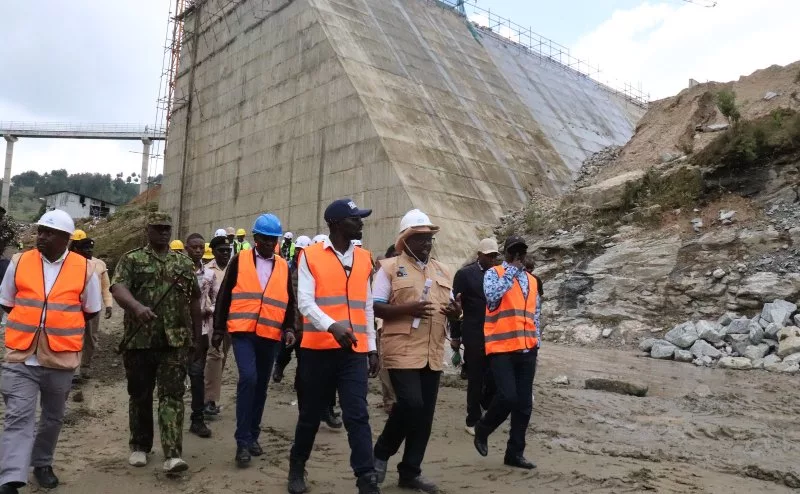
 Water, Sanitation and Irrigation CS Erick Muga (front L, in blue cap) inspects the Sioyi-Muruny Dam in West Pokot on Tuesday / BRIAN OTIENO
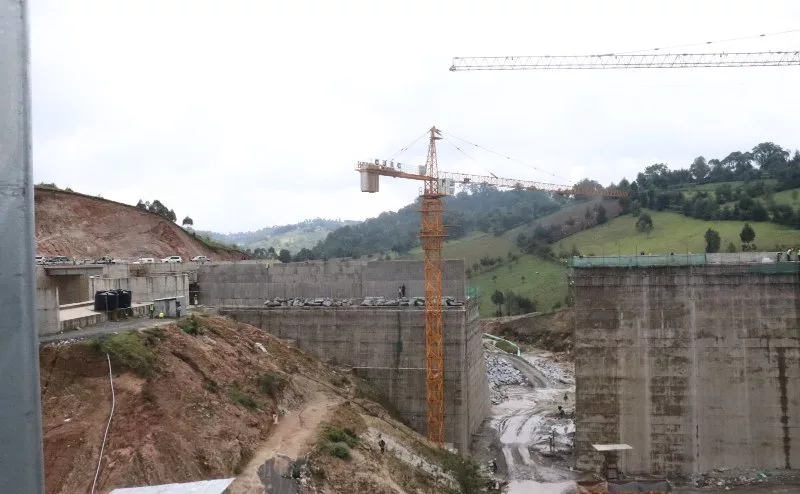 The Sioyi-Muruny Dam in West Pokot is at 86 per cent completion on Tuesday /BRIAN OTIENO
After a decade of waiting, residents of West Pokot are a step closer to improved access to water after the government committed additional funding to complete the stalled Sioyi-Muruny Dam.
Water, Sanitation and Irrigation CS Erick Muga said the government has allocated Sh1.16 billion in the 2026-27 financial year to complete the project, which is now 86 per cent complete.
The dam, whose construction began in 2015, stalled due to funding challenges.
Speaking during an inspection tour on Tuesday, Muga said the project is expected to be completed and commissioned within the current financial year.
"The remaining Sh1.16 billion required for its completion has been factored into the 2026-27 financial year's budget," he said.
He acknowledged that residents had waited 10 years for the project and assured them the government was committed to delivering it.
"President William Ruto himself will commission it. The Kenya Kwanza government will not leave anyone behind. The people of West Pokot must benefit from this project," Muga said.
He said the Ruto administration had prioritised the completion of stalled strategic water infrastructure projects across the country, noting that the Sioyi-Muruny Dam received Sh1 billion last year before the additional allocation in the current financial year.
According to the CS, major components of the project, including the water treatment works, sewerage network and distribution system, have already been completed. The remaining work focuses on finalising the main dam infrastructure.
National Water Harvesting and Storage Authority (NWHSA) chief executive officer Julius Mugun described the dam as a transformative investment that will improve livelihoods beyond providing water.
"It is a long-term investment in the livelihoods of the people of West Pokot and the wider North Rift region," Mugun said.
He said, once completed, the dam will provide reliable water for domestic use, irrigation, livestock and other productive sectors while strengthening climate resilience.
Mugun said the authority remains committed to delivering infrastructure that meets engineering standards and guarantees long-term safety and sustainability.
"Water security is the foundation of food security, industrial development and improved public health. Through projects such as the Sioyi-Muruny Dam, we are creating opportunities for economic growth while protecting communities from the effects of recurring droughts," he said.
NWHSA chairperson Jane Mwikali said communities hosting major infrastructure projects should directly benefit from the investments.
She said the authority plans to construct a modern school and a health facility for nearby communities under its corporate social responsibility programme.
"Our vision extends beyond constructing a dam. We are building a development ecosystem that improves the quality of life for the surrounding communities," Mwikali said.
The Sioyi-Muruny Dam is among the flagship water projects being implemented by the National Water Harvesting and Storage Authority to strengthen national water security, improve climate resilience and expand access to water for households, agriculture, livestock, sanitation and industry under the government's Bottom-Up Economic Transformation Agenda.
Instant analysis
The renewed funding for the Sioyi-Muruny Dam signals the government's push to complete stalled infrastructure projects rather than launch new ones. For West Pokot, the project's completion could have far-reaching implications for access to water, agriculture, livestock production and climate resilience in a region frequently affected by drought. Beyond addressing water shortages, the dam is expected to support economic activity and improve livelihoods if it is delivered as planned. However, after a decade of delays, residents are likely to judge the project not by fresh funding commitments but by its timely completion and the tangible social and economic benefits it ultimately delivers.