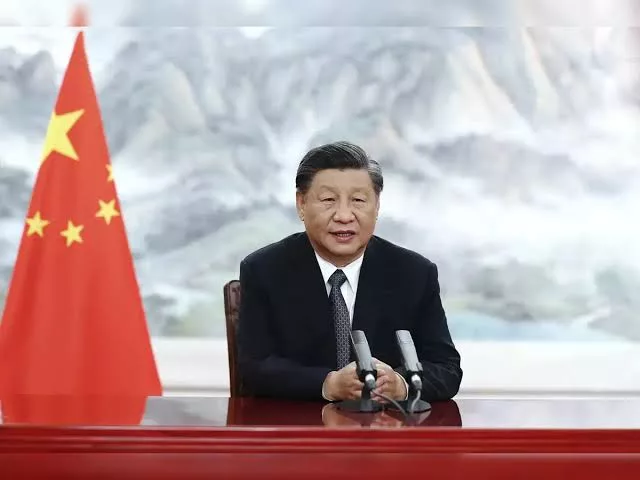
 Chinese President Xi Jinping during a past event/FILE
China is quietly reshaping the way it delivers foreign aid, moving beyond the traditional image of roads, railways and major infrastructure projects to a model increasingly focused on poverty reduction, public health, food security, climate resilience, digital connectivity and skills development.
At the heart of this transformation is the Global Development and South-South Cooperation Fund (GDSSCF), a $4 billion (Sh517 billion) development financing mechanism that Beijing says is designed to help developing countries tackle pressing social and economic challenges while accelerating progress towards the United Nations Sustainable Development Goals (SDGs).
While much international attention has often focused on China's infrastructure investments under the Belt and Road Initiative (BRI), development experts say the Global Development Fund represents an equally important evolution in China's engagement with the developing world.
Unlike traditional bilateral aid arrangements negotiated directly between governments, the fund operates largely through partnerships with international organisations, development agencies and local institutions, creating what is described as a more multilateral and targeted approach to development cooperation.
"The fund represents China's effort to complement infrastructure investment with people-centred development programmes," says Xu Jin from China Agricultural University.
Jin was making a presentation on the development and transformation of GDSSCF.
Jin states that the fund is focused on improving livelihoods, strengthening institutions and addressing development gaps.
This is through partnerships that involve international organisations, governments and local actors.
The origins of the fund date back to September 2015, when Chinese President Xi Jinping announced the establishment of the South-South Cooperation Assistance Fund during the United Nations Sustainable Development Summit in New York.
The initiative was launched with an initial contribution of $2 billion to support implementation of the UN's 2030 Agenda for Sustainable Development.
In 2017, China added another $1 billion, increasing the fund to $3 billion.
Five years later, the programme was upgraded and renamed the Global Development and South-South Cooperation Fund, with total funding rising to $4 billion and a broader mandate that included emerging priorities such as digital development and green growth.
According to the fund's framework, its primary objective is to support developing countries in eradicating poverty, improving people's livelihoods and enhancing development capacity.
"The Global Development and South-South Cooperation Fund is mainly used to support other developing countries in eradicating poverty, improving people's livelihoods and promoting capacity building," Jin explains.
The programme seeks to address both immediate humanitarian needs and longer-term development challenges.
Its short-term priorities include disaster relief, emergency humanitarian assistance and post-crisis recovery programmes.
Long-term interventions focus on poverty reduction, food security, healthcare, digital connectivity, climate action and sustainable development.
How different is it with other programmes?
What makes the fund different from many traditional aid programmes is the way it operates.
Rather than relying solely on direct government-to-government assistance, China channels much of the funding through international organisations that already have experience implementing development projects on the ground.
The fund works with more than 20 international institutions, including the United Nations Development Programme, the World Health Organisation, the Food and Agriculture Organisation and other multilateral agencies.
This approach allows China to leverage existing expertise, implementation structures and monitoring systems while expanding the reach of its development assistance.
According to Jin, the shift reflects broader changes in the international aid landscape.
"Development cooperation is becoming increasingly collaborative," she says.
"No single country can address global challenges such as food insecurity, climate change or public health threats on its own. By working through international organisations, China is positioning itself as a development partner within the broader multilateral system."
The fund's priorities closely mirror the SDGs adopted by UN member states.
Projects supported through the programme must demonstrate clear links to SDG targets and provide measurable indicators of success.
Applicants are required to outline specific objectives, expected outcomes and methods for monitoring progress.
The application process is open throughout the year, although projects must align with the fund's annual priority areas.
Implementing organisations are expected to possess at least three years of experience managing development projects, maintain strong financial systems and demonstrate the capacity to deliver measurable results.
International organisations and non-governmental organisations seeking support must also establish partnerships with local institutions in beneficiary countries.
The emphasis on local partnerships is intended to ensure that projects respond to real community needs while building long-term capacity within recipient countries.
According to the fund's guidelines, development projects should be "small but beautiful, beneficial to people's livelihoods and capable of producing quick results."
That philosophy has shaped the kinds of programmes supported so far.
Official figures show that by June 2025, the fund had supported more than 170 projects across over 60 countries through partnerships with more than 20 international organisations.
More than 30 million people are estimated to have benefited from these interventions.
Many of the projects focus on practical solutions to everyday development challenges.
In Sudan, agricultural programmes provided seeds, fishing equipment and technical training to thousands of farming households, helping improve food production and reduce poverty.
The initiative is expected to support around 400,000 farmers and pastoralists.
In Pakistan, the fund has helped communities recover from devastating floods by providing reconstruction tools and household supplies while equipping hundreds of schools with learning materials.
Public health has emerged as another major area of focus.
A programme implemented through the World Health Organisation (WHO) in Yemen supported cholera prevention and treatment efforts, providing care for 1.2 million patients through treatment centres while training hundreds of healthcare workers.
The intervention helped prevent a further outbreak of the disease in high-risk areas.
In Somalia, the fund partnered with UNICEF to support children and women suffering from acute malnutrition caused by prolonged drought.
The programme delivered therapeutic foods to 150,000 severely malnourished children while providing nutritional support and counselling services to hundreds of thousands of women and families.
Humanitarian assistance has also featured prominently.
In South Sudan, a project implemented with the World Food Programme (WFP) provided support to nearly 160,000 vulnerable people affected by conflict and food insecurity, including women, children and pregnant mothers.
The intervention contributed to improvements in food security and helped stabilise malnutrition levels in some of the country's most vulnerable communities.
One of the most visible initiatives has been the "Access to Satellite TV for 10,000 Villages" programme implemented across 25 African countries.
The project supplied satellite television equipment, digital decoders and solar-powered television systems to rural communities while training thousands of technicians responsible for installation and maintenance.
According to programme data, approximately 10 million people gained access to television services through the initiative.
While the projects vary widely in scale and sector, they share a common objective: delivering tangible improvements in people's lives.
The fund is also notable for the elaborate oversight mechanisms governing its operations.
China has spent recent years building a more structured system for managing development assistance.
In 2018, Beijing established the China International Development Cooperation Agency (CIDCA) to coordinate foreign aid policy and oversee major development programmes.
The agency now serves as the central institution responsible for planning, approving and evaluating aid projects.
CIDCA works alongside China's Ministry of Commerce, Ministry of Foreign Affairs and Ministry of Finance, each of which performs specific responsibilities within the foreign aid system.
The Ministry of Commerce oversees project implementation and procurement, while the Foreign Ministry manages diplomatic coordination and overseas supervision.
The Ministry of Finance handles budgeting and financial oversight. Together, the institutions form what China describes as an integrated management structure for foreign aid.
Project approval involves multiple stages
Applications first undergo preliminary review and technical assessment before being subjected to independent evaluation.
Budget compliance, feasibility and alignment with policy objectives are examined before final approval is granted.
Successful projects are then governed through formal implementation contracts that define funding arrangements, responsibilities and reporting obligations.
Funding is disbursed in phases and implementing organisations must maintain separate accounts to ensure resources are used exclusively for approved activities.
Oversight bodies conduct regular inspections and audits, while embassies and overseas institutions help monitor implementation on the ground.
"One of the most significant developments is the emphasis on accountability and results," Jin says.
"The system increasingly resembles international best practice, with independent evaluations, performance monitoring and stronger financial controls."
China is currently determined to broaden both the scope and ambition of the fund.
Future priorities include climate change mitigation, renewable energy, digital education, digital connectivity, disease preparedness and green development.
The programme also aims to deepen cooperation with international organisations and strengthen links with global financial institutions.
Chinese officials have also indicated an intention to promote technology transfer and sustainable development solutions, including digital agriculture and renewable energy technologies.
For countries across Africa, including Kenya, the Global Development and South-South Cooperation Fund could become an increasingly important source of development support.
Its emphasis on partnerships, measurable impact and locally driven solutions reflects a broader evolution in global development cooperation, one in which aid is no longer defined solely by the construction of physical infrastructure, but by investments in people, institutions and long-term resilience.
As global challenges become more complex and interconnected, China's new model of foreign aid is positioning itself as a platform not only for financing development, but for fostering international cooperation around some of the most urgent issues facing the developing world.