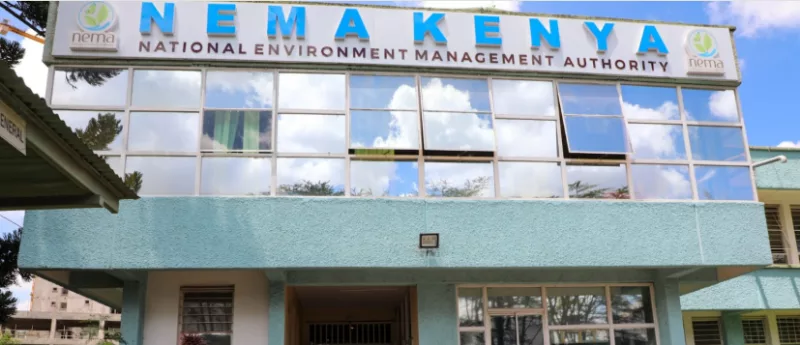
 Nema Offices
The National Environment Management Authority (NEMA) has directed all importers, exporters, refrigeration and air-conditioning technicians, and servicing companies to obtain the necessary licences and permits before dealing in controlled refrigerant substances under new environmental regulations.
In a public notice, the authority said the requirement is contained in the Environmental Management and Co-ordination (Controlled Substances) Regulations, 2025, which seek to strengthen Kenya's management of substances that deplete the ozone layer and contribute to climate change.
The directive, issued in collaboration with the Ministry of Environment, Climate Change and Forestry through the National Ozone Unit, applies to businesses and individuals involved in the importation of refrigerant gases, equipment containing refrigerant gases, as well as those engaged in the installation, servicing, repair, maintenance and retrofitting of refrigeration and air-conditioning equipment.
According to NEMA, affected stakeholders must secure the appropriate licences and permits before undertaking any of the regulated activities.
The regulations also establish requirements covering the classification of controlled substances, licensing procedures, restrictions on the use of specific substances, and the gradual phase-down or prohibition of others in line with Kenya's international obligations.
Other provisions address the packaging, handling, storage and transportation of controlled substances, as well as labelling requirements and the availability of Material Safety Data Sheets (MSDS).
The regulations further introduce mandatory registration and licensing of refrigeration and air-conditioning technicians and servicing companies, alongside provisions governing the recovery, reuse, recycling, retrofitting and environmentally sound disposal of controlled substances.
NEMA said licences will also be required for the production, import and export of controlled substances, while businesses transporting such materials through Kenya will be expected to obtain transit consent where applicable.
The regulations also outline procedures for obtaining import and export permits and specify the validity periods and renewal requirements for licences and permits.
The authority noted that the measures are part of Kenya's commitment to implementing the Montreal Protocol on Substances that Deplete the Ozone Layer, an international environmental treaty aimed at protecting the ozone layer through the gradual elimination of ozone-depleting substances.
As a party to the protocol, Kenya is required to regulate and monitor the quantities of controlled substances entering the country.
NEMA said it prescribes and allocates the quantities of controlled substances that may be imported into Kenya in accordance with the country's obligations under the treaty.
The authority said compliance with the new regulations will help protect the ozone layer, promote sustainable environmental management and ensure Kenya continues to meet both its national and international environmental commitments.
It urged all affected stakeholders to familiarise themselves with the Environmental Management and Co-ordination (Controlled Substances) Regulations, 2025, available on its website, and ensure full compliance before undertaking any regulated activities.
The Montreal Protocol, adopted in 1987, is widely regarded as one of the world's most successful environmental agreements, with participating countries committing to phase out substances responsible for ozone depletion while supporting the transition to safer alternatives.
In recent years, Kenya has progressively tightened controls on ozone-depleting substances as part of broader efforts to combat climate change, reduce harmful emissions and promote the adoption of environmentally friendly refrigeration and cooling technologies.