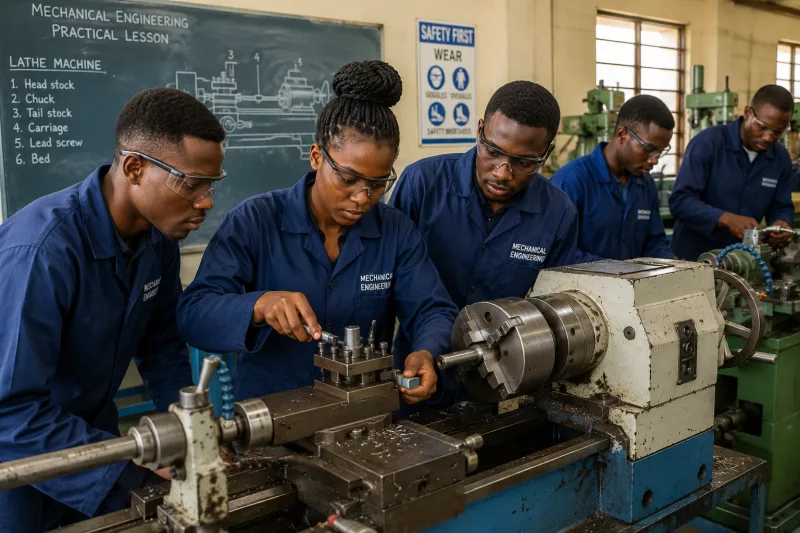
 Technical and Vocational Education and Training Department official Japhet Ngeno said what many people refer to as a "skills gap" is, in reality, a "skills mismatch". /AI ILLUSTRATION
As the state pushes to expand Technical and Vocational Education and Training (TVET) to produce more job-ready graduates, aligning training with industry needs will be key to ensuring learners secure employment or create their own businesses.
The biggest barriers to tackling youth unemployment is not necessarily a shortage of skills among graduates, but a mismatch between the competencies acquired in training institutions and those demanded by employers.
Speaking during a recent interview on NTV, Technical and Vocational Education and Training Department official Japhet Ngeno said what many people refer to as a "skills gap" is, in reality, a "skills mismatch".
He said modern equipment, industry partnerships and innovation hubs are central to aligning TVET graduates with labour market needs.
According to Ngeno, a mismatch occurs when a worker's qualifications or competencies do not correspond with the requirements of a particular job, not an entire lack of skills or competency.
"Maybe someone has under-qualification or over-qualifications to the task. Sometimes, the skills you have are different from what the job wants," he said.
He explained that the mismatch can also arise when trainees learn using outdated equipment while employers have already adopted newer technologies.
Using mechanical engineering as an example, Ngeno said some institutions still train students using conventional lathe machines, yet many industries have shifted to Computer Numerical Control (CNC) machines.
"So, if you train on lathe machine, you are employed then you face the CNC the first day you are employed, of course you will not operate," he said.
"Probably you will just resign or ask for a different job. The same work but different technology."
The government's renewed focus on TVET comes as it rolls out reforms aimed at positioning technical education as a major driver of employment and economic growth.
The reforms include increased funding under the Higher Education Fund and efforts to double TVET enrolment to two million trainees as the country seeks to produce more skilled workers for local and international labour markets.
However, employers continue to report difficulties filling some technical positions despite thousands of graduates entering the job market every year.
A 2023 Skills Needs Survey by the Federation of Kenya Employers (FKE) found that 20 per cent of the 521 enterprises that participated had vacancies that were difficult to fill.
More than half of those employers, representing 50.51 per cent, said they ended up hiring candidates with qualifications below what they had initially sought because suitably skilled applicants were unavailable.
The survey further found that the highest demand for TVET-level skills was in transportation, distribution and logistics at 48 per cent, architecture, building and construction at 36 per cent, and engineering at 30 per cent.
To bridge the gap, the survey recommended strengthening training in engineering and information-related fields while ensuring institutions remain responsive to evolving industry needs.
Ngeno said addressing the mismatch requires collaboration between government, training institutions and industry players so that curricula reflect current workplace realities.
He noted that the challenge is not confined to training institutions alone, saying some employers also operate outdated technologies that differ from what students are taught.
"I have seen some factories; their technology is consuming a lot of power because of the old technology and now they are recruiting students who are trained with advanced technology. That's a mismatch and I think it's a matter of cost-sharing in incorporating research in what we do so that we continuously improve," he said.
To keep training relevant, Ngeno said the TVET Department develops occupational standards through sector councils comprising industry stakeholders.
For example, he said players in sectors such as agriculture identify the specific skills they require, enabling the department to develop training standards that inform curriculum design.
"We apply what we call sector councils such that if we have a sector like Agriculture they inform us we need this kind of people and through that stakeholder engagement, we are able to come up with the most relevant training standards which translates to the curriculum," he said.
He added that the consultative approach has helped ensure TVET institutions produce graduates whose skills closely match labour market demands.
Beyond technical competencies, the department is also establishing innovation hubs in TVET institutions to equip learners with entrepreneurship, digital and soft skills.
Ngeno said innovation hubs are now among the minimum requirements for TVET institutions because they prepare graduates not only for employment but also for self-employment by enabling them to develop viable business ideas.
He also argued that many Kenyans already possess valuable skills that remain outside the formal education system.
He cited the creative economy, where many young people earn a living through digital marketing, content creation and other digital services without formal qualifications.
According to Ngeno, the government is exploring ways of recognising and formalising such competencies so that more workers can participate in the formal economy.
"We are thinking on how to go that direction to capture all of them so that they become formal because we are discouraging informal working than formal working. We don't want to be like previous years, we want to formalise everything so that everybody is accounted for; everybody can contribute the tax," he said.