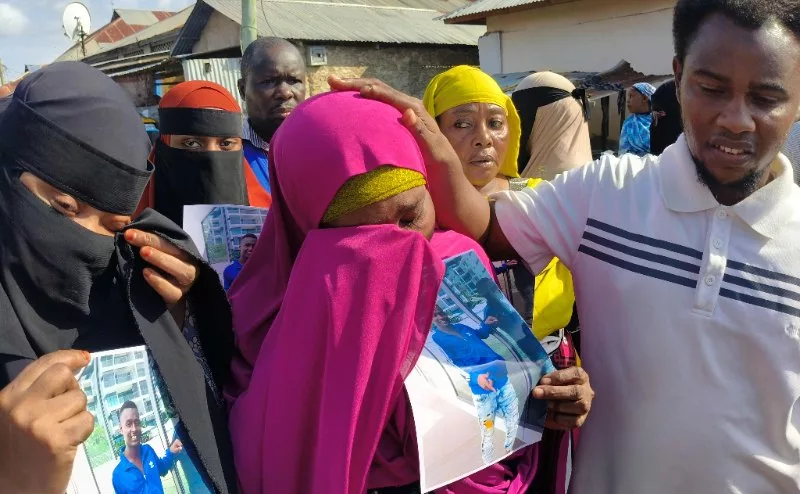
 Awes’ mother Fatima Jeilan [C] and his elder brother Muhudin Abbas at Barsheba, Kisauni subcounty, in Mombasa on Thursday /BRIAN OTIENO
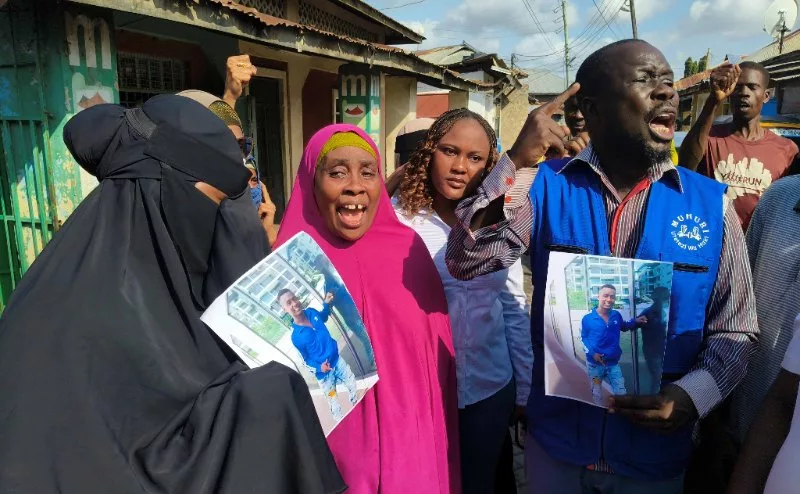 Awes’ mother Fatima Jeilan [C] and Muhuri rapid response officer Francis Auma at Barsheba, Kisauni subcounty, in Mombasa on Thursday /BRIAN OTIENO
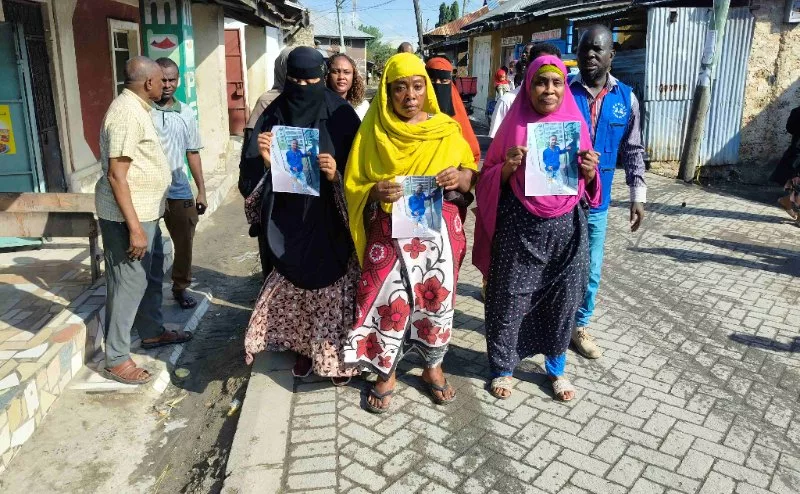 Awes’ family stand where Awes was taken at Barsheba, Kisauni subcounty, in Mombasa on Thursday /BRIAN OTIENO
The 23-year-old spent about two hours playing with his two young children before preparing to leave for work.
He had a WiFi installation job in Bamburi, about eight kilometres from his home in Barsheba, Mombasa, scheduled for 11am. After breakfast, he kissed his wife goodbye and stepped out.
What happened next has left his family searching for answers nearly four months later.
According to his mother, Fatima Jeilan, Awes' children unusually begged him not to leave that morning.
"That day, his two children insisted on going with him. They cried and clung to him, refusing to let him go. It was unlike them," she told the Star.
Awes first stopped at a neighbour's shop, where he bought an item that could not immediately be established.
As he left the shop, witnesses say a white Toyota Land Cruiser pulled up. Two men dressed in civilian clothes allegedly grabbed him, forced him into the vehicle and drove away.
"I only saw two men come out of the vehicle and seize Musa. There were other people inside," neighbour Fatuma Hamisi, who witnessed the incident, said.
Since then, the family says they have neither seen nor heard from him.
"It is now almost four months since he was taken. I don't know who took him. I only want my son back," Jeilan said as she fought back tears.
The family says those who took Awes never identified themselves, leaving them uncertain whether they were law enforcement officers or criminals.
His elder brother, Muhidin Abbas, said the incident happened so quickly that witnesses had little time to understand what was unfolding.
The family reported the disappearance at Mjambere police station, popularly known as Dog Section, where it was recorded under OB 13/20/04/26.
Since then, Abbas said they have searched police stations across Mombasa, Kwale and Kilifi counties and visited hospitals, but every effort has ended in frustration.
"We appeal to President William Ruto to help us. We don't know whether my brother is alive or dead. We are becoming more desperate every day," Abbas said.
He described Awes as a hardworking family man with no known criminal record or conflicts.
"He had never been arrested before and had no problems with anyone," Abbas said.
Neighbours described Awes as friendly, approachable and always willing to help others.
Hamisi said the uncertainty has weighed heavily on the entire neighbourhood.
"We cannot sleep peacefully because we do not know his fate. We need to know whether he is alive or dead so that the family can have closure," she said.
She described him as a devoted father who cared deeply for his family and neighbours.
Police said investigations into the disappearance are ongoing.
They said any new information received is being followed up and appealed to members of the public with information that could assist the investigation to report to the nearest police station.
The case has also attracted the attention of the human rights organisation Muslims for Human Rights (Muhuri).
The organisation's rapid response officer Francis Auma said they believe the disappearance bears similarities to other unresolved cases that have been reported in recent years.
"We have had many similar cases, and we are concerned by the pattern we continue to see," he said.
Auma said Muhuri plans to conduct a search mission across the Coast region before seeking legal intervention.
"We are giving the relevant authorities seven days to establish Musa Awes' whereabouts. If that does not happen, we will move to court and file a habeas corpus application seeking to compel his production," he said.
Auma said the organisation remains concerned by reports of disappearances despite previous commitments by the government to address the issue.
"We have seen people disappear and their families left without answers. We sincerely hope this will not become another unresolved case," he said.
Nearly four months after Awes vanished, his family says it has not given up hope. But each passing day without information has deepened their anxiety.
For Jeilan, the unanswered questions remain the hardest burden to bear.
"I only want to know where my son is," she said. "Whether he is alive or dead, we deserve to know."
Instant analysis
Musa Awes' disappearance adds to growing concern over unresolved missing persons cases and the emotional toll they inflict on families left without answers. Beyond the legal questions, such cases erode public confidence when investigations drag on without clear outcomes or accountability. The family's plea underscores the importance of timely, transparent investigations and effective communication from the authorities. Human rights groups argue that prolonged disappearances fuel fear and mistrust, particularly where allegations of enforced disappearances arise. For the government and security agencies, resolving such cases promptly is essential not only to deliver justice for affected families but also to strengthen public trust in the rule of law.