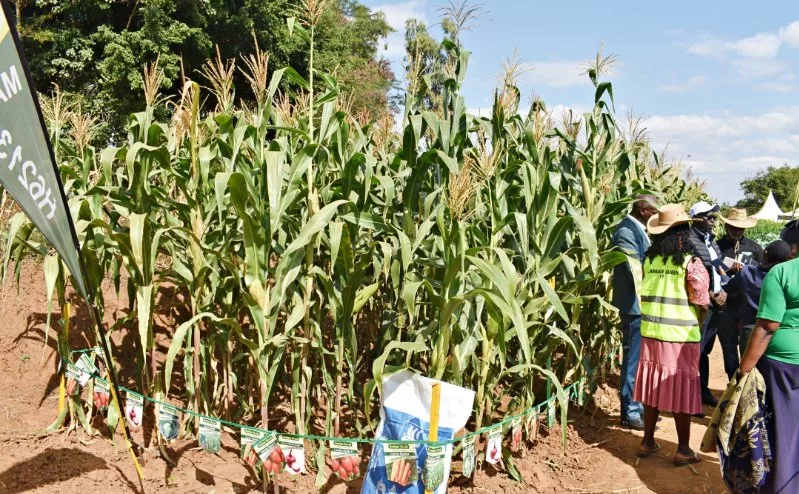
 A maturing drought-tolerant maize crop at the demonstration plot belonging to the Simlaw Seed Company at the Kitui Agricultural Training Centre on Wednesday/Musembi Nzengu.
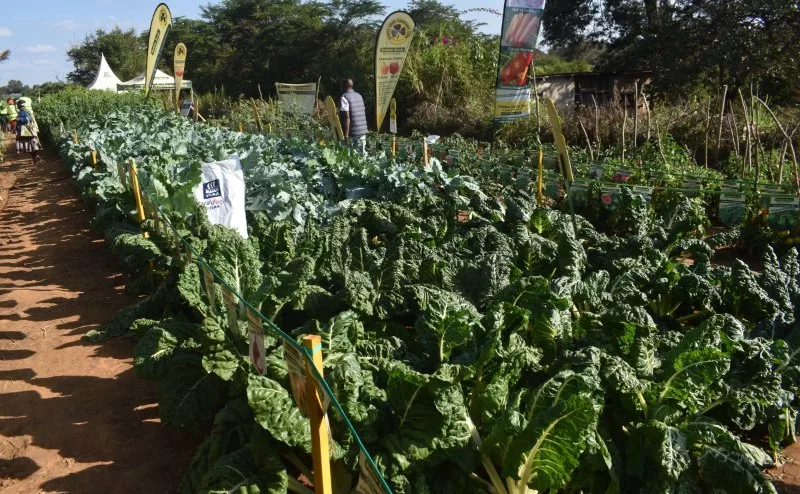 A vegetable demonstration plot belonging to the Simlaw Seed Company at the Kitui Agricultural Training Centre on Wednesday/Musembi Nzengu.
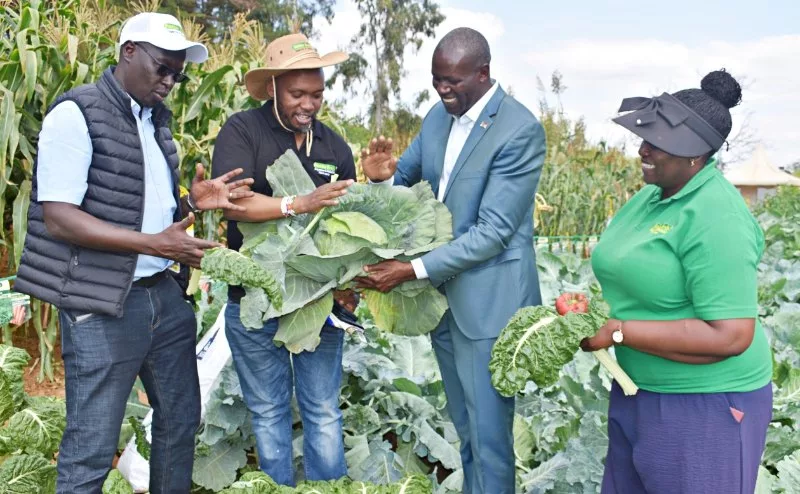 The Kitui CEC for agriculture Stephen Kimwele, the chairman of the Simlaw Seeds Company Benard Wambwa and the Simlaw General manager David Kiplagat admire a giant cabbage grown at Simlaw’s demonstration farm at the Kitui Agricultural Training Centre on Wednesday. Also in the photo is the Simlaw marketing manager Rosslynne Nyangi/Musembi Nzengu.
Read Also
The Kitui County Government has invited development partners and agricultural stakeholders to join efforts to break the cycle of low crop production and chronic food insecurity in the county.
Agriculture and Livestock executive Stephen Kimwele said achieving food security and increasing agricultural productivity remain among the top priorities of Governor Julius Malombe's administration.
"We are inviting all partners who can help us eliminate hunger in Kitui. We are ready to collaborate with organisations that can introduce technologies and innovations to improve agricultural productivity despite the challenges posed by climate change and unreliable rainfall," Kimwele said.
He reaffirmed the county government's commitment to working with development partners to improve agricultural production, increase farm yields and enable residents to become self-reliant in food production.
Kimwele spoke during a Farmers' Field Day at the Kitui Agricultural Training Centre, where the county government partnered with Simlaw Seeds Company to showcase improved seed varieties and modern farming technologies.
He welcomed Simlaw's decision to establish a demonstration farm at the training centre, saying it would give local farmers an opportunity to learn about high-yielding, drought-tolerant crop varieties suited to the region.
More than 5,000 farmers from across Kitui attended the field day to learn modern farming techniques and assess the performance of improved seed varieties under local conditions.
Kimwele said farmers had witnessed first-hand the potential of improved seed varieties.
"You have seen the giant cabbages, the large maize cobs on healthy green stalks and vegetables thriving despite the current dry season. This demonstrates the potential of quality seeds and good farming practices," he said.
He urged farmers to embrace modern, climate-smart farming methods as climate change and erratic rainfall continue to threaten agricultural production.
"It is evident that rainfall in our region is becoming increasingly unreliable. If we listen to agricultural experts and adopt climate-smart agriculture, including irrigation where possible, we can consistently achieve good harvests," he said.
Kimwele said his department would continue training farmers through field days, demonstration farms and annual agricultural shows to promote technologies that guarantee higher yields and improved food security.
Simlaw Seeds Board chairman Bernard Wambwa said the company partnered with the county government to demonstrate that farmers can still achieve high yields, even with limited rainfall, by planting quality, climate-resilient seed varieties.
"Through this field day, we have informed farmers that quality seed is readily available through our stockists,” he said.
“If they follow the recommended agronomic practices shared during the training, we can collectively defeat hunger in Kitui," Wambwa said.
Simlaw Seeds general manager David Kiplagat said the partnership has demonstrated that introducing drought-escaping crop varieties can significantly improve food production in arid and semi-arid areas.
"It is now clear that, even under unreliable rainfall, farmers can achieve good harvests by using the right seed varieties alongside appropriate farming practices," he said.
INSTANT ANALYSIS
Kitui's appeal for partnerships reflects a broader reality facing Kenya's arid and semi-arid counties: food security can no longer depend on rainfall alone. As climate change makes weather patterns increasingly unpredictable, counties are shifting towards climate-smart agriculture, improved seed varieties and stronger collaboration with the private sector.
Demonstration farms and farmer training can accelerate the adoption of new technologies. However, sustained success will depend on access to quality inputs, irrigation, extension services and reliable markets. If these investments are maintained, Kitui could reduce its dependence on food relief while building a more resilient agricultural economy capable of withstanding climate shocks.