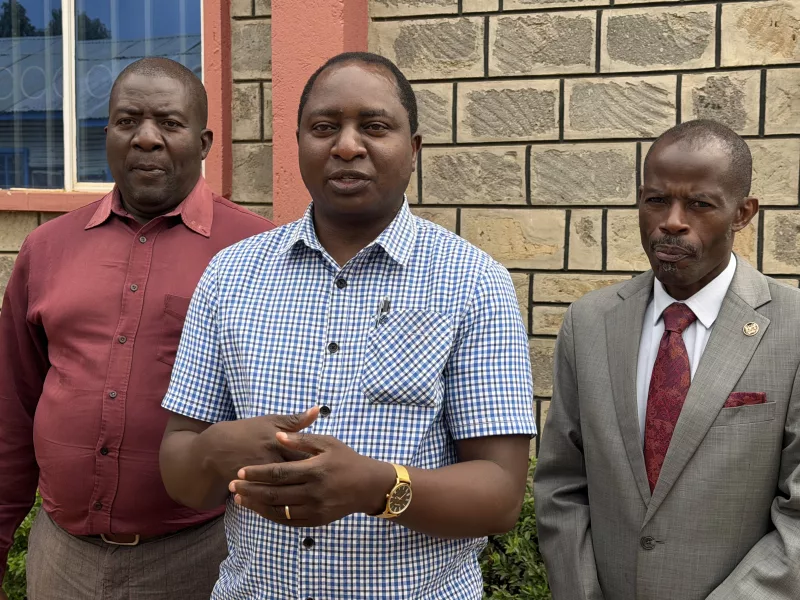
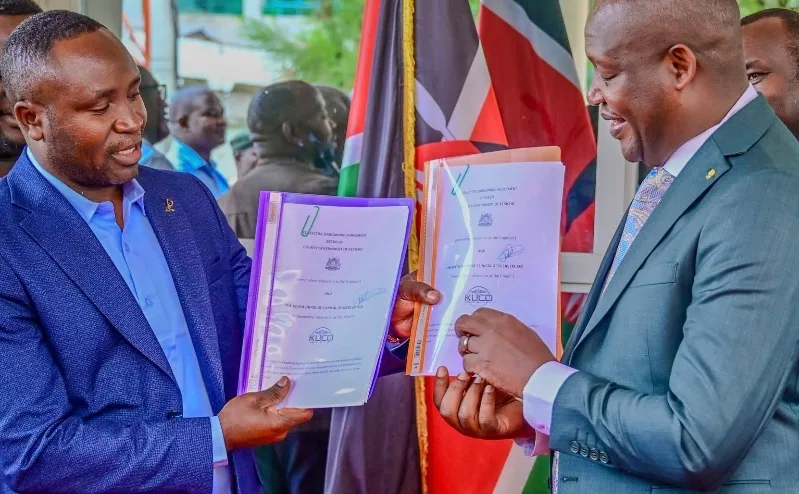
 Clinical officers union general secretary George Kibore and Governor Erick Mutai after signing a return-to-work
agreement at the county headquarters in Kericho town on Wednesday /MATHEWS NDANYI
Clinical officers union general secretary George Kibore and Governor Erick Mutai after signing a return-to-work
agreement at the county headquarters in Kericho town on Wednesday /MATHEWS NDANYIClinical officers in Kericho have resumed duty after ending a month-long strike, even as a nationwide nurses' strike continues to disrupt services across public hospitals in the North Rift.
The return to work of the clinical officers followed the signing of a Collective Bargaining Agreement (CBA) between the Kericho county government and the Kenya Union of Clinical Officers (KUCO).
Elsewhere in Uasin Gishu, Nandi, Trans Nzoia, Elgeyo Marakwet, Baringo counties, the nurses'strike has persisted with manu hospitals struggling to offer services.
Kenya National Union of Nurses
official Kevin Kimutai said nurses form the backbone of healthcare delivery and
that hospitals would be severely affected in their absence.
The governor also condemned the invasion of one of the county's hospitals during the strike by people he described as goons, saying the incident endangered vulnerable patients.
Mutai said healthcare facilities should remain places of healing and must be protected from violence, intimidation and any acts that put the lives of patients and healthcare workers at risk.
He commended both the county's negotiating team and the KUCO leadership for reaching an amicable settlement in the interest of Kericho residents.
Instant analysis
The end of the clinical officers' strike in Kericho offers some relief, but the simultaneous nurses' strike means the county, like much of Kenya, remains caught in a wider health workforce crisis. It underscores the fragility of public healthcare, where resolving one labour dispute does little if another erupts. The recurring industrial actions also expose persistent failures by county governments to honour collective bargaining agreements, promotions and salary obligations. For patients, the consequences are immediate: delayed treatment, overcrowded facilities and interrupted essential services. Unless governments address the underlying labour grievances, Kenya's public health system will remain vulnerable to repeated disruptions.