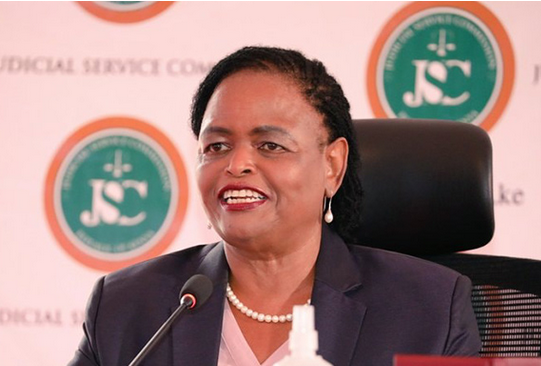
 Chief Justice Martha Koome/MARTHA KOOME/X
The Judicial Service Commission (JSC) has warned against the disruption of court proceedings in the name of demanding accountability, saying such actions undermine access to justice and delay the determination of cases.
The Commission said it had taken note of the Law Society of Kenya’s (LSK) call for a targeted boycott of judges and judicial officers, but cautioned that the boycott should not be used to interfere with court proceedings.
The warning came after the JSC held a consultative meeting with the leadership and members of LSK and the Senior Counsel Bar yesterday to discuss judicial accountability, institutional integrity and the efficiency of the justice system.
The commission, chaired by Chief Justice Martha Koome, said it recognised concerns raised about accountability but insisted that complaints against judicial officers should be handled through constitutional and legal mechanisms.
“Such actions do not advance judicial accountability. Instead, they impede the administration of justice, inconvenience litigants, delay the determination of cases and undermine the constitutional right of every person to have disputes heard and determined fairly and without unreasonable delay,” JSC said.
The commission also disclosed that it had received 506 petitions and complaints against judges and judicial officers this year, with 417 already processed.
The remaining matters, it said, were at different stages of the disciplinary process, including formal hearings and awaiting responses from affected judicial officers.
“These matters are being handled diligently, fairly and strictly in accordance with the Constitution and the Judicial Service Act to accord the parties the required due process,” the commission said.
The JSC further sought to demonstrate its record on disciplinary action, saying that since 2011 it had recommended the removal of 10 judges and the appointment of constitutional tribunals to investigate their conduct.
Four of the judges were subsequently removed from office.
“These outcomes demonstrate the Commission’s unwavering commitment to ensuring that judges and judicial officers uphold the highest standards of integrity, professionalism and accountability,” it said.
The commission said it was also pursuing reforms aimed at increasing transparency, including a policy providing for publication of individual performance data for judges and judicial officers.
Although the policy is currently the subject of litigation, the Judiciary said it was validating the data in readiness for publication, subject to the outcome of the case.
“This will be the first time that the Judiciary and the Judicial Service Commission publish individual performance data, demonstrating a bold commitment to openness, institutional accountability and public scrutiny,” the JSC said.
The commission cited court performance figures for the 2024/25 financial year as further evidence of ongoing efforts to improve efficiency.
The Supreme Court recorded a performance score of 96.30 per cent, while the Court of Appeal scored 84.97 per cent and the High Court 86.80 per cent. The Magistrates’ Courts scored 87.12 per cent, while the Environment and Land Court posted 87.12 per cent.
The Kadhi Courts were among the top performers at 95.41 per cent.
The JSC also said it had developed the Judicial Service (Petition for Removal of a Judge) (Procedure) Regulations, 2026, which are before Parliament.
The regulations seek to establish a clear and transparent framework for handling petitions seeking the removal of judges.
At the same time, the commission condemned threats, intimidation and cyberbullying targeting judges, judicial officers, staff and advocates.
“While constructive criticism and public scrutiny are essential to accountability, personal attacks, threats and deliberate campaigns of vilification undermine the dignity of individuals and public confidence in the administration of justice,” it said.
The JSC said it would continue working with LSK to combat corruption and unethical conduct in both the Judiciary and the Bar, while urging complainants to use established disciplinary channels.
“The Judiciary will continue to discharge its constitutional mandate without fear, favour or prejudice,” the commission said, assuring Kenyans of continued access to fair and impartial justice.
The commission said accountability and judicial independence were not competing ideals but “complementary pillars of the rule of law”.
![Hamisi Mwaguya [in coulored baseball cap] at the Kings Arena at Khadija estate in Nyali subcounty on Tuesday / BRIAN OTIENO](https://cdn.radioafrica.digital/image/2026/10/340e650a-21d8-475b-b658-a429e82e9367.jfif)