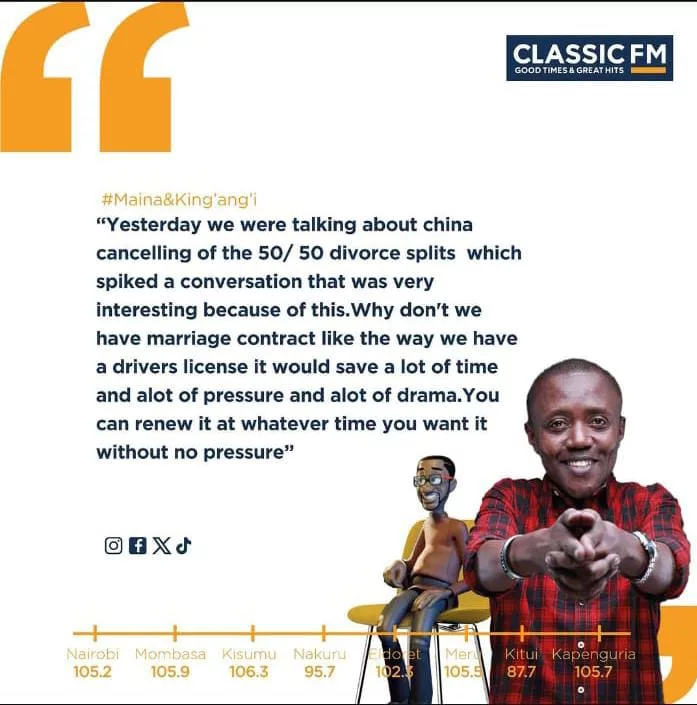
Classic 105 radio presenter Maina Kageni has ignited debate after suggesting that marriages could operate under renewable contracts rather than lifetime commitments, arguing that such a system could reduce conflict and lengthy divorce battles.
Speaking on the Maina & King'ang'i breakfast show, Kageni shared the idea while discussing reports about changes to divorce-related property division in China.
Advertisement
Advertisement
The conversation centred on financial contribution during marriage and whether current divorce processes fairly recognise both monetary and non-monetary support.
"Why don't we have marriage contracts like the way we have a driver's licence? It would save a lot of time, a lot of pressure and a lot of drama. You can renew it at whatever time you want without pressure," Kageni said.
He compared marriage to driving, noting that motorists undergo training, pass tests and renew their licences periodically, while marriage is often entered into with little formal preparation.
Advertisement
Advertisement
Discussion sparked by China's divorce laws
The presenters' conversation was prompted by discussions surrounding China's approach to divorce settlements.
During the show, they referenced reports that courts require evidence of each spouse's financial contribution when determining property distribution after divorce.
While discussing the issue, co-host Mwalimu King'ang'i questioned whether financial contribution should be the only measure used when marriages come to an end.
"There is something men don't understand, and it's the contribution of your woman to make sure you thrive mentally, succeed in your business and be happy," Kageni argued.
Maina and King'ang'i Breakfast Show // Instagram
King'ang'i added that many women contribute to a household in ways that are not reflected in bank statements.
"Ladies, you marry a man, you take care of him, prepare his favourite meals, and he starts thriving. She has invested her time and has also raised children who become your heirs. Does a woman have to make a financial contribution in a marriage, and ladies, is that fair?" King'ang'i posed.
Recognition of unpaid care work
The discussion touched on a long-standing debate over whether unpaid domestic work should be recognised during divorce proceedings.
According to UN Women, unpaid care and domestic work—including cooking, cleaning, childcare and caring for family members—contributes significantly to households and economies but often goes unrecognised because it is not financially compensated.
Similarly, Kenya's Matrimonial Property Act, 2013 recognises both monetary and non-monetary contributions when determining ownership of matrimonial property.
Non-monetary contributions may include childcare, companionship, domestic work, management of family businesses and farm work.
Marriage proposal sparks online debate.
Kageni's proposal of renewable marriage contracts quickly generated conversation among listeners, with many weighing the balance between lifelong commitment and modern relationship realities.
While some may see fixed-term marriage contracts as a practical way to reduce disputes if relationships fail, others argue that marriage is built on permanence rather than periodic renewal.
The Classic Conversation // Instagram
The conversation has once again highlighted changing attitudes towards marriage, divorce and the evolving definition of partnership, while raising broader questions about how societies value both financial contributions and the less visible work that keeps families together.