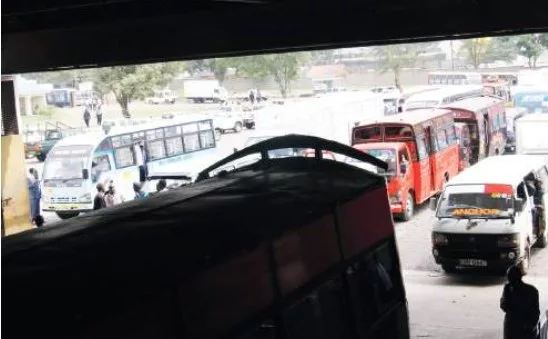
 Vehicles at the inspection unit headquarters on Likoni Road, Nairobi /FILE
Public service vehicle inspectors will be licensed and subjected to strict regulation by the National Transport and Safety Authority if a new Bill before Parliament becomes law.
The National Transport and Safety Authority (Amendment) Bill, 2026, seeks to establish a framework for regulating conformity assessors.
The assessors are responsible for certifying that buses, matatus and other PSVs comply with approved safety and technical standards.
The Bill, sponsored by Meru Senator Kathuri Murungi, is intended to eliminate conflicts of interest that has long characterised the inspection of public service vehicles.
"The principal object of this Bill is to amend the National Transport and Safety Authority Act to regulate public service vehicles conformity assessors," the Bill states.
There is currently no law governing the assessment of PSVs, leaving the process largely under the Kenya Association of Bus Manufacturers.
"There is no legal provision that regulates the assessment of public service vehicles and as such public service vehicle assessors have been carrying out assessment through the Kenya Association of Bus Manufacturers which led to a conflict of interest as the membership of the association comprises of owners of public service vehicles," the Bill states.
The Bill also expands NTSA's mandate by empowering the authority to register and license conformity assessors.
Under the proposed law, anyone wishing to operate as a conformity assessor must first obtain a licence from NTSA.
However, applicants will have to demonstrate that they are completely independent from the businesses whose vehicles they inspect.
The legislation bars conformity assessors from participating in the design, manufacture, supply, installation, ownership, purchase or maintenance of vehicles they certify.
It also prohibits the licensing of assessors linked to companies or individuals engaged in those activities.
"The authority shall before issuance of a licence satisfy itself that the conformity assessor is not engaged in the following activities with respect to the items to be inspected—design and manufacture, supply, installation, purchase and ownership, or maintenance," the Bill states.
"The authority shall, before issuance of a licence, satisfy itself that the conformity assessor is not linked to a person that is engaged in activities listed."
Licences issued under the proposed law will remain valid for three years before they are due for renewal.
The Bill also gives NTSA sweeping powers to regulate the inspection process.
The Authority will prescribe the criteria used during conformity assessments, designate conformity assessors every three years and carry out periodic audits to ensure compliance with the law.
"The authority shall prescribe a criterion for conducting the conformity assessment," the Bill states.
It further provides that NTSA shall conduct periodic audit on conformity assessors to ensure compliance with the provisions of the law.
After each inspection, conformity assessors must also submit technical reports to NTSA.
The reports will enable the authority to monitor compliance and strengthen oversight.
"Upon completion of the assessment... the conformity assessor shall submit a technical report to the authority," the Bill says.
The proposed reforms are expected to improve accountability and transparency in the certification of public service vehicles by separating inspectors from commercial interests in the transport industry.
Lawmakers believe the changes will help ensure that only vehicles that meet approved construction and safety standards are allowed on the roads.
INSTANT ANALYSIS
The proposed amendments seek to close a regulatory gap by introducing independent licensing and oversight of public service vehicle conformity assessors. By separating inspectors from manufacturers, owners and installers, the Bill aims to eliminate conflicts of interest that could compromise vehicle safety. If enacted, it would strengthen NTSA's enforcement role, improve accountability in PSV inspections and enhance public confidence in the safety and roadworthiness of Kenya's public transport fleet.