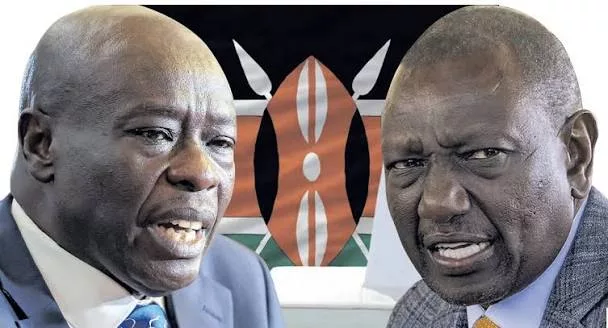
The renewed push to politically distinguish Mt Kenya East from Mt Kenya West has evolved from a regional identity debate into one of the most significant political battles ahead of the 2027 General Election, with implications for President William Ruto's re-election strategy and DCP leader Rigathi Gachagua's efforts to consolidate the mountain vote.
What began as Public Service Cabinet Secretary Geoffrey Ruku's call for Meru, Embu and Tharaka Nithi counties to chart their own political path has reopened the debate over the political future of Mt Kenya, with leaders including Deputy President Kithure Kindiki and Gachagua calling for the region to remain united.
The stakes are high because the region remains one of the largest electoral blocs.
According to the 2022 voters' register, Mt Kenya West, comprising Kiambu, Murang'a, Nyeri, Kirinyaga and Nyandarua, has 3,114,735 registered voters, representing 14.1 per cent of the national electorate.
Mt Kenya East, made up of Meru, Embu and Tharaka Nithi, has 1,338,373 registered voters, accounting for 6.1 per cent nationally.
Combined, the broader Mt Kenya region commands more than 4.45 million voters, over one-fifth of the country's electorate, making it a decisive battleground in any presidential contest.
Political analysts say the outcome of the debate could determine whether Mt Kenya heads into 2027 as one formidable voting bloc or as competing political centres, a scenario that would significantly reshape the presidential contest.
Ruku has in recent weeks intensified calls for Mt Kenya East counties to distance themselves politically from what is traditionally known as Mt Kenya West.
His latest social media posts left little doubt about his position.
"We as Mt. Kenya East do not care what happens in Mt. Kenya West," he wrote.
In another post, he declared: "We don't care! We're Mt. Kenya East!"
He followed it with another provocative message saying: "Mambo ya West kutukulia kwa mfuko kama njugu karanga imekwisha. Liberation has come early."
His remarks came as political temperatures remained high following the Ol Kalou parliamentary by-election.
The CS has consistently argued that Meru, Embu and Tharaka Nithi have long been treated as junior partners within the broader Mt Kenya political formation.
Speaking during a church service in Igembe Central on June 13, Ruku argued that leaders from Mt Kenya East had been sidelined despite their contribution to Kenya's liberation struggle.
"I want to categorically state that Merus are not Kikuyus. When professionals from Kiambu or Murang'a get jobs, it is said the Mountain has gotten its share. How is that possible?" he posed.
"The time has come; we divorce as a mountain because if you do not support our son Kithure Kindiki and we have supported you all along, then clearly let's split the mountain."
The remarks immediately drew criticism from leaders allied to both President Ruto and DP Kindiki.
Energy Principal Secretary Alex Wachira dismissed the proposal while speaking in Narumoru on June 15, insisting the Mountain had always derived its strength from unity.
Wachira argued that Mt Kenya East had benefited whenever leaders from the wider region held power, citing appointments during former President Mwai Kibaki's administration, including Njeru Ndwiga, Kiraitu Murungi, David Mwiraria and former Head of Public Service Francis Muthaura.
He urged residents to support President Ruto's second-term bid before rallying behind one united regional candidate in 2032.
Nyeri Senator Wahome Wamatinga and Kieni MP Njoroge Wainaina also backed calls for unity.
Kindiki has equally rejected attempts to create political fault lines within the region.
Without directly mentioning Ruku, Kindiki appealed for restraint and warned leaders against promoting narratives that divide Kenyans.
"This is our country, and whenever we have disagreements, let us exercise moderation because there is tomorrow. Let us not destroy relationships that have been built over centuries because of temporary issues," Kindiki said.
"We are together. We are one community and one country, and we have no other home to go to. We are one family, from the Coast to Western, from Northeastern to the Rift Valley and Central Kenya. Kenya is our homeland, and we must protect it, love it and live together in peace."
In a surprising political twist, Gachagua, who has repeatedly criticised Kindiki over the past year, publicly backed the Deputy President's position on the Mt Kenya unity debate.
Speaking on Monday, July 20, Gachagua praised Kindiki for opposing attempts to split the region.
"Kindiki made a statement which made me happy. Yesterday, he said the Mountain was one and should not be divided. For what it's worth, you are right because the only way Ruto can come back as President is if the Mountain is divided," Gachagua said.
He went further and appealed to Mt Kenya residents to ease their attacks on Kindiki despite their political differences.
"The toxic political environment requires us to protect our own," Gachagua said.
He described Mt Kenya as Kindiki's political home and urged supporters to redirect their political fire towards President Ruto and Interior Cabinet Secretary Kipchumba Murkomen instead.
The remarks marked the first time the two fierce rivals have found themselves on the same side of a major regional political issue.
Analysts say Gachagua's unexpected defence of Kindiki underscores the seriousness with which he views the Mt Kenya East debate.
According to political observers, Gachagua's entire 2027 strategy depends on presenting Mt Kenya as one united political constituency capable of negotiating with presidential candidates from a position of strength.
If Meru, Embu and Tharaka Nithi embrace a separate political identity under leaders allied to President Ruto, Gachagua's influence across the region could diminish considerably.
Instead of commanding one consolidated voting bloc, he would have to compete with another power centre led by Kindiki and Ruto's allies.
Such fragmentation would weaken his bargaining power and complicate efforts to rally the entire region behind one political direction.
For President Ruto, however, the debate presents a potential political opportunity.
Kindiki remains one of the administration's most influential figures in Mt Kenya East.
Should the eastern counties increasingly identify with Kindiki while sections of Mt Kenya West remain aligned to Gachagua, the President could retain significant support within the broader region despite deteriorating relations with some western counties.
Rather than confronting one united regional voting bloc, Ruto would face a divided political landscape where different leaders command influence in different counties.
That fragmentation could work to his advantage in a tightly contested presidential race.
Former Kirinyaga Woman Representative Wambui Ngirici has also criticised Ruku's remarks, arguing that he was speaking beyond his mandate.
"Dear CS Geoffrey Ruku, 'we' is a very expensive pronoun. Unless you're expecting a baby, kindly stick to 'I'. Otherwise, your vote is just one among millions in the Mountain. Please don't issue collective certificates on behalf of everyone," she posted.
The exchange has exposed growing ideological differences over the future of Mt Kenya politics.
Those opposed to the split argue that the region's greatest political strength has always been its unity, allowing it to negotiate for Cabinet positions, development projects and national leadership as one bloc.
Supporters of the Mt Kenya East identity, however, insist the eastern counties deserve greater political recognition and should no longer be viewed merely as extensions of Kikuyu-dominated politics.
Whether Ruku's campaign gains momentum remains uncertain.
But the debate has already achieved one outcome: it has forced political rivals, including Kindiki and Gachagua, onto the same side of an argument they both believe is crucial to the region's political future.
As campaigns gradually gather pace towards 2027, the battle may no longer simply be between Kenya Kwanza and the opposition.
It may also be over whether Mt Kenya remains one political mountain, or becomes two.
For Gachagua, the numbers explain why he has moved swiftly to defend the unity of the Mountain.
His political strategy hinges on presenting the entire Mt Kenya region as a single negotiating bloc worth more than 4.45 million votes.
Losing the 1.34 million voters in Mt Kenya East to a separate political identity aligned with Kindiki would significantly weaken his claim to speak for the entire region and diminish his leverage in coalition negotiations ahead of 2027.
For Ruto, however, a politically distinct Mt Kenya East could prove advantageous.
Rather than confronting a united voting bloc of more than 4.45 million voters, he could retain substantial support from the region through Kindiki and leaders in Meru, Embu and Tharaka Nithi, while Gachagua consolidates only parts of Mt Kenya West.
Such a split would reduce the likelihood of a unified anti-Ruto voting bloc emerging from the Mountain, making the East–West debate one of the most consequential political contests to watch as Kenya heads towards the 2027 General Election.