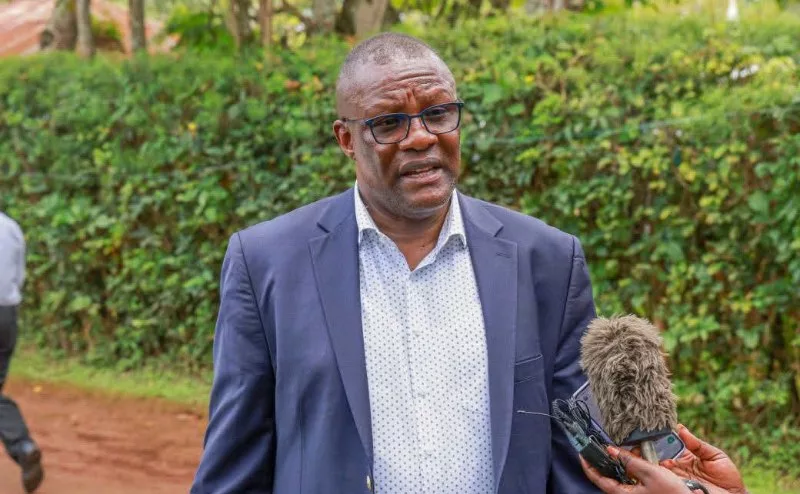
 Presidential candidate Eliud Owalo speaking to the media in Ugenya, Siaya County./Faith Matete
 Presidential candidate Eliud Owalo has criticised the growing culture of political handouts, saying Kenya must move away from leaders dishing out money and instead focus on sustainable economic empowerment.
Owalo said politicians who distribute large sums of money to crowds should be held accountable for the source of their wealth, warning that handouts only offer temporary relief without addressing the economic challenges facing citizens.
"Handouts are not development and handouts are not sustainable,” Owalo said while speaking in Ugenya.
He said the country needed to create sustainable opportunities for young people and women instead of relying on cash donations, which he said could not guarantee the wellbeing of beneficiaries beyond the day the money was given.
Owalo, who is a presidential candidate under the newly unveiled People’s Prosperity Party, said the party was anchored on the ideology of distributed social democracy, which seeks to move resources from the hands of a few individuals and distribute them more equitably among Kenyans.
He said the party's agenda includes reducing taxes and public debt, fighting corruption, reforming the education sector, improving public health services, transforming Kenya into a leading sporting nation in Africa, expanding opportunities for young people in the digital and creative economy and upholding the rule of law.
Owalo said the party would now embark on opening offices across the country and recruiting members as it builds its structures ahead of the 2027 General Election.
He also condemned the use of young people by politicians to perpetrate violence against opponents, saying political differences should not be allowed to breed hatred and enmity.
“We should differ in political opinion, but that should not be a source of enmity amongst ourselves,” he said.
Owalo said the lack of employment and livelihood opportunities had left many young people vulnerable to manipulation by politicians, who use them to unleash violence during political contests.
He called for issue-based politics, saying politicians should be allowed to present their policies and development agendas to voters on a level playing field.
On youth empowerment, Owalo said his party would focus on expanding opportunities in the digital and creative economy as well as sports, noting that traditional white-collar jobs were increasingly unavailable.
He also proposed the formation of women into cooperative societies to enable them to pool resources, improve their bargaining power and access financial support from donors and other institutions.
Owalo said empowering women and young people would help expand Kenya's tax base and economic productivity, arguing that millions of Kenyans were currently unable to contribute to the tax system because they lacked sustainable sources of livelihood.
He said the party would seek to increase the participation of women and young people in political leadership, including through possible nomination incentives when the time comes.
Owalo urged Kenyans to join the People’s Prosperity Party, which he described as an issue-based political outfit seeking to address the challenges facing ordinary citizens.