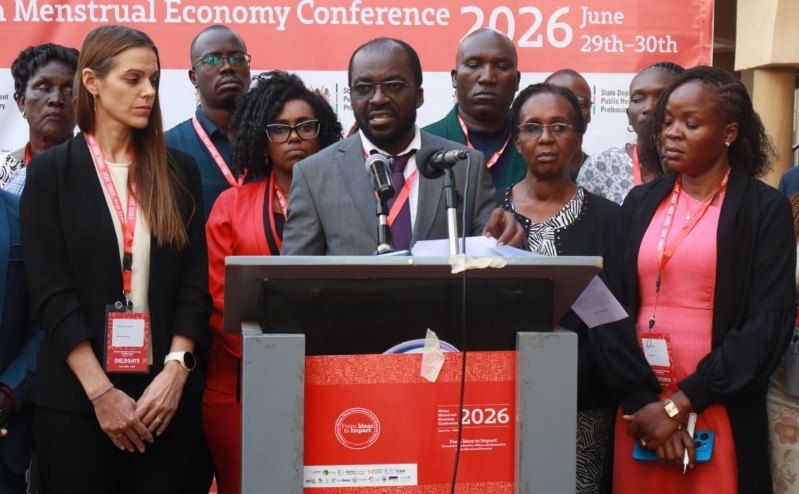
 Head of policy, advocacy and research at the center for African progress(CentAPro), Alex Manyasi , alongside other delegates during a press presentation in Nairobi/HANDOUT
Kenya has adopted a new declaration to position menstrual health as a strategic national growth sector, marking a shift from viewing menstruation primarily as a public health concern to recognising it as an emerging economic opportunity.
The declaration was adopted at the inaugural Kenya Menstrual Economy Conference (KMEC) held in Nairobi on June 29–30, 2026, under the theme “Ideas to Impact: Strengthening Markets, Policy and Innovation in Kenya’s Menstrual Economy.”
The conference brought together the Ministry of Investments, Trade and Industry, county governments, development partners, manufacturers, investors, researchers, financial institutions, civil society organisations and other stakeholders.
State Department for Industry Principal Secretary Juma Mukhwana, while officiating the two-day conference in Nairobi, said the country must move beyond viewing menstruation solely as a health issue and recognise it as an economic opportunity that cuts across various industries.
"We must move beyond seeing menstruation as simply a biological function and prioritise initiatives that build a vibrant menstrual economy, which creates jobs, expands manufacturing, supports innovation and ensures that every woman has access to affordable, safe and quality menstrual health products,” he said.
Participants agreed that investment in menstrual health and hygiene extends beyond dignity and health outcomes and represents an underdeveloped economic sector with potential to contribute to industrialisation, enterprise growth, innovation, employment creation and women’s economic empowerment.
According to the declaration, Kenya’s menstrual economy is currently estimated at 100 million US dollars in investment value and has installed production capacity exceeding two billion sanitary pads annually, although current output remains below 50 per cent.
Stakeholders resolved to formally integrate the menstrual economy into Kenya’s industrialisation and investment agenda under the Bottom-Up Economic Transformation Agenda (BETA), Vision 2030 and other national development priorities.
The declaration also commits stakeholders to support local manufacturing, strengthen value chains and expand opportunities for women-led enterprises, youth innovators and micro, small and medium enterprises.
As part of the roadmap, participants agreed to establish a Multi-Agency Action Plan on the Menstrual Economy under the leadership of the Ministry of Investments, Trade and Industry.
The framework will bring together national and county governments, development partners, manufacturers, financial institutions, and research institutions to coordinate implementation.
Stakeholders further committed to undertaking Kenya’s first nationally coordinated Menstrual Health Economy Market Assessment to generate data on the size, competitiveness and investment potential of the sector.
The findings are expected to guide future policy, regulation, taxation, certification, procurement, and investment reforms.
The declaration also proposes measures to improve access to finance, promote research and innovation, encourage public-private partnerships and strengthen market access for locally manufactured menstrual health products.
Environmental sustainability also featured prominently in the commitments, with stakeholders backing implementation of menstrual waste management guidelines, promotion of circular economy practices and environmentally responsible production systems.
To ensure follow-through, participants agreed to establish an implementation and accountability framework, publish periodic progress reports, and present annual updates during future Kenya Menstrual Economy Conferences.
The declaration positions Kenya as seeking to become a regional leader in menstrual health manufacturing and innovation while expanding access, creating jobs and improving the health and dignity of women and girls.