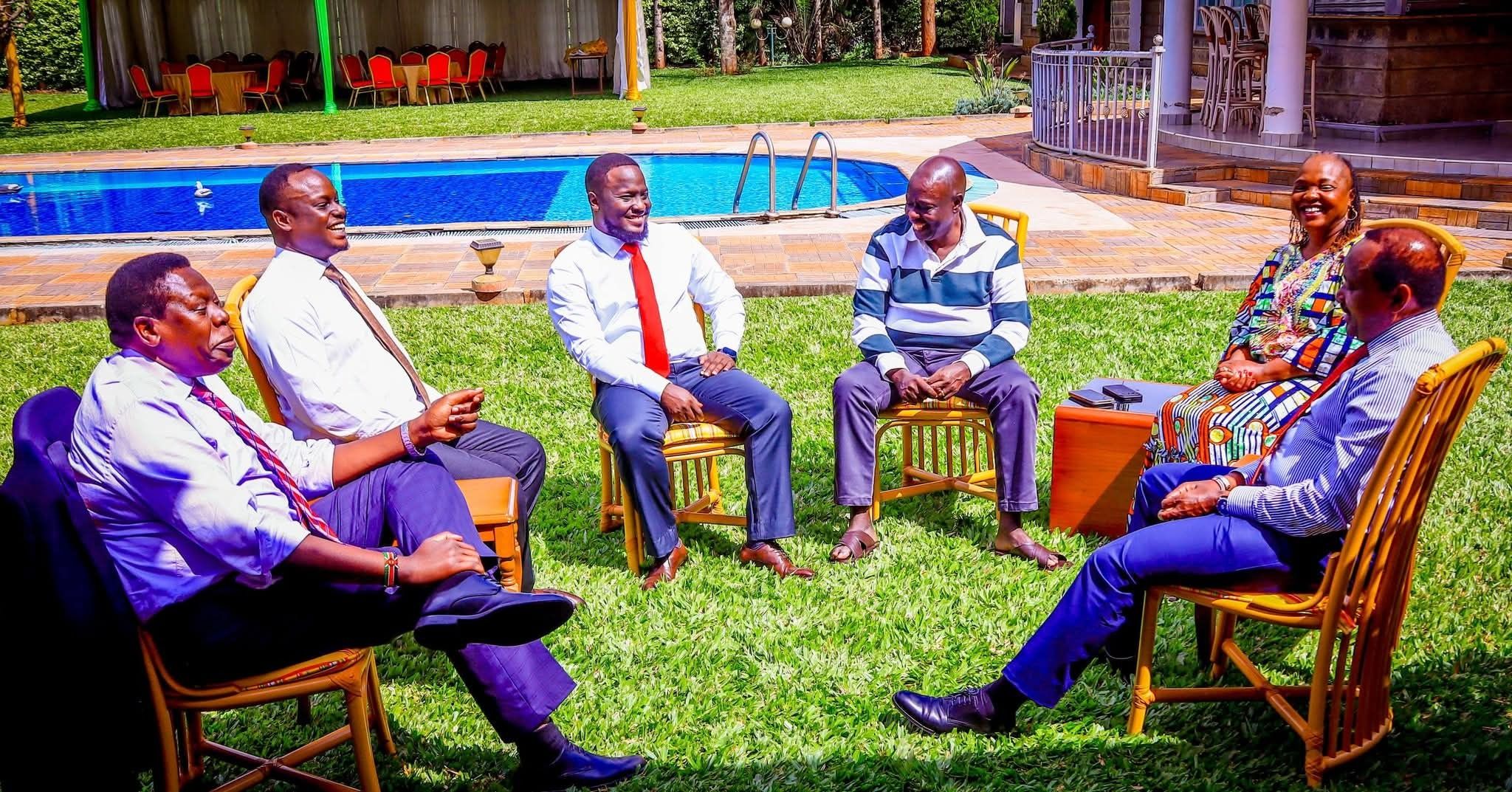
 Rigathi Gachagua (centre) with his sons, spouse Pastor Dorcas Rigathi, and United Opposition co-principals Kalonzo Musyoka and Eugene Wamalwa at his Karen home as they await the court's verdict in his impeachment case on June 8, 2026. /DCP/X
Former Deputy President Rigathi Gachagua on Monday hosted opposition co-principals Kalonzo Musyoka and Eugene Wamalwa at his Karen residence as a three-judge bench delivered its highly anticipated verdict in the case challenging his impeachment from office.
The ruling could significantly influence both his political future and the shape of the opposition ahead of the 2027 General Election.
Photos shared on the Democracy for Citizens Party (DCP) social media platforms showed Gachagua, Kalonzo and Wamalwa in a relaxed mood as the opposition leaders waited for the High Court's verdict in the consolidated petitions challenging Gachagua's impeachment.
Also present were former Second Lady Pastor Dorcas Rigathi and the couple's two sons.
The judgment was being delivered by a three-judge bench comprising Justices Eric Ogola, Anthony Murima and Freda Mugambi.
The show of solidarity underscored Gachagua's growing stature within the United Opposition, a coalition of leaders seeking to unseat President William Ruto in the 2027 General Election.
Although the ruling centres on the legality of Gachagua's removal from office in October 2024, its political ramifications extend far beyond the courtroom.
Gachagua has recently declared himself the most suitable candidate to face Ruto in 2027, citing his influence in Mt Kenya and his ability to rally opposition forces against the incumbent president.
His allies have increasingly framed him as the natural choice to lead the coalition's challenge, even as other prominent figures continue to eye the top seat.
Gachagua has openly argued that the Mt Kenya region remains the country's single most decisive voting bloc, as his allies view a favourable court ruling as a major political boost that would strengthen his standing within the opposition and reinforce his claim to lead the coalition into the next election.
Political spectators have, however, pointed out that that stance could trigger fault lines within the opposition alliance.
A section of coalition leaders, including Martha Karua, has advocated for a scientific and evidence-based process to determine the coalition's presidential flagbearer.
The proposal is intended to avoid premature succession battles and ensure the eventual candidate enjoys broad national support.
The debate has revived memories of the events leading up to the 2013 General Election when Kalonzo found himself sidelined in favour of the alliance between Uhuru Kenyatta and William Ruto.
At the time, Kalonzo's presidential ambitions suffered a major setback after the duo argued that his Ukambani support base lacked the electoral weight required to secure victory, popularising the now-famous "tyranny of numbers" narrative.
More than a decade later, similar questions about regional voting blocs, electoral arithmetic and coalition power-sharing are beginning to surface within the opposition camp.
Recent opinion polls suggest the contest for opposition leadership remains far from settled.
A survey by Tifa Research placed President Ruto ahead with 24 per cent support. Kalonzo emerged as the highest-ranked opposition figure with 19 per cent support, followed by former Interior Cabinet Secretary Fred Matiang'i at 14 per cent.
Nairobi Senator Edwin Sifuna was ranked fourth with 10 per cent support, while Gachagua placed fifth with 9 per cent support.
Even so, Gachagua's supporters argue that opinion polls alone may not capture the influence he commands in Mt Kenya, a region widely regarded as one of the country's most critical electoral battlegrounds.
Gachagua has been working to consolidate support across the Mt Kenya region while expanding his national appeal, and a victory in the court would likely be presented by supporters as both legal vindication and political validation.
The court case stems from Gachagua's impeachment in October 2024, when he was removed from office after the Senate upheld five charges against him, including allegations relating to ethnic mobilisation, violations of the National Cohesion and Integration Act, undermining the independence of the Judiciary and gross misconduct arising from public attacks on the National Intelligence Service.
Gachagua challenged the process in court, arguing that he was denied an opportunity to adequately defend himself after falling ill and being admitted to hospital during the Senate proceedings.
While he initially sought reinstatement to office, he later abandoned that pursuit and shifted his focus to compensation and the restoration of benefits associated with the position of deputy president.
As the judges continued delivering their lengthy verdict on the consolidated petitions, whether the ruling ultimately strengthens Gachagua's standing within the opposition or intensifies competition over the coalition's presidential ticket remains uncertain.
Legal experts have nevertheless pointed out that even if the court declines to overturn his impeachment, Gachagua would still retain the option of pursuing appeals through higher courts.