
Raymond Kahuma, the Ugandan content creator known for his Guinness World Record-breaking feats, has swapped the kitchen for the catwalk.
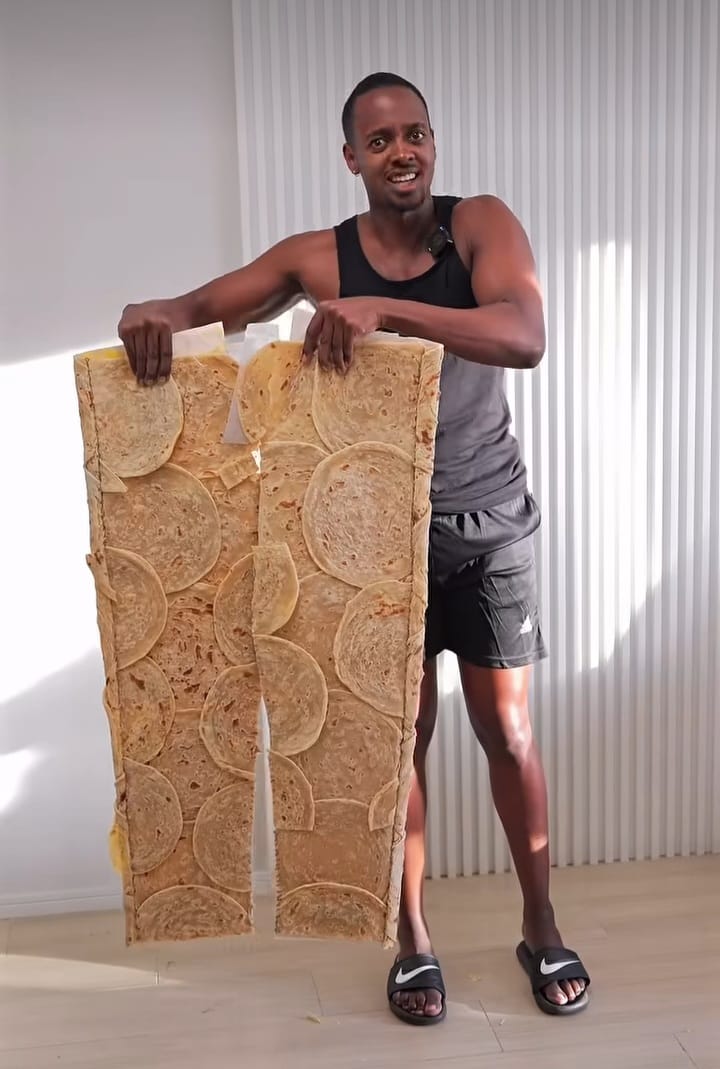
Kahuma, who made headlines in 2022 for creating the world’s largest Ugandan Rolex—a popular street food consisting of a chapati wrap—is no stranger to working with dough on a massive scale. His latest project, however, took his culinary skills into the world of fashion: constructing a functional pair of trousers entirely out of chapatis.
Mixing Flour and Fashion
The process began with the dough. Kahuma chose to use "layered chapati" to ensure the material remained soft and foldable like fabric, yet strong enough to endure the stitching process. In total, the team prepared 60 thick chapatis to serve as the "fabric" for the garment.
“Is it possible to make trousers entirely out of chapatis? To answer this question, we started by making dough for the chapatis. We needed the chapatis to be layered chapatis so they would be soft and foldable for the trouser fabric, but still very strong to stitch them together,” Kahuma said.

The construction required more than just flour and water. The team utilised thread, liquid adhesive gum, scissors, and hemming gum to bring the vision to life. To maintain a hygienic workspace, they laid down multiple layers of cling film before taking Kahuma’s specific measurements.
“In total, we made 60 thick chapatis. We also used thread, liquid adhesive gum, a pair of scissors, andhemming gum, and then we took my measurements.”
Building the Layers
Precision was key to making the bread wearable. Using the hemming gum, the team cut out four identical shapes to represent the four sides of the trousers. This provided a template for the assembly.
"We started laying the chapati one by one to fill up that outline," Kahuma explained during the build.
To secure the chapatis, liquid adhesive gum was applied to one side of each disc before sticking them onto the heming gum. Any gaps in the outline were filled with smaller, custom-cut pieces of chapati.
The front panels were then taken outside to dry in the sun, allowing the adhesive to hold the layers together permanently. This process was repeated for the rear surfaces of the trousers.
From Kitchen to Catwalk
Once the panels were dry, the tailoring began. Using scissors, the team refined the edges to ensure a clean shape. Rather than using a sewing machine, they used needles and thread to stitch directly through the thick layers of chapati along the sides.
As the panels were flipped and the side parts tucked under, the structure began to resemble traditional clothing. The final construction involved stitching the inside arc of the trousers to complete the legs.
A 10kg Wardrobe Choice
The finished garment was surprisingly substantial. While a standard pair of jeans weighs less than a kilogram, Kahuma’s chapati trousers weighed approximately 10 kg.
"Honestly, I didn't think it was possible to actually make these," Kahuma admitted.
Getting into the trousers proved to be a challenge. With the help of a tailor, Kahuma donned a formal shirt and carefully slid one foot at a time into the heavy, doughy legs.
He described the internal sensation of the garment as "really weird," noting that the interior felt "cold and very soft" against his skin. After a final stitch was added to the back to secure the fit, Kahuma was able to stand and move in the world's first pair of chapati trousers.