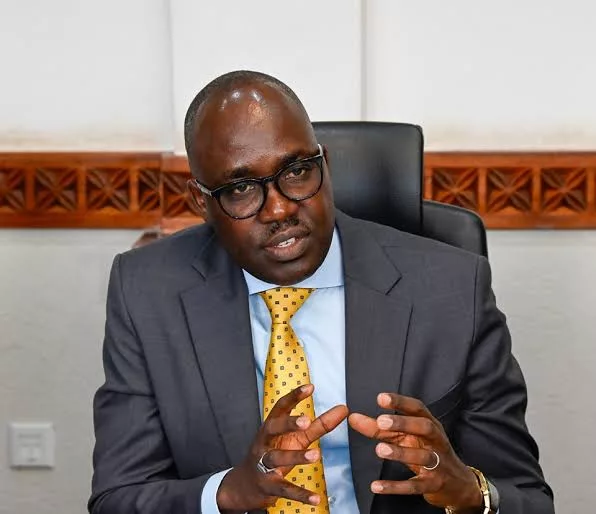
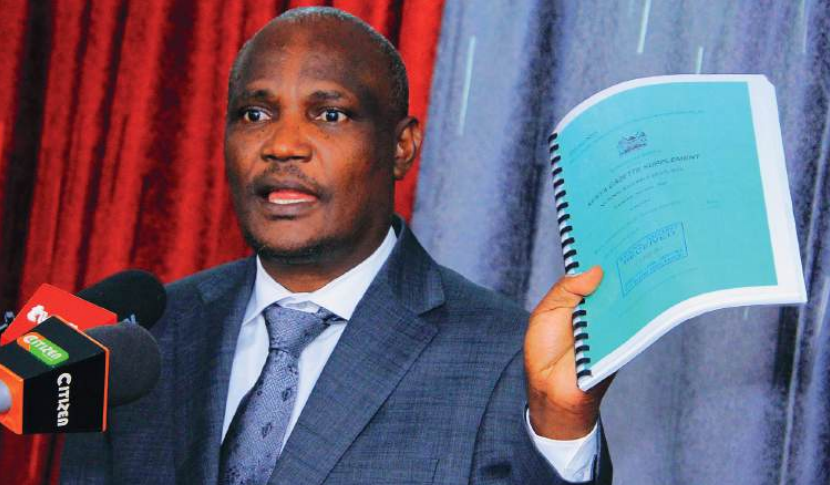
 Treasury CS John Mbadi with the 2026-27 Finance Bill during a press briefing at his office /EZEKIEL AMING’A
The Budget and Appropriations Committee approved Sh2.08 trillion for recurrent spending, which caters for salaries and operations, while Sh851 billion will finance development projects.
Security agencies are among the biggest beneficiaries of the spending plan, revealing President William Ruto’s continued prioritisation of security, education, and infrastructure.
The Ministry of Defence emerged as the single largest beneficiary among ministerial votes, receiving Sh252.1 billion.
The allocation reflects increased spending on personnel, equipment modernisation and ongoing defence industrialisation initiatives.
The amount includes an additional Sh2.1 billion for the Kenya Shipyards and for general defence operations, to cater for increased personnel numbers.
The National Intelligence Service has been allocated Sh64.1 billion, reflecting Parliament's growing emphasis on intelligence-led security operations.
NIS emerged as the single biggest winner, considering it had been allocated Sh58 billion by the Treasury before the review by the committee chaired by Alego Usonga MP Samuel Atandi.
The new allocation is Sh3 billion higher compared with the current year’s budget, which was pushed up from the initial allocation of Sh51 billion.
This means that the NIS budget has increased by Sh13 billion since July 1, 2025, when this year’s budget was rolled out. The funds are intended to boost field services, training school, and liaison offices.
The National Police Service has been allocated Sh147.4 billion, an increase of Sh12 billion from the current year’s Sh135 billion.
The State Department for Internal Security and National Administration will receive Sh63.9 billion, up from this year’s Sh56 billion.
The amounts are to support security operations, administration and disaster response functions, and are viewed from the lens of the 2027 poll preparedness.
Among the notable increases is Sh800 million for the purchase of helicopters for the police and Sh200 million to overhaul broken ones.
Internal security received a net increase of Sh8.4 billion from the initial Treasury allocations, which are also to boost the operations of Kenya Coast Guard, Private Security Regulatory Service Board and the National Disaster Operations Centre.
The Budget team has allocated Sh24.9 billion to the Independent Electoral and Boundaries Commission for management of electoral processes.
The committee noted that the allocation is intended to facilitate preparatory activities, including voter registration, boundary-related operations, and election technology requirements.
MPs observed that additional funding requirements for the election cycle will be provided in subsequent financial years, with the balance of the estimated election budget expected in the 2027-28 financial year.
“There is a need for timely funding of the commission to avoid the last-minute financing challenges that have characterised previous election cycles and to ensure adequate preparation for the 2027 polls,” the committee said.
Education continues to command a substantial share of public resources, with the sector allocated Sh781 billion, up from the current year’s Sh703 billion.
The State Department for Basic Education has been allocated Sh136.6 billion, while Higher Education was allocated Sh163.9 billion.
President Ruto has, over time, reiterated his government's commitment to financing learning institutions and implementing the Competency-Based Education programme.
“This administration has made education not just a priority, but the foundation of our future. No nation can rise above the knowledge, the capabilities, and the skills of its citizens,” Ruto said in his Madaraka Day speech.
Teachers are the big winners, with the Teachers Service Commission receiving an extra Sh1.8 billion to clear pending bills for teachers’ medical cover.
Additionally, Sh1.5 billion was added for examination invigilation, and Sh600 million for the Directorate of Quality Assurance to support CBE rollout. Junior school capitation also received an extra Sh200 million.
Road infrastructure also remains a major priority, with the State Department for Roads allocated Sh228.6 billion despite significant reductions in some development projects.
The Medical Services department will receive Sh134.7 billion to support healthcare delivery, medical supplies and ongoing reforms under the Universal Health Coverage agenda.
Independent constitutional institutions have also secured significant funding in next year’s spending plan.
Parliament has been allocated Sh50.98 billion to facilitate legislation, representation and oversight functions, up from the current Sh48 billion.
The Judiciary and Judicial Service Commission will receive Sh30.4 billion, an increment of about Sh2 billion from the current year’s budget.
The Office of the Auditor-General, whose role has become increasingly critical in exposing misuse of public funds, has received Sh9.8 billion.
Marginalised regions are expected to benefit through the Equalisation Fund, which received Sh10.25 billion to finance basic services in historically underserved areas.
Overall, the changes approved by the budget committee after reviewing agency requests resulted in a gross adjustment of about Sh31.6 billion across government.
Agriculture benefited from targeted interventions aimed at supporting cash crops and farmer incomes.
Parliament approved Sh1 billion for coffee seedling distribution, signalling a shift toward revitalisation of the coffee sector.
Sugar reforms received Sh234 million for the settlement of arrears, while coconut and cashew nut revival programmes received Sh60 million each.
Road infrastructure recorded some of the deepest reductions after Parliament removed more than Sh25.9 billion from various road projects.
Although Sh3.3 billion was subsequently added for critical road interventions, the sector still suffered a substantial net reduction.
Among the projects affected were compensation payments linked to the Nairobi Expressway and several road projects spread across counties.
The health sector also experienced significant cuts.
The Primary Healthcare Fund lost Sh1.1 billion, dealing a blow to efforts aimed at strengthening frontline healthcare services and preventive care.
Development funding for national referral and specialised hospitals was also reduced.
Universities were not spared, with Parliament cutting Sh692 million earmarked for infrastructure development in public universities.
MPs have further reduced capitation grants by Sh90 million, affecting institutions including the University of Nairobi, Moi University, Jomo Kenyatta University of Agriculture and Technology, Dedan Kimathi University and the Technical University of Kenya.
Social protection programmes also suffered reductions, with the National Social Safety Net Programme losing Sh440 million following a review of beneficiary numbers.
The counterpart funding for the Kenya Social and Economic Inclusion Project was reduced by Sh100 million.
The National Police Service saw Sh2.29 billion removed from multi-agency security operations, although allocations for helicopters partly cushioned the reduction.
Water and Sanitation allocation has gone up from Sh56.4 billion to Sh61.4 billion while that of Energy has increased from Sh31.5 billion to Sh35.8 billion.
Treasury budget was reduced from Sh132.4 billion to Sh122.8 billion, while that of the Petroleum Department reduced from Sh22.39 billion to Sh22.04 billion.
MPs have recommended prioritising pending bills before commencing new projects.
It has also called for enhanced absorption of development funds by ministries and agencies, and stricter monitoring of donor-funded projects.
The team emphasised protection of allocations for critical social programmes despite fiscal constraints, pushing improved accountability and value-for-money audits across government entities.
INSTANT ANALYSIS
The 2026-27 budget reveals the government's strategic priorities as it heads toward the 2027 General Election. Security agencies, intelligence services, and the electoral commission are among the biggest beneficiaries, signalling a strong focus on national stability and election preparedness. Education remains heavily funded, reflecting the administration’s commitment to human capital development and the rollout of the Competency-Based Education system. However, the budget also exposes difficult trade-offs. Significant cuts to primary healthcare, university infrastructure, social protection programmes, and road projects highlight the fiscal pressures facing government.