President William Ruto is going flat out to consolidate support in the Northeastern region, increasingly viewed as a potential political lifeline that could be decisive in securing his 2027 re-election.
Unlike other regions, the opposition lacks a dominant political figure in the Northeastern, a vast region whose voter population is steadily growing.
In addition, the team led by Wiper Leader Kalonzo Musyoka and DCP’s Rigathi Gachagua has yet to campaign in that vast region.
National Assembly Majority Whip Silvanus Osoro mocked the opposition, saying there are some presidential aspirants who have never been to Wajir.
The jibe came after Ruto led the nation in marking Madaraka Day celebrations in Wajir, a county and regional first since independence.
“I bet there is a presidential aspirant who has never stepped foot in this area and is not aware its in Kenya. He thinks Kenya is only their backyards only or Nairobi. When they speak, they say Kenyans have said No,” Osoro said.
"To be declared President, you must garner at least 25 per cent of the votes from at least 24 counties," the Mugirango South MP added.
Gachagua recently opened a major war with Northeastern regional leaders, including MPs and governors, accusing them of squandering devolution cash.
This is after he sparked controversy by suggesting that learners from outside the Mount Kenya region—specifically from areas like Northeastern Kenya—should not be prioritised for admission into prestigious national schools in the Mt Kenya area.
Gachagua has said he is reaching out directly to Northeastern voters who are themselves victims of what he claims is financial impropriety from their leaders.
However, Ruto’s UDA party has continued its dominance in the region.
The ruling party decisively won the recent Isiolo South by-election as well as another in Garissa Township.
In addition, all key leaders, including all the governors from Northeastern, are also allied to the President.
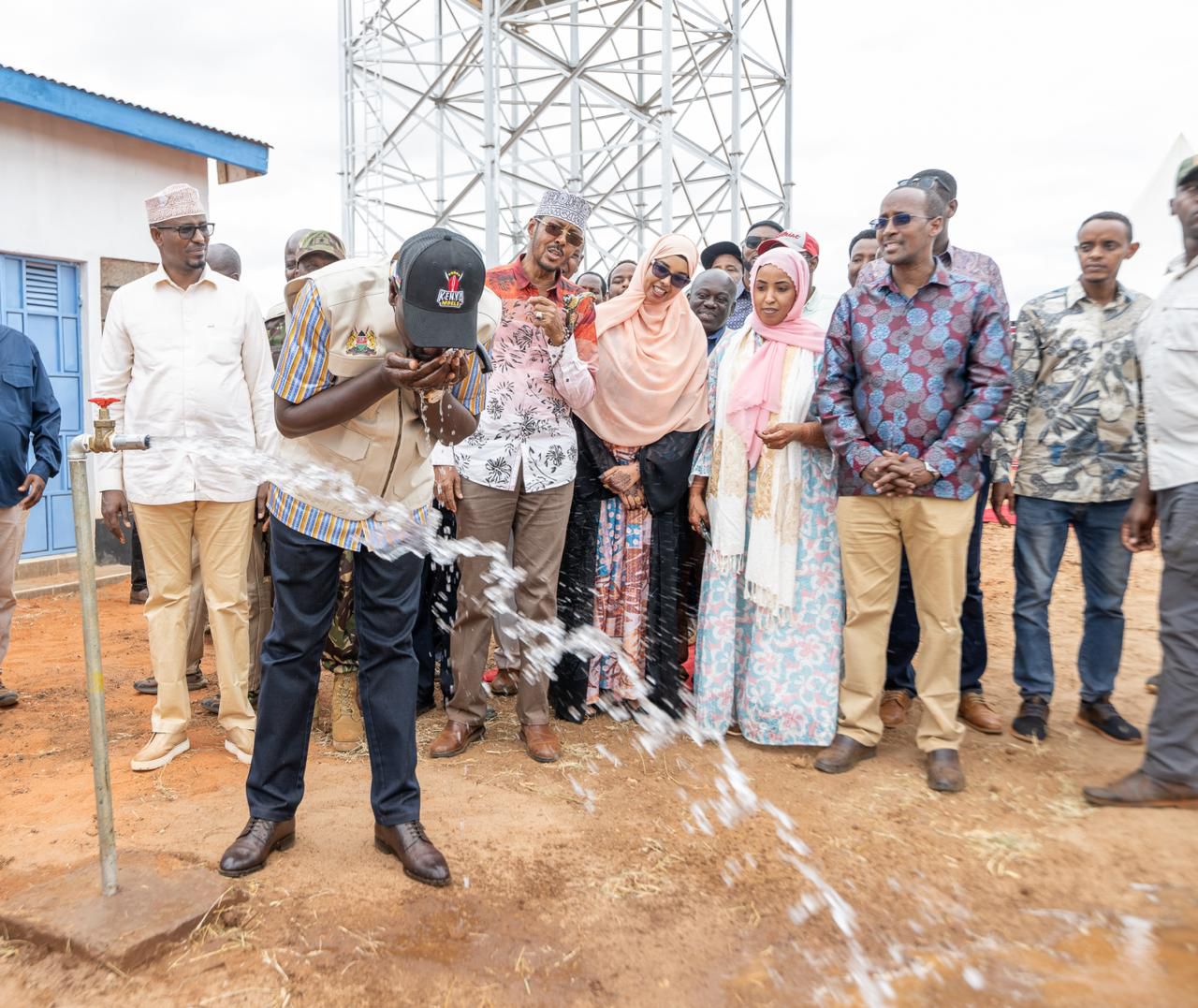
Ruto has employed a multi-pronged strategy focused on security, infrastructure, education and political inclusion in an aim to rally Wajir, Mandera, Garissa, Marsabit, and Isiolo counties behind him.
Some leaders have said Ruto has engineered the most consequential development projects for the region long associated with marginalisation, insecurity and underdevelopment.
"The greater Northern Kenya region is receiving full government attention to ensure affirmative action measures to correct historical mistakes," Deputy President Kindiki Kithure told the Star on inquiry on what explains the renewed focus.
He added that the government was also constructing markets, housing and electricity projects.
More residents are being rallied to register under the Taifa Care universal health insurance programme.
According to Kindiki, the opening of access to national identification documents had ended decades of discrimination and strengthened the government's inclusivity agenda.
"It has not only brought dignity to all the people of Kenya but also put the inclusivity agenda forward by ensuring the development projects of our country are equitably shared," he said.
The decision to take this year's Madaraka Day celebrations to Wajir has been lauded by local leaders as a turning point.
Pundits observe that the push into Northeastern, backed by frequent presidential visits, sometimes spearheaded by Kindiki, is a calculated bid.
When combined, the counties of Mandera, Wajir, Garissa, Marsabit, Isiolo and neighbouring Turkana account for nearly 1.28 million registered voters.
The numbers could prove critical for Ruto in the face of the fragmentation he has suffered in the Mt Kenya vote, which propelled him to power in 2022
It is said to conveniently add to efforts he is putting in Nyanza and the Coast, which were traditional opposition voting blocs of the Raila Odinga era.
Political observers note that while Northeastern may not rival Mt Kenya in raw voter numbers, the region votes cohesively when local leaders rally behind a particular candidate.
Ruto has spent the better part of the year deepening engagement with the region through development projects, policy reforms and repeated visits.
Core to the government's outreach is the Isiolo-Mandera road, a 760-kilometre corridor traversing Isiolo, Wajir and Mandera counties.
The project, which forms part of the Sh100 billion Northern Kenya Gateway Corridor, is viewed as the largest ongoing infrastructure investment in the country and a potential game-changer for the region.
Once completed, the road will connect Kenya to Ethiopia and Somalia, unlock trade opportunities, improve security and significantly reduce travel times that have for decades constrained economic growth.
Of the efforts, the most consequential political shift perhaps has been the abolition of discriminatory vetting requirements for national identity cards.
For decades, thousands of Kenyan Somalis struggled to obtain identification documents, limiting access to voting, banking services, employment opportunities and even mobile phone registration.
Today, with streamlined registration processes, thousands are obtaining IDs for the first time.
Addressing the Madaraka Day celebrations in Wajir, Ruto defended the reforms and pledged that his administration would do more.
"We did not abolish verification of citizenship. We abolished discrimination," he said.
The President also issued an apology for decades of state neglect, acknowledging that his predecessors’ regimes failed to adequately invest in roads, schools, healthcare, and water infrastructure.
"Poleni sana ndugu zetu. It was never meant to be this way," Ruto said, adding that hosting Madaraka Day in Wajir was “what we meant when we said we will leave no one behind.”
The administration has also poured billions into the Last Mile Connectivity Programme, pledging to end the historical reliance on lanterns and diesel generators.
The government has further rolled out livestock restocking programmes through the National Disaster Management Authority and the Livestock Development department to help pastoralist communities recover from successive droughts.
Education has emerged as another key pillar of the administration's strategy.
Classrooms, laboratories and teacher training institutions have been established across the region 'to bridge long-standing disparities between Northeastern and the rest of the country’.
During the Madaraka Day celebrations, Ruto announced plans to establish a university in Wajir.
He said the process would commence this year once land is identified.
The institution would be the second in the region after Garissa University.
The President also announced the construction of a civilian terminal at Wajir International Airport.
He also highlighted the recruitment of 1,800 teachers from Wajir, Garissa and Mandera counties, the operationalisation of teacher training colleges in Wajir, Kotulo and Mandera, and the enrolment of more than 4,600 trainees from the region in teacher training institutions.
Following the deliberate steps, a section of leaders from the region have already declared support for Ruto beyond 2027.
Health CS Aden Duale said, “Northeastern has got its first liberation under President Ruto. Come the next election, we know where our vote will go, and it is two-term.”
"Our people are behind President Ruto. We will support him 100 per cent in the election. He shouldn't panic because we have seen the hand of the government," Marsabit Governor Ali Mohamud said.
Petroleum Principal Secretary Kello Harsama said residents were experiencing government presence in a way they had never witnessed before.
"For the first time since independence, we have a government we can call ours. We have, since 1963, been forced to tell people we are in government when in reality we were not," Harsama said.
"We have no way of saying thanks but to wake up early in August 2027 and hand Ruto a second term. We have people getting IDs for the first time."
Eldas MP Adan Keynan said support for Ruto is rooted in trust and appreciation for the administration's focus on historically marginalised regions.
"Ruto's administration has invested in infrastructure, education, security and economic empowerment across Northern Kenya," he said.
"This has reignited hope in a region long neglected and, for that, we stand firmly behind him."
Yet another education pledge is to integrate Duksi, Madrassa and pastoral learning systems into the national education framework.
President Ruto directed the Ministry of Education to develop a framework that formally recognises alternative learning pathways.
"This will ensure that every child, regardless of background or circumstance, has a recognised pathway into learning, skills and opportunity," he said.
For political strategists, the move could strengthen Ruto's standing among religious leaders and families who view recognition of Duksi and Madrassa education as a matter of cultural inclusion.
Public Service CS Geoffrey Ruku has also been expanding government services, including the issuance of birth certificates, national IDs and other critical documentation.
The battle for the region has taken root.
Opposition figures, including Gachagua, Kalonzo, former Interior CS Fred Matiang'i, Martha Karua and Eugene Wamalwa, are expected to court the region as coalition building gathers pace ahead of 2027.
Even so, area leaders say Ruto would enter that contest with an added advantage. “Unlike many of his rivals, he can point to tangible interventions already being implemented in the region,” Duale said.
INSTANT ANALYSIS
As the 2027 elections draw nearer, the political calculus is becoming increasingly clear. Northeastern, with its growing electorate and unprecedented level of government attention, is no longer an afterthought in the electoral arithmetic. It is emerging as one of the country's most consequential battlegrounds.