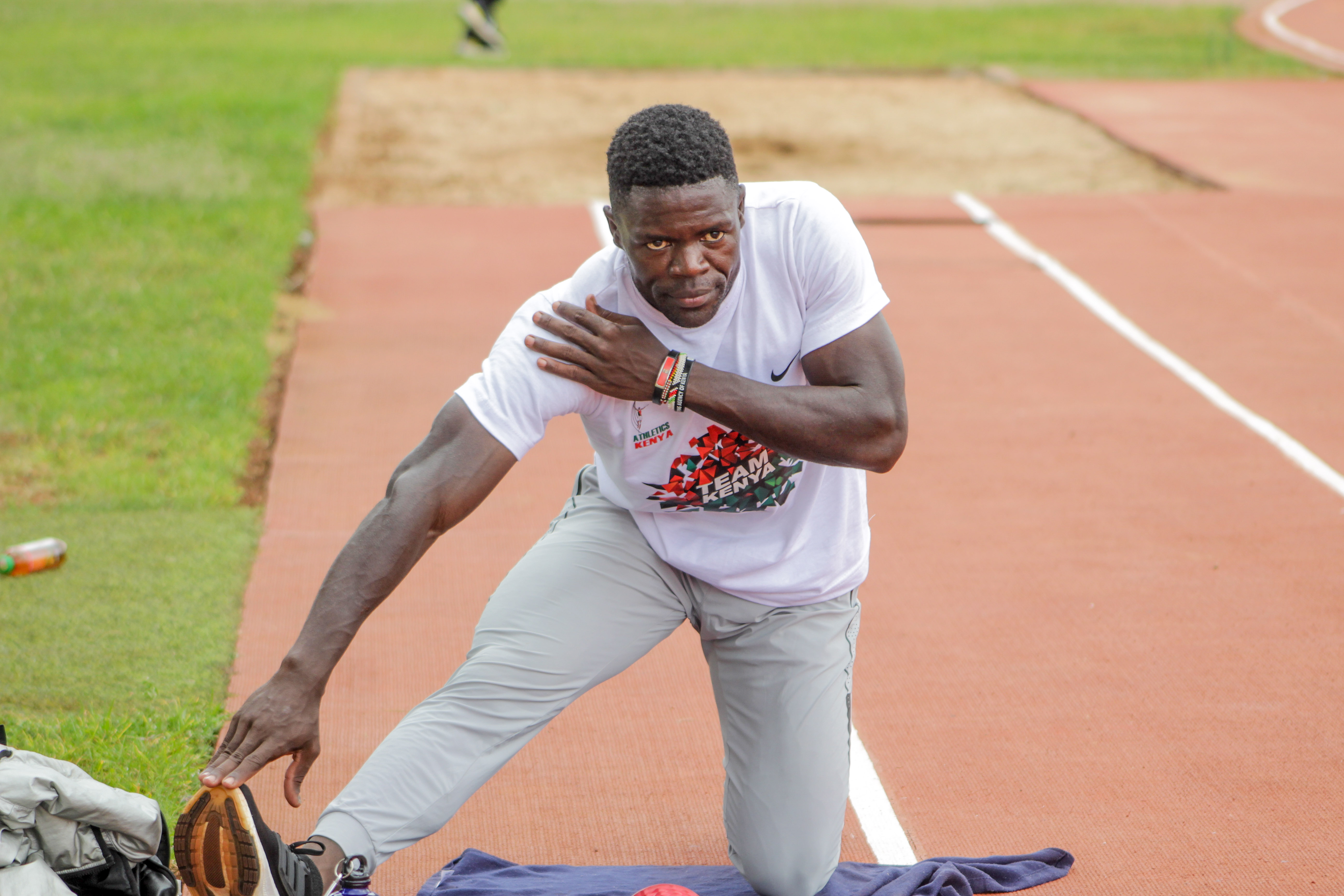
 Moses Wasike during training/ TEDDY MULEI
For many sprinters around the world, Jamaica’s Usain Bolt is not merely a reference point but the very definition of what human speed can become when talent meets absolute conviction.
His 13-year reign at the summit of global sprinting reads less like a career and more like a finished manuscript of perfection, each chapter marked by dominance, spectacle and a rewriting of what was once believed possible in the 100m and 200m.
Bolt did not just win races; he transformed expectation itself. His 9.58 seconds at the 2009 World Championships in Berlin remain the most iconic mark in the men’s 100m, a time so extraordinary that even now, more than a decade and a half later, it still stands untouched and largely unthreatened.
In the same race of historical brilliance, American Tyson Gay produced 9.69 seconds, the second-fastest time ever recorded, yet even that performance existed in the long shadow of Bolt’s supremacy.
The numbers, stark as they are, only tell part of the story. No athlete has truly approached 9.60, and in sprinting circles, that gap has become less of a statistic and more of a reminder of how rare Bolt’s era really was.
His dominance extended seamlessly into the 200m, where his world record of 19.19 seconds, also set in Berlin, continues to stand as one of the most unassailable marks in athletics.
It is little surprise, then, that sprinters across continents continue to study him not as a relic of the past but as an ongoing instruction manual for excellence.
In Kenya, that influence took root in a quiet, unlikely figure.
His name is Moses Wasike. Short, powerfully built and carrying himself with a calmness that masks the intensity of his pursuit, Wasike is part of a rare breed in Kenyan athletics, a self-built sprinter.
In a country globally celebrated for distance running depth, sprinting has often existed at the margins, shaped by limited infrastructure, limited coaching depth and athletes forced to improvise their way forward. Wasike’s journey sits firmly inside that reality, yet rises beyond it through sheer persistence.
For most sprinters, progress is structured through systems, having good coaches, technical programs, biomechanics sessions, recovery plans and carefully managed competition cycles.
For Wasike, the path was far less defined. He built his understanding of sprinting outside of any formal pipeline, relying instead on observation, repetition and a stubborn willingness to learn alone. That education began not on a track, but on a screen.
“I started my athletics career by following matters on sprinting on social media to learn more about the sport, workout regimens and just how to run. That is when I started following Usain Bolt's training regimen to learn how he used to sprint and maybe copy his style,” Wasike admits.
Even now, long after his first races, that digital classroom remains part of his preparation. Before stepping into competition, he returns to Bolt’s races, not for entertainment but for instruction, studying the stillness before the gun, the posture in the blocks, the rhythm of acceleration that separates elite sprinters from the rest. “Even before meetings, I used to watch some of his videos before hitting the blocks for my race.”
But Wasike’s story does not begin with structured ambition or early identification. It begins almost accidentally, in the corridors of Murende Mixed High School in Busia County, where he first discovered that he could run faster than expected and faster than those around him believed possible.
Born on August 22, 1994, in Shiamakhanga village to William Wasike and Albina Sheunda Radibo, he had shown little interest in sport during his early schooling years. “I started running in 2013 while in Form Three. I did not run in the primary; I was not very interested in any game, actually.”
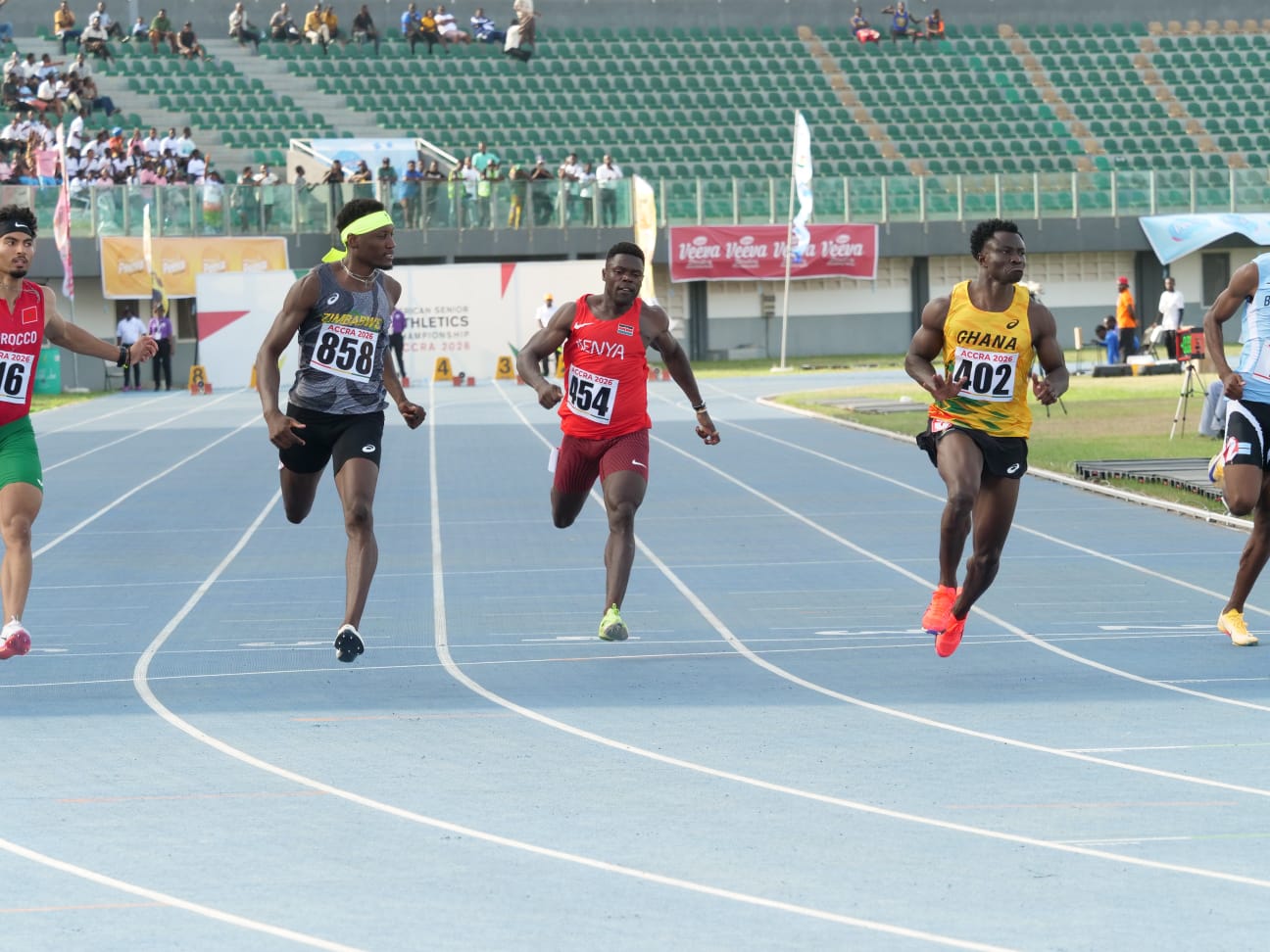 Moses Wasike (454) at the African Senior Championships/ AK
The turning point came through challenge rather than design. At school, a student known for 100m speed dominated inter-class competitions and carried a reputation that stretched to the provincial level. Wasike, with no background in sprinting, decided to challenge him.
“In high school, we had a student who used to run the 100m in our school, and he would go up to the Provincial level. We had inter-class games coming up, and I decided to challenge him and told him I would beat him.”
The reaction was immediate disbelief. “People laughed because I had never run before, so it looked like a big hoax to them. Just to silence their doubts, I started doing training, without even knowing what I was doing; I just did running up and down hills and some other funny exercises,” he says.
Those early “funny exercises,” as he calls them, were unstructured and instinctive, but they became the foundation of a sprinting identity he did not yet understand. Without coaching or technical guidance, he trained through repetition and raw determination, slowly building both confidence and speed.
The results came unexpectedly quickly. Against all expectations, he rose through school competitions and progressed to the national championships at Kakamega High School in 2013. “I ended up finishing first in the games, and I also went all the way to the nationals in 2013, and I finished third.”
But just as quickly as sprinting appeared in his life, it faded. “After that, I just decided to focus on books now and dropped running totally.”
After high school, like many young athletes navigating economic realities, he stepped away from the track in pursuit of stability. “So after finishing form four, I had an uncle who connected me to some work in a certain company.”
The job provided structure and income, but something remained unsettled. Even in employment, the body remembered what the track had felt like.
“But even then I felt my body was aching for something. I knew I had to pursue my career in sprinting; the only problem was that I didn’t know anything about running or even have a coach.”
In 2017, he made a decision that reshaped everything. He left his job, a position that paid him Sh30,000 a month and returned home to chase sprinting full-time, a move that left his family uncertain and unconvinced.
“In 2017, I left my job and went back home and told my parents that I wanted to pursue sprinting. They did not accept that idea; they were puzzled why I would leave a job which was paying me Sh30,000 a month to pursue something I had never done before.”
With no system to fall into, he returned to the only training he knew: hills, push-ups, jogging, improvisation. What followed was a long stretch of self-directed development shaped more by persistence than structure. “I decided to start training by just running up and down hills, doing push-ups, jogging, just about everything.”
It was during this period that he leaned even more heavily on Bolt’s example, not as imitation but as a survival strategy. The Jamaican’s famously demanding training routine became a reference point for what discipline could look like at the highest level: six-day training weeks, explosive strength work, core stability, technical sprint phases and repeated exposure to race-specific intensity.
Wasike absorbed what he could and adapted what he understood. “His training was very tough, but I managed because I had devoted myself to chasing my dream in sprinting.”
Eventually, he joined a group in Ngong, still without a personal coach, still learning largely through observation. His first real exposure to elite-level competition came in 2018 at the National Championships, where he arrived without proper sprint spikes and ran both the 100m and 200m, failing to progress beyond the heats in 11.15 and 22.69, respectively.
“I remember I went to my first race without proper spikes, having quit my job; there was little income I could get to buy spikes. But my family sent me some money, around Sh1,500, and I got some ordinary spikes, not for elite sprinting, just to wear when I was running.”
For many, that might have been a stopping point. For Wasike, it was simply the beginning of understanding what he did not yet know.
The following year, progress began to emerge. He lowered his personal best to 10.6 seconds, finishing third at an Athletics Kenya weekend meeting in Nyeri, before reaching the 200m semi-finals at the national championships and improving further to 22.28 that same year. But consistency proved elusive. Without coaching support, recovery knowledge or structured planning, his body often bore the cost of his ambition.
In 2023, after moving to Eldoret, performances briefly improved, but physical strain soon followed.
“In 2023, I moved from Ngong to Eldoret, and that’s when I started to post good results. But I had no proper sprints coach, so I did not know anything about how I should take care of my body, so my body just shut down.”
The following year brought a deeper personal blow. He lost his father, a moment that forced him back home and nearly ended his sprinting journey entirely.
“In 2024, I lost my dad, and I had to go back home. My mother told me to quit my pursuit in sprinting because it was not paying and I was not making waves yet.”
Around him, peers were advancing into national teams and international competitions, while he remained on the margins, questioning whether the sacrifice still made sense. “My fellow sprinters were making it to Team Kenya and going outside while I was still stuck in the same place.”
For a moment, quitting felt rational. “That is the year I wanted to give up because I saw there was no future for me. I was putting in the work, but the results of all that hard work were not there. But as a man, you have to pick yourself up and dust off because I had quit my job to start focusing on sprinting; there was no turning back,” he says. There was no turning back, only forward, however uncertain.
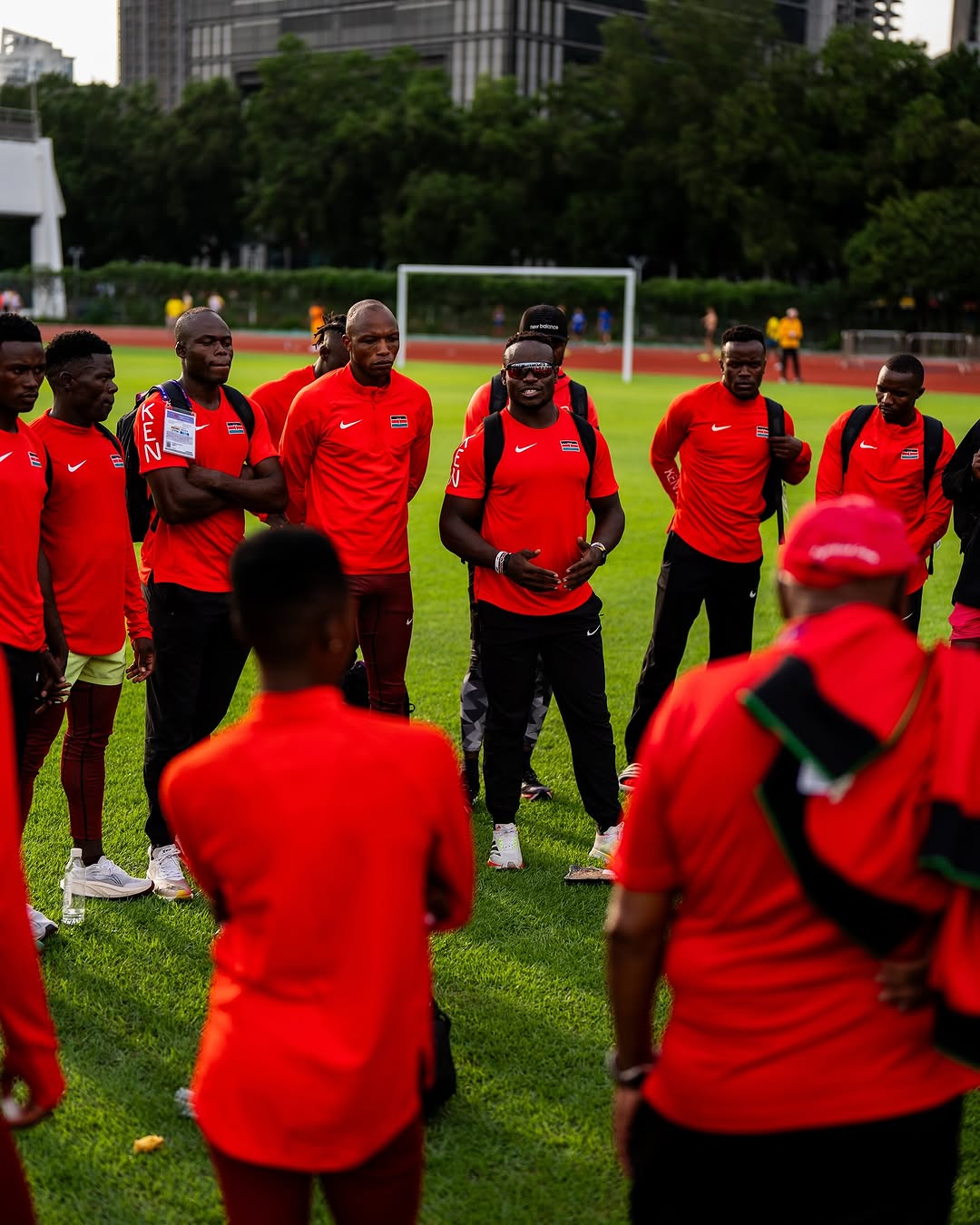 Moses Wasike alongside Kenya's 4x100m men's squad at the 2025 World Relays in Guangzhou, China/ HANDOUT
In 2025, that persistence began to show measurable return. He lowered his 100m personal best to 10.47 at the World Relays trials in Guangzhou, China, earning a place in Kenya’s 4x100m squad as a reserve.
The team of Boniface Mweresa, Ferdinand Omanyala, Meshack Babu and Steve Onyango ultimately set a national record of 38.35 to qualify for the World Championships in Tokyo later that year as Wasike watched from the sidelines.
He, however, took that as a learning experience. “The first time to represent Kenya was at the 2025 World Championships in Guangzhou; it was a very nice experience for me.”
“After that, my focus turned into sharpening myself for the 2025 Tokyo World Championships, but unfortunately I fell sick, so at the trials I did not really do so well; I did not attain the cut mark for the relay team.”
However, at the trials for the World Championships, Wasike failed to make the cut for the relay teams after finishing sixth in the 100m, timing 10.50.
“It was a big blow because I saw some young sprinters like Dennis Mwai going, and I was left behind. That gave me the morale to train even harder.”
And just like any other time, frustrations got the better of him, and he took his anger out in training.
It was at the tail end of 2025 that Wasike met veteran sprinter Millicent Ndoro, also self-coached. The duo would exchange training programmes so that they could evolve and keep up with the other sprinters. They were discovered by Kenya Defence Forces (KDF) sprints coach Vincent Mumo.
“We met Coach Mumo in 2025; at the time, none of us had a coach to do our timings, so we requested Mumo to do it, and we shared our training programme with him. We requested him that before he can implement his own programme with us, we first finish our own programmes, and he understood. That is where we now formed the Ultimate Sprints Club”
In 2026, Wasike was one of the top sprinters nationally. He kickstarted the year with the trials for the World Relays in Gaborone, Botswana, where he significantly lowered his personal best to 10.26 in the heats before going on to clock 10.43 in the finals, securing his slot in the Gaborone-bound team.
“I started early training after missing a ticket to Japan for the world championships. I told myself I don’t need to rest if at all I am to have a strong 2026.”
“I am happy that training has been good, I have not sustained any injury, and I thank God.”
In Gaborone, Wasike lined up in the mixed 4x100m quartet alongside Millicent Ndoro, Dennis Mwai and Mercy Oketch. In day one of the 2027 World Championships qualification rounds, the team set a national record of 41.35 to place fourth, missing out on the automatic two slots.
In day two of the qualification rounds, the team recorded 41.84, missing the ticket to Beijing.
“Running the 4x100m mixed relay is very tough. I had not trained properly to change batons with female sprinters; I was used to the men’s relay. But I knew I had to accept it and show up for my country. I had to look at how Ndoro was running and how she handled the baton change just to learn how to have a smooth exchange with the female sprinters.”
Wasike exuded satisfaction with the team's display in Botswana. “Despite everything, we were happy with our time; we set a national record.”
“I hope that we can get more chances for the 4x100m mixed relay. Our coaches also need to ensure they bring up our female sprinters well. In Botswana, if we could have had female sprinters who could run 11.2 or 11.3, then we could have qualified for the World Championships next year.”
After Botswana, Wasike donned the national colours yet again for a continental assignment, this time in his individual 100m at the African Senior Championships in Accra, Ghana.
There, Wasike opened his campaign on a flying note, winning his heat in 10.63 ahead of Botswana’s Godiraone Lobatlamang (10.69) and Jesus Topize of Mauritius (10.70).
However, Wasike failed to make it past the semis, after timing 10.70 for sixth place in his heat.
Cameroon’s Emmanuel Eseme won continental gold in 10.26 as South Africa’s Bradley Nkoana (10.32) and Nigeria’s Chidera Ezeakor (10.32) secured silver and bronze.
“Ghana was good, but the only challenge was the change in environment. It is very hot over there. Also, when running, it was very windy, so it made it somewhat difficult; those athletes from the West African nations who were already used to those conditions were the ones who were winning.”
“I knew that I would make the finals after winning the heats. But when I got to the semis, the block messed me up; maybe it’s because it was my first major tournament and I was running against some top sprinters who have competed in European tours and Diamond League races.”
“I was very frustrated because I knew I had failed my country. The target was to get to the finals, but that did not happen, and that really disappointed me,” he said.
Despite not making the finals, Wasike hopes to use lessons gained in Ghana in his next quest, securing a ticket to the Commonwealth Games.
“However, I thank God I got good experience, which I hope will help me in the upcoming competitions.”
“The Commonwealth Games are the biggest target now. It will be an honour to represent Kenya on the global stage. I know I have to work hard to shave off a few microseconds from my best, and with the way my body is I am confident I can make it.”
Still, the ambition remains sharp. The Commonwealth Games now sit ahead as his next target, with a personal goal of breaking into 10.1 or even 10.0 territory. “The target is to get to 10 flat or 10.1 so that I can enhance my chances of making the team for the Commonwealth Games.”
While he knows competition at the national trials will be tough, Wasike is not under any pressure.
“These are people I have run with; I know them well, and I am ready for the competition that will come at the trials. It does not faze me.”