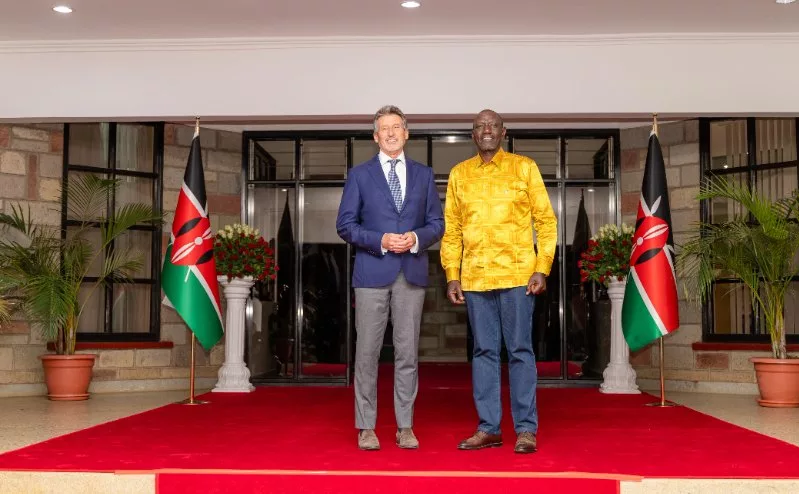
 President William Ruto with World Athletics President Sebastian Coe/ HANDOUT
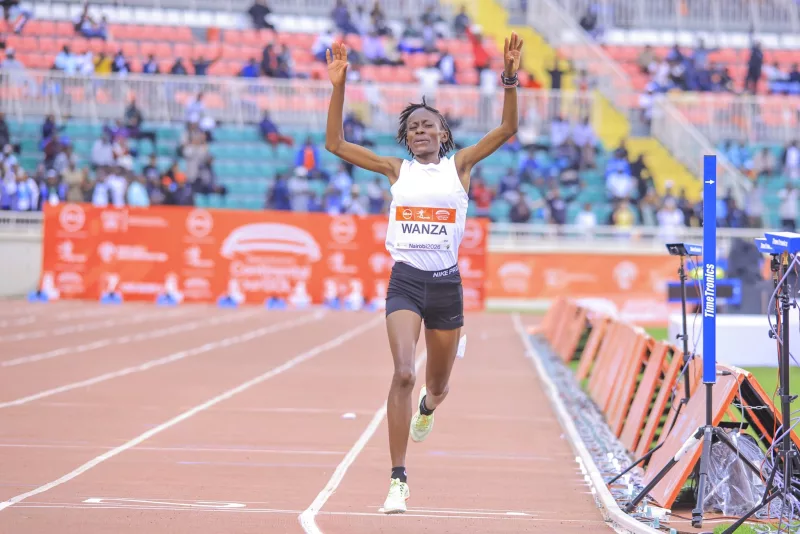
World Athletics President Sebastian Coe has challenged Kenya to fill the Moi International Sports Centre, Kasarani, to capacity during the 2029 World Athletics Championships, saying a full house would be a defining measure of the global showpiece’s success.
Speaking during a press briefing on Wednesday morning at the Radisson Blu Hotel in Upper Hill, Nairobi, Coe stressed that while several factors would determine the championships' success, attracting a sell-out crowd would rank among the most important.
“What does a successful championship look like? A successful championship, amongst other things, but probably in the top three things we want, is people in the stadium,” Coe said.
Coe reiterated that World Athletics are keen to see Kasarani filled. “We want a full stadium,” he declared. Coe revealed an electrifying atmosphere, fuelled by enthusiastic spectators, would inspire athletes to raise their game as they battle for global honours. “If there is a great experience and atmosphere, athletes will rise to the occasion,” he said. “It makes their lives much easier if they are competing in front of a lively Kenyan crowd.”
Kenya’s reputation for turning out in large numbers to support athletics has already been demonstrated at previous international competitions. During the 2017 World Under-18 Championships, also staged at the venue, Kenyan fans turned out in impressive numbers to cheer on the world’s best junior athletes.
Attendance on peak days was estimated at between 60,000 and 65,000 spectators. On the fourth day of the global junior showpiece, the event attracted nearly 88,000 spectators across the two sessions, with 37,600 attending the morning programme and 50,300 the evening session.
Coe also noted that athletics’ position as the leading sport on the Olympic programme should be reflected in the numbers whenever the world’s best athletes converge for major competitions. “Our sport is the number one Olympic sport,” Coe said. “If you can’t fill a stadium, then people look at it and say maybe this is not as strong a sport as we say it is,” he noted.
Beyond the spectacle and the numbers through the turnstiles, Coe highlighted athletics’ deep-rooted connection with Kenya, describing the sport as a defining part of the country’s identity and one of its most recognisable contributions to the global sporting landscape. “This is a passion, and it identifies what people see and view of Kenya,” he said.
Coe also drew from his own experience as an athlete, recalling the fierce competition he faced from Kenyan runners during his illustrious track career.
“I can speak from that because in my career, my main competition for many years was Kenyan athletes. Sometimes I was successful and other times not so successful,” he recalled.
For Coe, awarding Nairobi the 2029 World Championships was a recognition of Kenya’s immense contribution to athletics over the years. "It was also an opportunity to take the sport’s biggest outdoor track and field competition to a continent that has produced generations of world-beating champions."
He e added, “We had four outstanding cities in the bid process, and all four would have made great host cities and would have delivered great World Championships,” Coe said.
“Nairobi came through very strongly on a whole series of factors and the compelling story that Kenya has contributed so much to the sport,” he added.
For Coe, bringing the sport’s flagship event to Africa represents an important statement about athletics’ global reach and the need to recognise the regions that have played a central role in shaping its history.
“This would also be the first senior championship that Africa will be hosting. We have had the junior championships, and the World Relays, but Africa has never hosted the senior championship. That is a very important statement,” he said.
However, Nairobi’s successful bid also attracted scrutiny over Kenya’s history of doping violations, with questions raised about the country’s ability to safeguard the integrity of competition ahead of the 2029 showpiece.
Coe defended the decision to award Kenya the championships, citing encouraging progress in the country’s efforts to combat doping and strengthen the integrity of athletics.
The World Athletics president said reforms introduced at the global level have placed the Athletics Integrity Unit (AIU) at the centre of the fight against doping, providing a robust framework to protect clean athletes and preserve confidence in the sport.
“We are making good progress. One of the first things I did as World Athletics President was the reform of the sport, and sitting at the centre of that was the Athletics Integrity Unit (AIU),” Coe said.
He also highlighted his intervention to persuade the Kenyan government to increase funding for the Anti-Doping Agency of Kenya (ADAK), saying greater financial support was an important step towards strengthening the country’s capacity to tackle doping violations. “A few years ago, I also persuaded the government to dedicate more funding to the fight against doping,” he said.