The Finance Bill, 2026, is emerging as a major relief package for low-income households, with the government avoiding new taxes on essential commodities while introducing incentives aimed at lowering the cost of transport, healthcare and clean energy.
Unlike previous finance bills that triggered public outrage over proposed tax increases, the current bill largely focuses on tax compliance, widening the tax base and easing pressure on ordinary Kenyans struggling with the high cost of living.
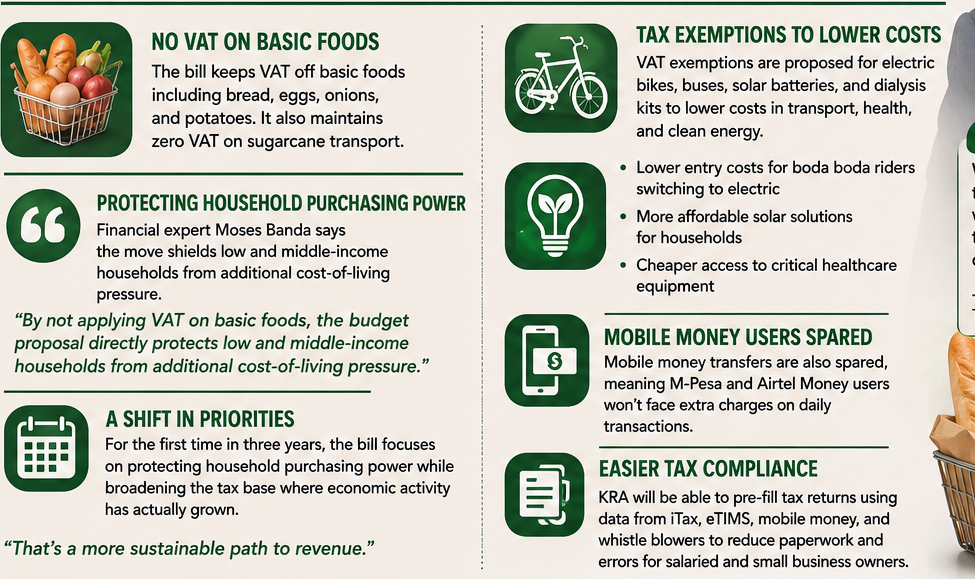
Among the key proposals in the bill is the decision to retain VAT exemptions on basic food items such as bread, eggs, onions and potatoes.
The bill also maintains zero-rated VAT on sugarcane transportation, a move expected to protect farmers and consumers from higher production costs.
According to financial analysts, the proposals signal a shift in government policy toward protecting household purchasing power.
“By not applying VAT on basic foods, the budget proposal directly protects low and middle-income households from additional cost-of-living pressure,” Moses Banda, a financial expert, said.
“Looking at the bill keenly, you can see that the government is seeking innovative ways to ease economic pressure on the people."
According to Banda, this is the first time in nearly three years that the Finance Bill appears deliberately structured to shield vulnerable households while targeting revenue collection in sectors where economic activity has significantly expanded.
“For the first time in three years, the focus is on protecting household purchasing power while broadening the tax base where economic activity has actually grown. That’s a more sustainable path to revenue,” he noted.
The bill also proposes VAT exemptions for electric bicycles, electric buses, solar batteries and dialysis equipment to make clean energy, transport and healthcare more affordable.
Analysts say the proposals could lower operational costs for thousands of boda boda riders seeking to transition to electric motorcycles while also reducing the cost of solar power installations for households and small businesses.
“Zero-rating electric bikes, solar batteries and dialysis equipment is smart policy,” Banda explained.
“It lowers the cost of clean energy and healthcare while supporting jobs in new sectors.”
The proposed exemptions come at a time when the government is pushing for green energy adoption and affordable healthcare under its broader economic transformation agenda.
Treasury Cabinet Secretary John Mbadi has defended the bill, saying the government is not seeking to overtax citizens but rather improve efficiency in tax collection and seal loopholes used for tax evasion.
“We are focused on compliance to broaden the tax base so that we have more people paying taxes and stop over-reliance on a few people,” Mbadi said.
The CS noted that the Treasury is increasingly relying on technology to modernise revenue collection and improve accountability.
“We need to apply technology in collection of taxes. Many businesses have shifted to digital systems, but we are still collecting taxes manually,” Mbadi said.
He added that the government is targeting individuals and businesses that avoid taxes through loopholes in the current system.
Additionally, the Finance Bill spares mobile money users from additional transaction charges, meaning millions of Kenyans using M-Pesa and Airtel Money for daily transactions will not face extra costs.
The Treasury has also proposed a new tax compliance framework allowing the Kenya Revenue Authority to pre-fill tax returns using information from iTax, eTIMS, mobile money records and whistleblower reports.
The system is expected to reduce paperwork, minimise filing errors and simplify compliance for salaried workers and small business owners.